Briarcliff Manor gets grouped with the Hudson river villages, and its housing
does not behave like one. Only 13.3% of it predates 1940. The
median build year is 1968, and more than a quarter of the
village is a townhouse or an apartment. The Victorian retrofit that defines
Tarrytown and Irvington is a small part of the work here.
The houses we insulate in Briarcliff Manor
The geography is unusual too: the village straddles two towns, with parts in
Mount Pleasant and parts
in the Town of Ossining. Its
own numbers: 82.8% owner-occupied, 63.5%
detached and 77.5% counting attached houses, 14.0% single-family
attached — townhouses — and another 14.0%
in buildings of 50 units or more. By decade: 21.4% in the 1950s, 16.2% in the
1960s, 14.2% in the 1990s.
So the core single-family work here is post-war, not antique. Ranches,
expanded ranches, split levels and raised ranches, built with roughly
R-19 in the attic and R-11 to R-13 in the walls. What we find,
in order of what it costs the owner: loose fill settled and scoured thin at the
eaves with no baffles to stop the soffit vents blowing through it; an attached
garage with an unsealed common wall and open joist bays running into the house;
on a split level, the mid-level floor cantilevered over that garage with a
bedroom above it; dropped soffits open to the attic; an uninsulated hatch in a
bedroom closet; a whole-house-fan louver nobody ever covered.
The townhouses are the really different problem, and almost nobody quotes
them properly. Above a row of attached units the attic is often one continuous
space: the party wall stops at the ceiling plane, or the draft-stop above it has
gaps at the top plates and the ridge. You cannot air seal one unit in isolation
— your neighbor’s leaks vent through your attic and blown material migrates
sideways — and the attic and roof are usually common elements, so the
scope and often the money sit with the association. These units and the 1990s
houses also tend to run ducts and an air handler through unconditioned attic,
where sealing the duct system beats a fourth inch of cellulose. We survey the
whole plane, not just your ceiling.
We seal before we insulate
Insulation slows heat moving through a surface. It does nothing about air
moving through a gap. Pack a leaky attic with cellulose and you have a leaky
attic with cellulose in it — the air still moves, it just moves through
something softer.
In a Briarcliff Manor ranch the holes are the garage common wall and the bays
above it, the dropped soffits, the attic hatch, the fan louver and the top
plates, plus baffles at the eaves so the new material is not wind-washed thin by
February. In a townhouse the biggest hole is often the party wall itself where it
dies into the attic, and the second biggest is the duct system, which is
pressurized and does not leak gently. Then we insulate.
If a quote gives you a depth and never mentions air sealing, it is half a
job.
What insulation costs in Briarcliff Manor
Most of our projects run between $3,500 and $12,500. A
detached Briarcliff Manor ranch or split with an accessible attic, a garage
ceiling and a hatch to seal sits in the lower half and is the most common job we
do here. A townhouse runs higher per square foot than owners expect, because the
shared attic plane, the party wall and the duct runs are three separate scopes
coordinated with an association.
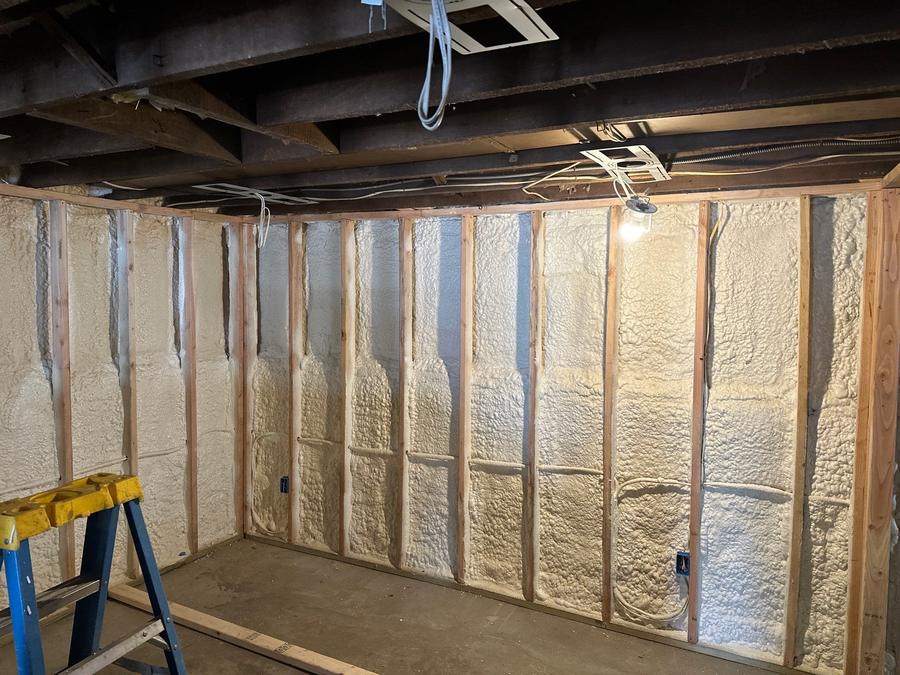
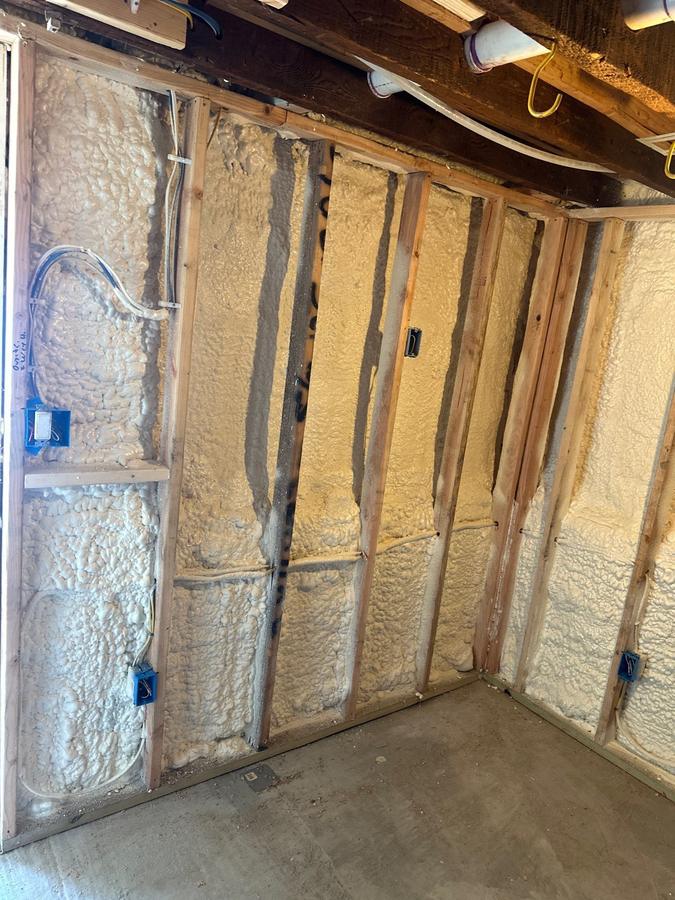
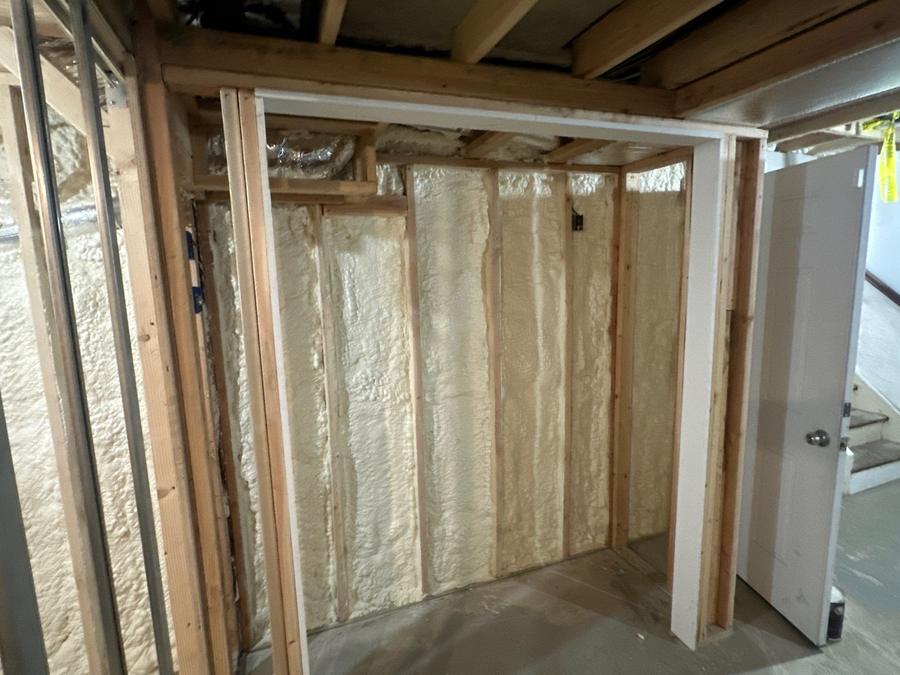
Open cell foam runs R-3.9 to R-4.2 per inch. Closed cell runs R-6.9 to R-7.1
per inch and also acts as a vapor retarder, which is why it costs more and why it
is right in some assemblies and unnecessary in others. All products are
manufactured in the United States and meet applicable building code and safety
standards. ENERGY STAR says sealing air leaks and adding insulation can save up to 10% on annual energy bills.
Insulation rebates in Briarcliff Manor
With 28% of the village in townhouses or larger buildings, the first rebate
question in Briarcliff Manor is whether the assembly you want insulated belongs
to you or to your association. Settle that before anything else. The utility is
simple: Con Edison for gas and electricity. Con
Edison’s residential Weather Ready program is not
accepting applications, and Con Edison’s own page tells Westchester
customers to expect news about 2027 incentives and to use NYSERDA in the
meantime. The $4,000 figure still on one of its index pages is stale.
The live program is NYSERDA Comfort Home:
$2,500 to air seal and insulate the attic and rim joist,
$3,000 if wall and floor insulation is added, and
$2,000 more toward ENERGY STAR windows afterwards. The
contractor has to be on NYSERDA’s Comfort Home list and the house has to meet the
conditions of the whole package, not half of one. Households at or below 80% of
area median income should look at EmPower+: no cost up to
$14,000 downstate, or half the cost up to $7,000
at moderate incomes. See the full New York
rebate guide for the mechanics.
The federal Section 25C tax credit ended for anything placed in service after
31 December 2025. There is no federal insulation credit on a
2026 job.
Code and climate in Briarcliff Manor
The median Briarcliff Manor home went up in 1968 and more than half the
village was standing by 1970, which is to say before New York had an energy code
worth the name. The current one is the 2025 Energy Conservation
Construction Code of New York State, in force since 31 December
2025 and based on the 2024 IECC. Westchester is climate zone 4.
For new construction and additions it sets R-49 in the
ceiling, R-30 in wood-framed walls (or R-20 cavity plus R-5
continuous), R-30 in floors, and R-15 continuous or R-19 cavity in basement and
crawl space walls. Anyone quoting R-60 is quoting Connecticut’s code.
None of it applies to a building already standing, including a
1990s one. The code does not require an existing building to be altered, only
that an alteration not leave you with less R-value than you had. The Department
of Energy separately recommends R-60 for a retrofit attic here, which is
guidance, not law.
Common questions about insulation in Briarcliff Manor
Do you install insulation in Briarcliff Manor, NY?
Yes. Most of what we do here is post-war detached housing — ranches,
splits and raised ranches from the 1950s and 1960s — plus townhouse and
condo work, a far larger share of this village than of its neighbors. Parts of
Briarcliff Manor sit in Mount Pleasant and parts in the Town of Ossining, and we
work all of it.
How much does insulation cost in Briarcliff Manor?
Most projects run $3,500 to $12,500. A detached ranch or split with an
accessible attic, a garage ceiling and a hatch sits in the lower half. A
townhouse costs more per square foot than people expect, because the shared attic
plane, the party wall and the ducts are three separate pieces of work.
Are there insulation rebates in Briarcliff Manor?
Yes, through NYSERDA. The village is Con Edison for gas and electric, and Con
Edison’s weatherization program is not accepting applications, so Comfort Home is
the live one: $2,500 for air sealing plus attic and rim joist, $3,000 with walls
and floors. EmPower+ covers income-qualified households. No federal credit
applies to a 2026 job.
Our Briarcliff Manor townhouse shares an attic with the neighbors. Can it be insulated?
Usually yes, but not as a solo job. If the party wall stops at the ceiling,
your attic and theirs are one space, so sealing only your ceiling leaves their
leaks venting through your insulation. The right sequence is to close the party
wall and the shared top plates first, which means talking to the association.
We will survey the whole plane and tell you what is realistic before you spend
anything.
Free energy audit in Briarcliff Manor
We walk the attic, look at whether the ducts and air handler live up there,
check the garage ceiling and the rim joist, and give you a written scope and a
price. No charge, no obligation. If the honest answer is duct sealing and a
garage ceiling rather than more depth, that is what we will quote.
Call 914-554-2289 or use the form on this page. Open
8am–8pm, seven days. We have insulated hundreds of homes across New York,
Connecticut and New Jersey with a 100-plus in-house crew.
Get my free estimateor call 914-554-2289, 8am–8pm every day
Learn more
- Insulation contractors across Westchester County
- Mount Pleasant and Ossining, the two towns Briarcliff Manor straddles
- New York insulation rebates in full
- Types of insulation
- Open cell and closed cell spray foam compared
- Insulating an older home
- What happens during an energy audit
- Full insulation FAQ