Bronxville is two insulation markets sharing one village. Just under half the
units sit in buildings of ten or more — pre-war co-ops with solid masonry
walls, steam risers in open shafts and an uninsulated flat roof over the top
floor. Most of the rest are Tudors and colonial revivals built before 1940.
Different building, different decision-maker, different job. This page covers
both.
The houses we insulate in Bronxville
The Census does not publish a median year built for Bronxville. It
bottom-codes the village at 1939 or earlier, its way of saying
the middle of the stock is older than the table can measure. Close to
70% of the 2,442 units predate 1940 and 84% are owner-occupied,
but only about a third are detached houses. That last number shapes the work.
The detached stock is stucco-and-half-timber Tudor and center-hall and Dutch
colonial revival, roughly 1900 to 1935, with slate or clay-tile roofs, steam heat
through radiators and a full-height attic nobody ever finished. What we find up
there is consistent: original rock wool settled to two or three inches and
wind-washed thin at the eaves, sometimes with vermiculite in it. Vermiculite gets
tested before anyone disturbs it, not after.
The leaks are just as consistent. A masonry chimney chase carrying two or
three flues, open cellar to roof. Dropped soffits over built-ins and butler’s
pantries, framed open into the joist bays. Back-plastered closet ceilings.
Plumbing stacks. A scuttle hatch with no dam and no gasket. The roof settles the
strategy: insulating the deck under slate or clay tile means scaffolding and a
slater, which almost never pays, so the work goes to the attic floor. Dam every
bypass, gasket the hatch, then blow the flat deep.
Now the other half of the village. Nearly 48% of
units sit in buildings of ten or more, 26% in buildings of 20 to
49 alone. Those brick walls have no cavity, so anyone offering to dense-pack them
is selling something that will not work. Steam risers run in open shafts, and the
top-floor units sit under an uninsulated flat roof.
What helps is a roof-assembly upgrade timed to the next reroof, plus
compartmentation of the stair, elevator and trash shafts so the building stops
behaving like one tall chimney. That is a capital project, not a service call:
the buyer is the board, and the timeline runs in seasons. Better said at the
first meeting than the third.
We seal before we insulate
Insulation slows heat moving through a surface. It does nothing about air
moving through a gap. Fill a leaky attic with cellulose and you have a leaky
attic with cellulose in it — the air still moves, it just moves through
something fluffier.
So the first half of a real job is closing the holes. In a Bronxville Tudor
that is the chimney chase, the dropped soffits, the plumbing stacks, the top
plates and the hatch, all before an inch of insulation goes down. It photographs
badly and it decides whether the depth you paid for does anything. Then we
insulate.
If a quote gives you a depth and never mentions air sealing, it is half a
job.
What insulation costs in Bronxville
Most of our projects run between $3,500 and $12,500. In
Bronxville the number is set by what has to come out before anything goes in:
three inches of settled rock wool to clear, a vermiculite question to test and
five open bypasses to dam is days of labor before the first board foot is
sprayed. A clean attic floor sits near the bottom. Co-op work is scoped building
by building and does not fit that range.
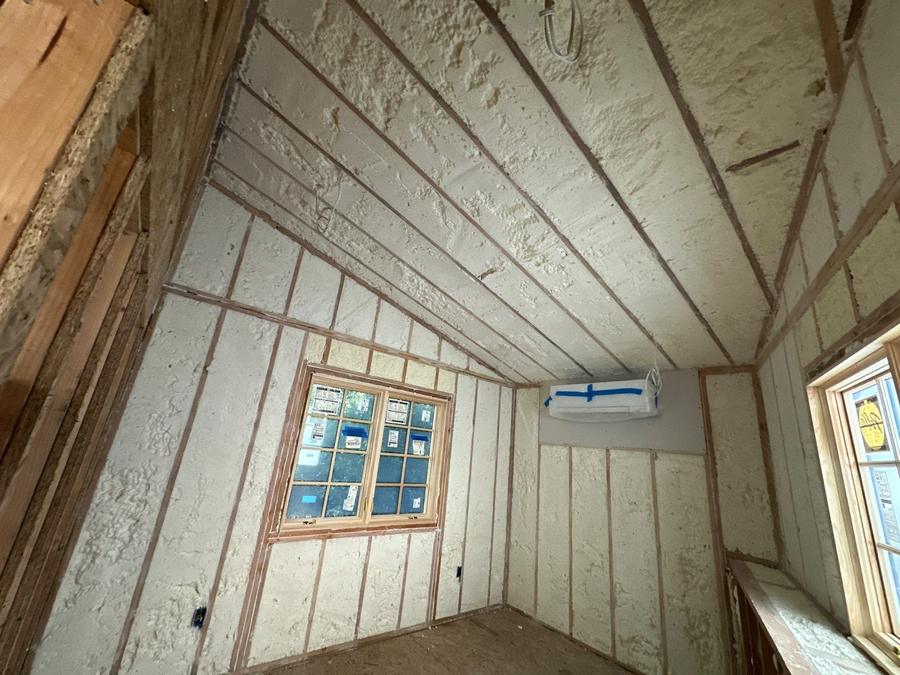
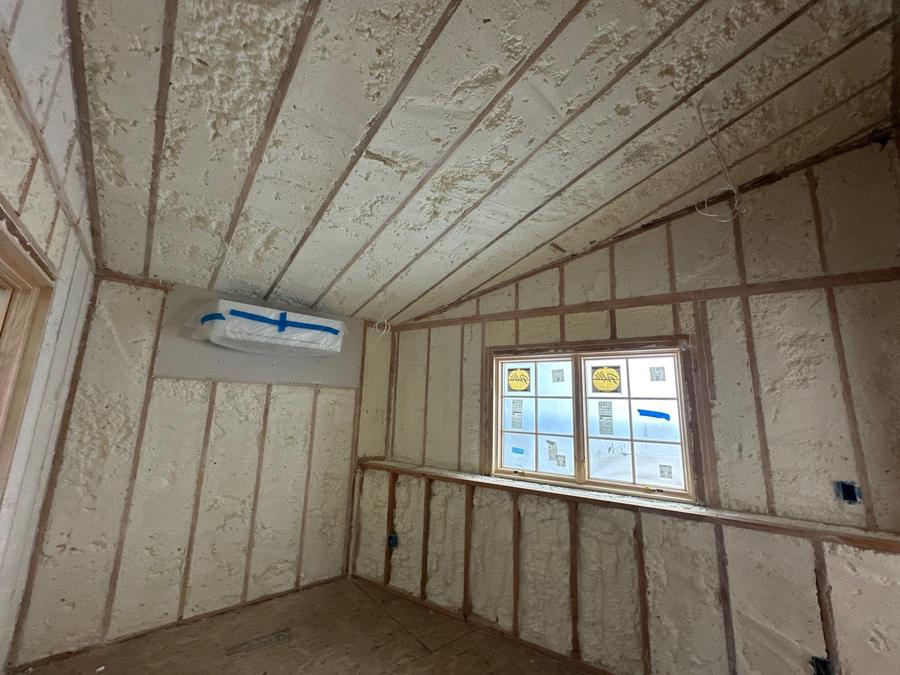
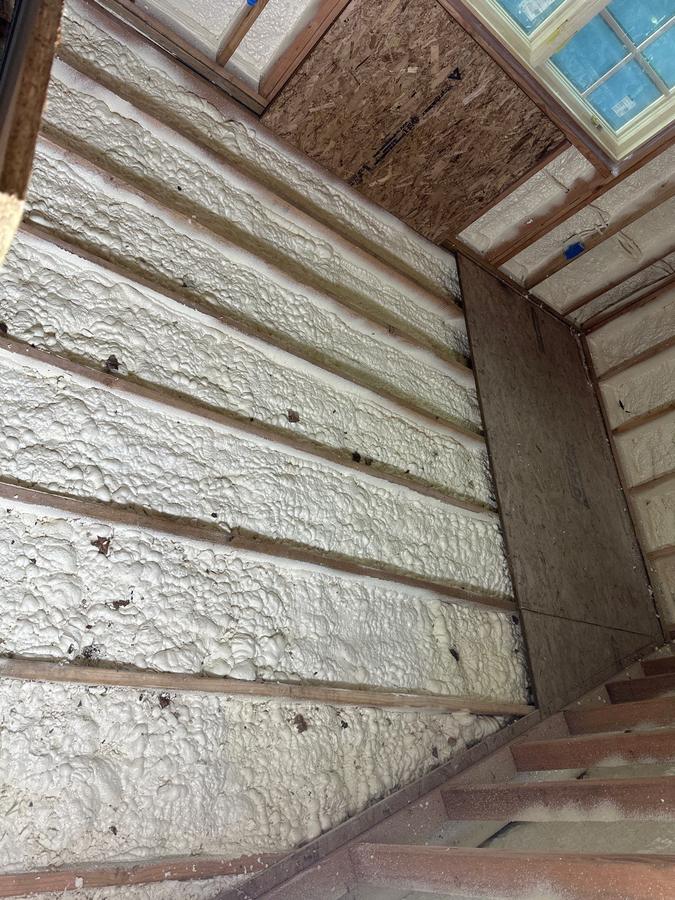
Open cell foam runs R-3.9 to R-4.2 per inch. Closed cell runs R-6.9 to R-7.1
per inch and also acts as a vapor retarder, which is why it costs more and why it
is right in some assemblies and unnecessary in others. All products are
manufactured in the United States and meet applicable building code and safety
standards. ENERGY STAR says sealing air leaks and adding insulation can save up to 10% on annual energy bills.
Insulation rebates in Bronxville
Bronxville is Con Edison territory for both electricity and
gas, and the first thing worth knowing is what is not available. Con Edison’s
residential Weather Ready weatherization program is
not accepting applications; its own page says to expect news
about 2027 incentives and points Westchester customers to NYSERDA meanwhile. A
$4,000 Con Edison figure quoted anywhere, including on Con Edison’s own index
pages, is stale.
The live program is NYSERDA Comfort Home:
$2,500 to air seal and insulate the attic and rim joist,
$3,000 if wall and floor insulation is added, and
$2,000 more toward ENERGY STAR windows once that is done. It
has to be installed by a contractor on NYSERDA’s Comfort
Home list, and the house has to meet the conditions of the whole package —
you cannot do half a tier and claim it. At or below 80% of area median income,
look at EmPower+ instead: no cost up to $14,000
downstate, half the cost up to $7,000 at moderate incomes.
A co-op is different: the work is a building expense the board approves, so
what applies gets settled with the managing agent, not claimed by the shareholder
upstairs. See
the full New York rebate guide for the
mechanics.
The federal Section 25C tax credit ended for anything placed in service after
31 December 2025. There is no federal insulation credit on a
2026 job.
Code and climate in Bronxville
Close to seven in ten buildings in Bronxville went up before 1940, which is to
say before New York had an energy code at all. The current one is the
2025 Energy Conservation Construction Code of New York State, in
force since 31 December 2025 and based on the 2024 IECC.
Westchester is climate zone 4.
For new construction and additions it sets R-49 in the
ceiling, R-30 in wood-framed walls, R-30 in floors and R-15
continuous or R-19 cavity in basement walls. Those numbers changed at the end of
2025: anyone quoting Westchester’s older figures is working from a dead code, and
anyone quoting R-60 is quoting Connecticut’s.
None of it applies to a house that is already standing. The code does not
require an existing building to be altered, only that an alteration not leave you
with less R-value than you had. ENERGY STAR recommends R-60 for a retrofit attic here, which is guidance, not law.
Common questions about insulation in Bronxville
Do you install insulation in Bronxville, NY?
Yes. We work both sides of the village: the pre-1940 Tudors and colonial
revivals, where the job is the attic floor and the bypasses under it, and the
pre-war co-ops, where it is the roof assembly and the shafts. Those are not the
same project, which is why the audit comes first.
How much does insulation cost in Bronxville?
Most house projects run $3,500 to $12,500. What moves a Bronxville house up
that range is removal and access: settled rock wool to clear, a vermiculite
question to test, several bypasses to dam, and a Tudor roofline that takes hours
to air seal. A clean attic floor with few penetrations sits near the bottom.
Are there insulation rebates in Bronxville?
Yes, through NYSERDA. Bronxville is Con Edison territory, and Con Edison’s own
weatherization program is not accepting applications, so the live money is
Comfort Home: $2,500 for air sealing plus attic and rim joist, $3,000 with walls
and floors. EmPower+ covers households at or below 80% of area median income. No
federal tax credit applies to a 2026 job.
We are a Bronxville co-op board. Can our building be insulated?
Usually yes, but not the way a house is. The brick walls have no cavity, so
the gains are in the roof assembly over the top floor and in compartmenting the
stair, elevator and trash shafts. Time that to your next reroof rather than doing
it twice. Expect an engineer, a managing agent and a multi-season timeline.
Free energy audit in Bronxville
We walk the attic, the cellar and the crawl space, find where the building is
losing air and heat, and give you a written scope and a price. No charge, no
obligation. If your attic depth is fine and the real problem is an open chimney
chase and an ungasketed hatch, we will say so. It is a smaller job and the honest
one.
Call 914-554-2289 or use the form on this page. Open
8am–8pm, seven days. We have insulated hundreds of homes across New York,
Connecticut and New Jersey with a 100-plus in-house crew.
Get my free estimateor call 914-554-2289, 8am–8pm every day