More than half of Cortlandt heats with fuel oil —
52.2% against 31.1% on utility gas — and
that one number changes the conversation. An oil customer buys heat by the
gallon and watches it arrive on a truck. When the envelope improves it shows up
in deliveries per winter, plainly and quickly, in a way a gas customer on a
level budget plan can go a year without noticing.
The houses we insulate in Cortlandt
Cortlandt has 16,010 housing units, 69.9%
detached and 78.6% owner-occupied, the highest ownership rate
on our Westchester list. The median build year is 1962, the
1950s is the largest single decade at 22.3%, the 1960s add
15.9% and 17.9% predates 1940. The typical Cortlandt house is a postwar cape,
ranch or split, warmed by a tank in the basement.
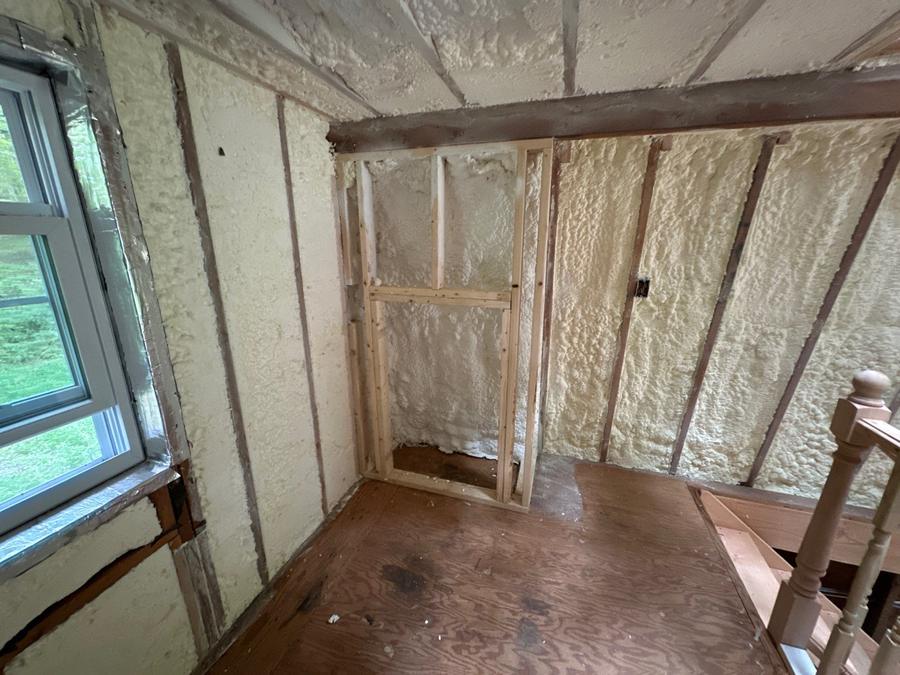
The capes generate most of the calls. A story-and-a-half cape has knee walls
behind the upstairs bedrooms, and behind each one a triangular floor cavity
running out to the eaves. What we normally find is a batt stapled between the
knee wall studs with nothing covering the attic side of it, and the joist bays
underneath open to the soffit. Cold air enters at the eave, fills the triangle,
blows through the back of the batt and comes up through the floor into the
bedroom. Every piece of insulation the house is supposed to have is present and
the room is still cold.
The ranches are simpler and the list is always the same: loose fill settled
to four or five inches and thinned to nothing over the top plates at the eaves;
an open masonry chimney chase from basement to roof; a garage ceiling under a
bedroom with nothing in it; and a rim joist never touched. In a Cortlandt
basement that rim joist matters more than it sounds — the tank, the burner
and the distribution lines all live down there, and every foot of uninsulated
band around them is heat going outside before it reaches a room.
What we do about it is ordinary and it works. Block and baffle at the eaves,
seal the chase, the top plates, the hatch and the bath fan penetrations, bring
the attic floor to depth, insulate the rim joist, and close the garage ceiling.
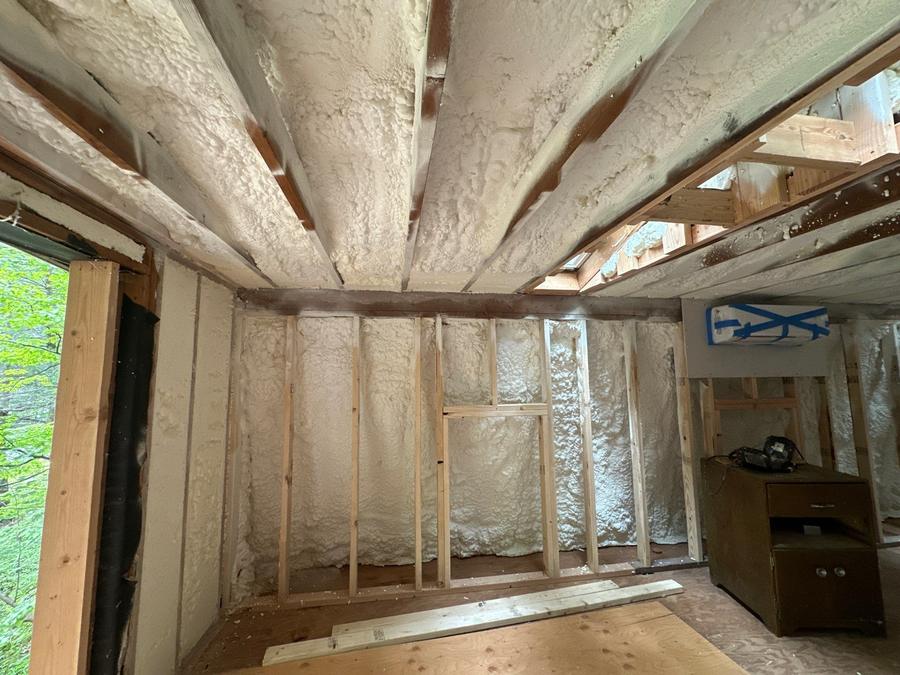
On a cape, add a rigid air barrier on the attic face of the knee walls and block
the joist bays beneath them — or foam the roof plane, if the rafter bays
are too shallow for both a vent channel and useful depth.
We seal before we insulate
Insulation slows heat moving through a surface. It does nothing about air
moving through a gap. Pack a leaky attic with cellulose and you have a leaky
attic with cellulose in it — the air still moves, it just moves through
something softer.
In a Cortlandt cape that is not a general principle, it is the reason your
bedroom is cold. The batt on the knee wall does nothing because outdoor air
moves freely across the back of it. Put a rigid air barrier on that face, block
the bays underneath, and the same batt starts working. Then we insulate.
If a quote gives you a depth and never mentions air sealing, it is half a
job.
What insulation costs in Cortlandt
Most of our projects run between $3,500 and $12,500. A
ranch attic with a chase to close and a garage ceiling sits near the bottom. A
cape with knee walls on both sides, settled fill to clear and finished space to
protect sits higher, because that is a day of careful work before anything gets
installed.
One note on payback specific to this town. ENERGY STAR says sealing air leaks and adding insulation can save up to 10% on annual energy bills. On a gas budget
plan that is a change you have to look for. On oil it is deliveries, and you
count them yourself.
Open cell foam runs R-3.9 to R-4.2 per inch. Closed cell runs R-6.9 to R-7.1
per inch and also acts as a vapor retarder, which is why it costs more and why
it is right in some assemblies and unnecessary in others. All products are
manufactured in the United States and meet applicable building code and safety
standards.
Insulation rebates in Cortlandt
Cortlandt straddles the gas frontier — 52.2% fuel oil to 31.1% utility
gas — but for electricity the whole town is Con Edison,
and the rebate question runs through Con Edison and then straight past it. Con
Edison’s residential Weather Ready program is not
accepting applications, and its own page points Westchester customers
to NYSERDA and promises news about 2027 incentives. The $4,000 Con Edison
weatherization figure still on their index pages is stale.
The live program is NYSERDA Comfort Home, run by the state
rather than by whoever delivers your fuel: $2,500 to air seal
and insulate the attic and rim joist, $3,000 with wall and
floor insulation added, $2,000 more toward ENERGY STAR windows
afterwards. The contractor must be on NYSERDA’s Comfort Home list and the house
must meet the conditions of the whole package. At or below 80% of area median
income, EmPower+ is the route: no cost up to
$14,000 downstate, half the cost up to $7,000
at moderate incomes. See
the full New York rebate guide.
The federal Section 25C tax credit ended for anything placed in service after
31 December 2025. There is no federal insulation credit on a
2026 job.
Code and climate in Cortlandt
Nearly four in ten Cortlandt houses went up in the 1950s and 1960s and
another 17.9% before 1940, so most of this town was framed before New York had
an energy code to frame it to. The current one is the 2025 Energy
Conservation Construction Code of New York State, in force since
31 December 2025 and based on the 2024 IECC; Westchester is
climate zone 4.
It sets R-49 in the ceiling, R-30 in
wood-framed walls (or R-20 cavity plus R-5 continuous, R-13 plus R-10
continuous, or R-20 continuous), R-30 in floors, and R-15
continuous, R-19 cavity or R-13 plus R-5 continuous in basement and crawl space
walls. Anyone quoting R-60 is quoting Connecticut. None of it applies to
a house already standing. The code does not require an existing
building to be altered, only that an alteration not leave you with less R-value
than you had. ENERGY STAR recommends R-60 for a retrofit
attic here, which is guidance, not law.
Common questions about insulation in Cortlandt
Do you install insulation in Cortlandt, NY?
Yes. Cortlandt is mostly postwar detached housing on its own lots —
capes, ranches and splits, with the 1950s alone accounting for 22.3% of the
town. The scope is usually the attic plane, the knee walls if it is a cape, the
rim joist and the garage ceiling.
How much does insulation cost in Cortlandt?
Most projects run $3,500 to $12,500. A ranch attic with a chimney chase and a
garage ceiling sits near the bottom. A cape with knee walls on both sides,
settled fill to clear and finished rooms to protect sits higher, because it is
hand labor rather than a hose and a hopper.
Are there insulation rebates in Cortlandt?
Yes, through NYSERDA. Cortlandt is Con Edison for electricity, and Con
Edison’s own weatherization program is not accepting applications, so Comfort
Home is the live one: $2,500 for air sealing plus attic and rim joist, $3,000
with walls and floors. EmPower+ covers income-qualified households. No federal
tax credit applies to a 2026 job.
We heat with oil in Cortlandt and are not on a gas main. Is insulation still
worth doing?
Yes, and sooner than your neighbors on gas. Delivered fuel is a lump you
notice, so a 20% cut in demand turns into fewer fills rather than a slightly
smaller monthly debit. Comfort Home runs through NYSERDA rather than a fuel
supplier, so confirm eligibility with the program.
Free energy audit in Cortlandt
We walk the attic, the knee wall spaces if the house is a cape, the basement
and the rim joist, and give you a written scope and a price. No charge, no
obligation. If the money belongs in the rim joist and the garage ceiling rather
than the attic, that is the smaller job and the one we will quote.
Call 914-554-2289 or use the form on this page. Open
8am–8pm, seven days. We have insulated hundreds of homes across New York,
Connecticut and New Jersey with a 100-plus in-house crew.
Get my free estimateor call 914-554-2289, 8am–8pm every day