Greenburgh built 9,123 of its 38,077 housing units in the 1950s. That one decade is 24.0% of the town; the 1960s, the next busiest, added 15.0%, and the median unit dates from 1959. The town grew first along the Hudson River, for most of its history its main transportation route, and the land away from the river was rural before the post-war decades filled it with houses.
46.5% of units, 17,700 of them, are detached houses, and that is where most of our Greenburgh work is. Another 8.5% are attached townhouses and duplex halves, 5.2% sit in two-unit buildings and 8.3% in buildings of three or four. There is a large apartment side too: 12.6%, or 4,816 units, are in buildings of fifty or more, whose roofs and walls belong to an owner or a board rather than the household inside. 73.9% of occupied units are owner-occupied. Utility gas heats 61.2% of homes, fuel oil 20.3%, electricity 14.7% and bottled gas 2.2%, so about one household in five still takes oil deliveries.
Greenburgh is a town of two halves. Roughly half its residents live in six incorporated villages: Ardsley, Dobbs Ferry, Elmsford, Hastings-on-Hudson, Irvington and Tarrytown. The other half live in the unincorporated area, where most properties fall inside one of three hamlets, Fairview, Greenville and Hartsdale, each roughly matching a fire district. Tarrytown, Irvington and Hartsdale each have a write-up built on their own numbers; what follows is the town as a whole, and above all the unincorporated streets no village covers.
The houses we insulate in Greenburgh
On those streets, in Fairview and Greenville and in neighborhoods such as East Irvington, North Elmsford and South Ardsley, the house we open up most often is a 1950s ranch. A ranch loses its heat across one long, low attic. The loose-fill or rock wool laid down when it was built has settled to a few inches, and under it every interior wall top plate, plumbing vent, flue chase and ceiling box is an open hole into the attic. The eaves are worst: a low roof pitch leaves almost no depth over the exterior wall, baffles were rarely installed, and wind through the soffit vents strips heat from whatever insulation sits at the edge.
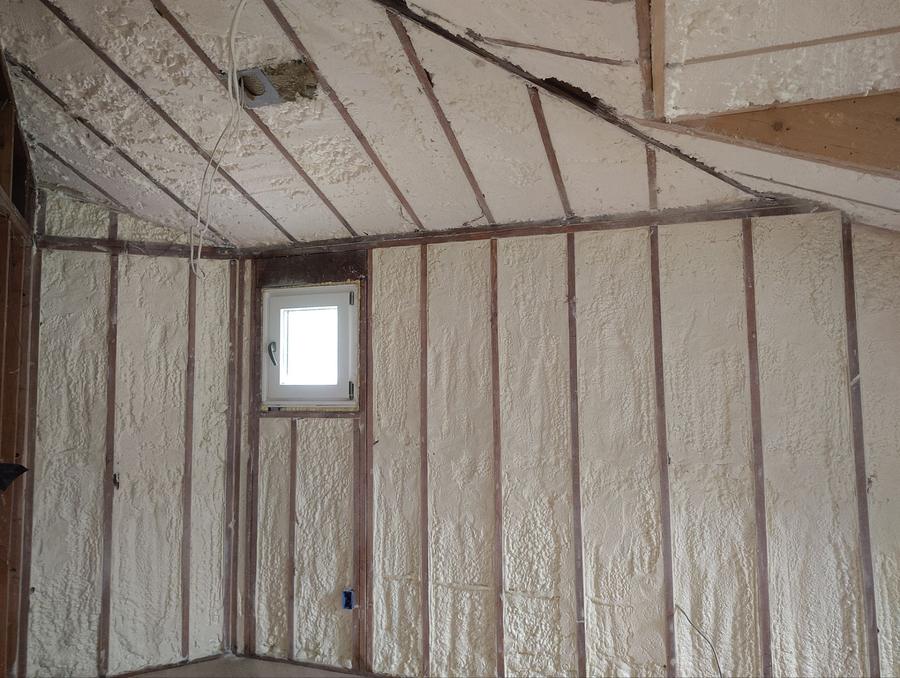
The 1950s cape fails in a different place. Its upstairs bedrooms sit under the roof between short knee walls, and behind each knee wall is a crawl attic insulated on the wrong plane: a batt stapled to the back of the wall and nothing across the floor joists that run out to the eave, so winter air reaches the underside of the upstairs floor. We either seal and insulate the knee walls and block the joist bays at the eave, or bring the whole crawl attic inside with foam on the underside of the roof, and ductwork running through that space usually decides which.
The 1960s and 70s, 23.7% of the town, brought raised ranches and split-levels, and two assemblies owners notice from the bedroom: a room over the garage, with open joist bays and car exhaust below its floor, and a cantilevered overhang where the floor joists run past the foundation with only a thin soffit panel beneath. The garage ceiling gets sealed and filled bay by bay; the cantilever gets its soffit opened, its joist bays blocked at the rim and filled, and the panel put back.
20.3% of the town heating with oil changes the arithmetic. Oil is bought by the delivery, so every gallon the attic and rim stop losing pushes the next delivery further out, and an oil-heated ranch usually earns back its air sealing sooner than the same house on gas. Past the end of a gas main, a house heats with oil, bottled gas or electricity.
Village or unincorporated Greenburgh: what changes and what does not
Addresses here mislead. East Irvington is not part of the Village of Irvington, North Elmsford is not part of Elmsford, and South Ardsley is not part of Ardsley: all three are unincorporated neighborhoods of the town, outside the villages they are named for and outside the three hamlets as well. For our purposes a home in any of them is a Greenburgh home, the same as one in Fairview or Greenville.
The town also divides by railroad. Metro-North’s Hudson Line runs through the west with stations at Hastings-on-Hudson, Dobbs Ferry, Ardsley-on-Hudson, Irvington and Tarrytown; the Harlem Line runs through the east with a station at Hartsdale.
For insulation, the village line matters less than people expect. Con Edison supplies the electricity in every village and across the unincorporated area, the same state programs and energy code apply on both sides, and our pricing does not change at the line. The one real difference is gas. Most homes in the six villages sit on Con Edison gas lines; in the unincorporated town the gas runs on many streets but not all, and that is where oil tanks and propane cylinders are more likely. If you are unsure which side you are on, we can tell from the address.
We seal before we insulate
Insulation slows heat conducting through a ceiling; it does little to stop warm air leaving through a gap, and a ranch attic is full of gaps. Blow a foot of cellulose over an unsealed ceiling and the warm air keeps rising past it.
In a Greenburgh ranch the sequence runs from the edges in. Pull the old insulation back from the eaves and fit baffles in every rafter bay. Seal the top plates, the plumbing vent, the flue chase with sheet metal and fire-rated sealant, the ceiling boxes and the bath fan housings, and run the fans outside. Weatherstrip and insulate the hatch. Blow the attic to depth. Then seal and insulate the basement rim joist, where the frame sits on the foundation. In a raised ranch the garage ceiling and the cantilever come first, because they sit under the bedrooms people complain about.
If a quote specifies a depth of insulation and never mentions air sealing, it is half a job.
What insulation costs in Greenburgh
Most of our projects run between $3,500 and $12,500. On a Greenburgh ranch the number follows the attic’s square footage, how much old insulation has to come out before the sealing (wet or rodent-fouled material is removed, not buried), and the length of rim joist around the basement. A cape adds knee walls and slopes; a raised ranch or split adds the garage ceiling and any cantilevers. The foam side of the price is laid out in what spray foam costs.
Open cell foam runs R-3.9 to R-4.2 per inch. Closed cell runs R-6.9 to R-7.1 per inch and also acts as a vapor retarder, which is why it costs more and why it is right in some assemblies and unnecessary in others. All products are manufactured in the United States and meet applicable building code and safety standards. ENERGY STAR says sealing air leaks and adding insulation can save up to 10% on annual energy bills.
Insulation rebates in Greenburgh
All of Greenburgh, villages and unincorporated area alike, is Con Edison for electricity, and Con Edison is the gas company too: its gas reaches many streets of the unincorporated town and most streets in the villages. That Con Edison electric account is what puts every Greenburgh home in NYSERDA’s programs.
Con Edison’s own Weather Ready insulation rebates are closed; Con Edison sends Westchester homeowners to NYSERDA’s Comfort Home program and says new weatherization incentives are coming for 2027. Comfort Home pays $2,500 toward sealing and insulating the attic and rim joist, $3,000 if walls and floors are added, and $2,000 more toward ENERGY STAR windows, for one- to four-family homes whose owners pay the System Benefits Charge. The money flows only through a NYSERDA-approved Comfort Home contractor, listed on the state’s MyEnergy portal. Comfort Home is open in 2026 but closes when the new utility programs start around January 2027, so an owner who wants that money should not wait.
Households under Westchester’s income limits use EmPower+. For a family of four, the lower-income tier is at or below $102,000 a year and gets air sealing and insulation at no cost up to $14,000; the moderate-income tier is below $136,000 and gets half the cost covered up to $7,000, through an EmPower+ contractor. Renters can apply as well as owners. If a heat pump is in your plans, New York’s heat pump program is moving to reward, and from 2028 require, a sealed and insulated house before it pays, so insulate first.
We quote the job, tell you which programs your household may fit, and say plainly when a program requires its own contractor. The federal insulation tax credit (Section 25C) ended for work placed in service after 31 December 2025, so there is no federal credit on a 2026 job, and New York has no state tax credit for insulation. The detail is in our New York and New Jersey rebate guide.
Code and climate in Greenburgh
76.9% of Greenburgh’s housing was built before 1980. Almost all of it went up before New York’s first statewide energy code took effect on 1 January 1979, so a 1950s attic here was never held to any insulation level. Westchester County is Climate Zone 4.
The code in force is the 2025 Energy Conservation Construction Code of New York State, effective 31 December 2025. For a new house it calls for R-49 ceilings, though R-38 over the whole ceiling satisfies that where its full uncompressed height carries out over the wall top plate at the eaves; R-30 floors; basement and crawl space walls at R-15 continuous, R-19, or R-13 plus R-5 continuous; U-0.27 windows; and no more than 3.0 air changes per hour at 50 pascals. That R-38 clause names the ranch’s weak point: a low 1950s roof has no room for full height at the eave, which is why baffles, and sometimes foam at the plate, matter.
An existing house is treated differently. Parts you are not altering need not be brought up to the new-home table, New York’s code does not require a blower door test when you insulate an existing home, and any roof or wall cavity opened during the work has to be filled to full depth. ENERGY STAR recommends R-60 for an uninsulated attic in this zone and R-49 where 3 to 4 inches are already down; R-49 is where we set a Greenburgh attic.
Common questions about insulation in Greenburgh
Do you install insulation in Greenburgh, NY?
Yes, across the whole town: the unincorporated streets of Fairview and Greenville, neighborhoods such as East Irvington, North Elmsford and South Ardsley, and the six villages. Most of what we see is the 1950s ranch, cape and split-level, since 24.0% of the town was built in that decade. An apartment in one of the town’s fifty-plus-unit buildings is a question for its landlord or board, and we will say so on the phone.
How much does insulation cost in Greenburgh?
Most projects run $3,500 to $12,500. For a 1950s ranch the drivers are the attic area, how much old insulation has to be pulled out before the sealing, and the length of rim joist in the basement. A cape adds knee walls and roof slopes, and a raised ranch adds the garage ceiling and any cantilevered overhangs. After a free walk-through you get a written scope and a price.
Are there insulation rebates in Greenburgh?
Greenburgh is Con Edison territory for electricity and gas. Con Edison’s Weather Ready rebates are closed, and it points Westchester homeowners to NYSERDA’s Comfort Home program, which pays $2,500 for sealing and insulating the attic and rim joist, or $3,000 with walls and floors, through its approved contractors until the new utility programs begin around January 2027. Income-eligible households use EmPower+. The federal 25C credit ended for work placed in service after 31 December 2025, and New York has no state insulation tax credit.
Our Greenburgh house heats with oil. Should we insulate before switching to a heat pump?
Yes. 20.3% of Greenburgh heats with fuel oil, and a house that leaks at the attic and rim needs more heating capacity than a sealed one, so a heat pump installed first gets sized for losses you could have stopped. New York’s heat pump program is moving to reward, and from 2028 require, a sealed and insulated house before it pays toward one. Sealing first lets the equipment match the house you will actually have, and if the switch is years away, the same work cuts oil deliveries in the meantime.
Free energy audit in Greenburgh
In a Greenburgh ranch or cape we go up through the hatch and check the depth and condition of what is there, the top plates, the eaves and the knee walls; then the basement rim, the oil or gas equipment and any ducts in unheated space; then the garage ceiling if bedrooms sit over it. You get a written scope and a price, with no charge and no obligation.
Call 914-554-2289 or send the form. Open 8am–8pm, seven days. We work out of New Rochelle, NY with a 100-plus in-house crew that never subcontracts.
Get my free estimateor call 914-554-2289, 8am–8pm every day