Port Chester has the densest small-multifamily fabric in Westchester County:
17.7% of its housing is in two-family buildings and 11.7% in three- and
four-family buildings — 29.4% small multifamily, with detached houses
only 21.9% of the stock.
The recurring job here is not the attic. It is the room that used to be the
attic.
The houses we insulate in Port Chester
The median Port Chester home was built in 1954, 35.2% of the stock predates
1940 and owner occupancy is 46.5%. That is dense working-class frame housing
on narrow lots, much of it two-family, most of it extended once or twice, and
much of it with a third floor converted into bedrooms along the way.
Those conversions are where the heat goes. A finished attic is not one
surface, it is five: the flat ceiling under the ridge, two sloped ceilings
following the rafters, two knee walls, and the triangular floor cavity behind
each knee wall running out to the eaves. What we find is batts stapled between
the knee wall studs with nothing on the attic side, empty or compressed rafter
bays, and the joist bays under the knee wall open to the soffit. Cold air
enters at the eave, fills the triangle, wind-washes the back of the batt, then
runs into the room through those open bays. The insulation is technically all
present and the room is unusable.
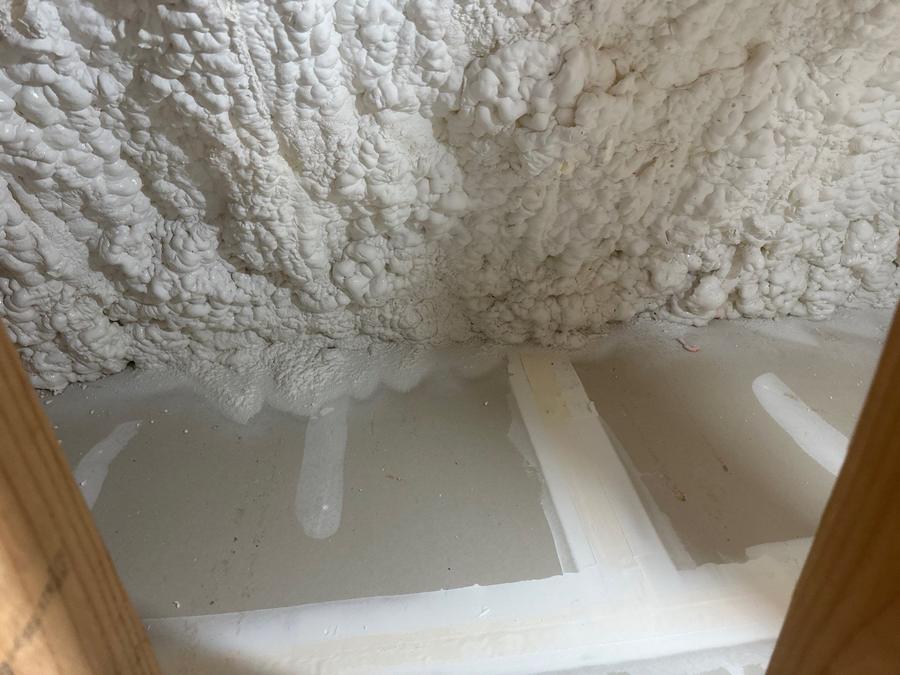
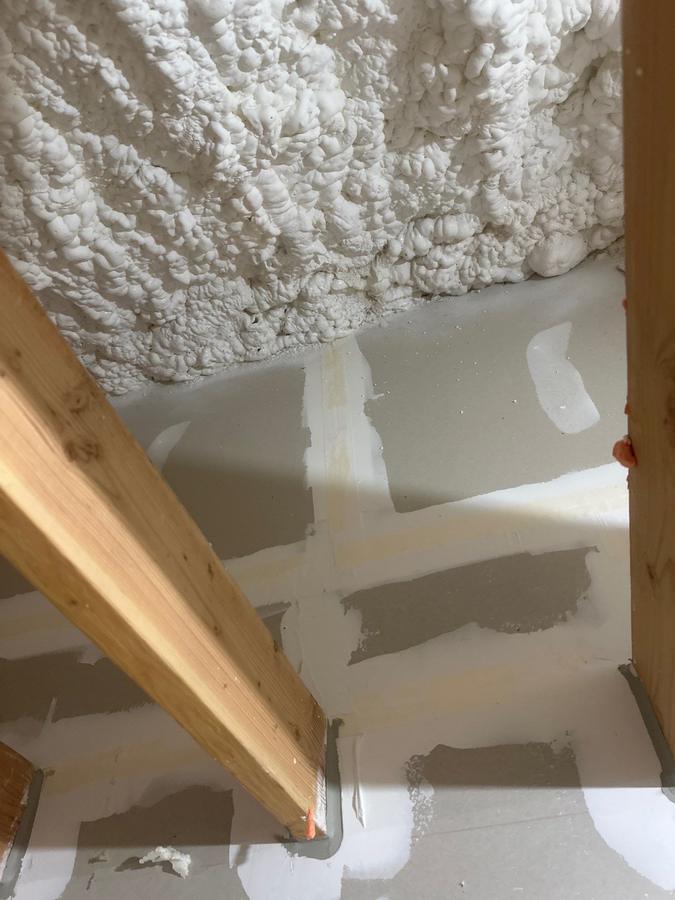
Two honest ways to fix it. Keep the roof vented: baffle every rafter bay from
the soffit up, fill the slope to the baffle, put a rigid air barrier on the
attic face of the knee wall, dense-pack behind it, and block the joist bays
under the wall. Or bring the roof plane inside the envelope with closed cell
against the deck, triangles included, so the knee wall stops being an exterior
wall. That costs more and has to cover the entire plane or it just moves the
cold spot — but in a 2×6 rafter bay, where you cannot fit both a vent
channel and useful depth, it is often the only thing that works.
Two more finds. Where an addition was built on, the original exterior wall is
usually still there, uninsulated, behind the addition’s ceiling. And
knob-and-tube turns up regularly in the pre-1940 houses, and has to come out
first.
Ice dams start in the sloped ceiling
The winter version of the same fault is worth spelling out, because people
treat it as a roofing problem. Heat leaking through an uninsulated sloped
ceiling warms the deck under the snow. The melt runs down to the eave
overhang, beyond the heated part of the house and still cold, and refreezes.
That ridge of ice holds the next meltwater back, and the water goes under the
shingles and into the knee wall cavity. New shingles do not fix it. A cold
roof deck does, which is why ice damming is an envelope problem.
We seal before we insulate
Insulation slows heat moving through a surface. It does nothing about air
moving through a gap. Pack a leaky attic with cellulose and you have a leaky
attic with cellulose in it — the air still moves, it just moves through
something fluffier.
In a converted Port Chester attic the sealing is most of the value: block the
joist bays under the knee walls, seal the knee wall doors and built-in storage
openings, close the chase where the plumbing stack and chimney pass through,
then insulate. In a two-family, add the floor cavity between units, which
carries smoke and combustion gases as well as heat.
If a quote specifies a depth of insulation and never mentions air sealing, it
is half a job.
What insulation costs in Port Chester
Most of our projects run between $3,500 and $12,500. An
unfinished attic floor with clear access sits at the bottom of that range; a
finished third floor sits higher, because five surfaces have to be treated
instead of one, and a two-family is priced as one building.
Open cell foam runs R-3.9 to R-4.2 per inch. Closed cell runs R-6.9 to R-7.1
per inch and also acts as a vapor retarder, which is why it costs more and why
it is right against a roof deck and unnecessary in an open attic floor. All
products are manufactured in the United States and meet applicable building
code and safety standards. ENERGY STAR says sealing air leaks and adding insulation can save up to 10% on annual energy bills.
Insulation rebates in Port Chester
Port Chester is Con Edison territory for gas and electric.
Con Edison’s residential Weather Ready weatherization program
is not accepting applications, and its own page points
Westchester customers to NYSERDA until news about 2027 incentives.
The live program is NYSERDA Comfort Home:
$2,500 for air sealing plus attic and rim joist insulation,
$3,000 if wall and floor insulation is added, and
$2,000 more toward ENERGY STAR windows afterwards. The
contractor must be on the Comfort Home list and the house has to meet the
package conditions.
The program to check first here is EmPower+. Households at or
below 80% of area median income get the work at no
cost up to $14,000 downstate; moderate incomes pay half the
cost up to $7,000. It is how New York delivers federal HEAR money,
and many owner-occupiers here qualify. A finished-attic job that looks
unaffordable at full price often is not once EmPower+ is applied. See
the full New York rebate guide.
The federal Section 25C tax credit ended for anything placed in service after
31 December 2025. There is no federal insulation credit on a
2026 job.
Code and climate in Port Chester
Over a third of Port Chester predates 1940, so most of it went up before New
York had an energy code — and almost every finished attic here was
converted without one applied. Westchester is climate zone 4, and the rulebook is the 2025 Energy Conservation
Construction Code of New York State, in force since 31
December 2025 and based on the 2024 IECC.
For new construction and additions it sets R-49 ceilings,
R-30 wood-framed walls (R-20 cavity plus R-5 continuous is
the usual alternative), R-30 floors, and R-15 continuous or R-19 cavity in
basement walls. Those numbers changed at the end of 2025, so anyone quoting
R-60 as New York code is quoting Connecticut’s. None of it applies to
a house already standing. The code does not require an existing
building to be altered, only that altering an assembly not leave less
insulation than was there. ENERGY STAR recommends R-60
for a retrofit attic in this zone, which is guidance, not law.
Common questions about insulation in Port Chester
Do you install insulation in Port Chester, NY?
Yes, and much of it is two-family houses and converted attics rather than
detached single-families, only 21.9% of the stock here. A two-family is scoped
as one building, because the wall bays and the floor cavity between units are
shared.
How much does insulation cost in Port Chester?
Most projects run $3,500 to $12,500. An open attic floor with clear access is
at the bottom. A finished third floor is higher: five surfaces to treat
instead of one, and access to the triangles through small knee wall doors.
Are there insulation rebates in Port Chester?
Port Chester is Con Edison territory and Con Edison’s Weather Ready program is
not accepting applications. The live money is NYSERDA Comfort Home —
$2,500 for air sealing plus attic and rim joist, $3,000 with walls and floors
— and EmPower+, at no cost up to $14,000 downstate at or below 80% of
area median income. Check EmPower+ first.
Our attic was finished into bedrooms. Why is it freezing up there?
Because the knee walls and sloped ceilings are the only thing between you and
the roof, and they are usually empty or wind-washed. Cold air enters at the
soffit, fills the triangle behind the knee wall and runs into the room through
the open joist bays under it. Fixing it means treating all five surfaces and
blocking those bays, not adding batts.
Free energy audit in Port Chester
We open the knee wall doors, look at the rafter bays and the triangles behind
them, walk the cellar and rim, then give you a written scope and a price. No
charge, no obligation. If the finished attic is sound and the loss is really
the cellar ceiling, we will say so.
Call 914-554-2289 or use the form on this page. Open
8am–8pm, seven days. We work out of New Rochelle, NY with a 100-plus
in-house crew.
Get my free estimateor call 914-554-2289, 8am–8pm every day