Almost a third of the City of Rye was built before 1940: 30.3% of its 6,151 housing units. Yet the city never stopped building, and 17.1% has gone up since 2000, 9.7% in the 2000s and 6.6% in the 2010s. Between the two sit 24.6% from the 1940s and 50s, 16.4% from the 1960s and 70s and 11.7% from the 1980s and 90s, and the median unit dates from 1957. The two ends of that stock need very different work.
This is the City of Rye, chartered in 1942, the most recent city charter in New York, and not the Town of Rye. The Town of Rye is a separate municipality made up of the villages of Port Chester, Rye Brook and part of Mamaroneck, and Port Chester and Mamaroneck have their own pages. The city sits on Long Island Sound, its western border paralleling Beaver Swamp Brook, its eastern edge formed by Milton Harbor and the Sound, with Blind Brook running through it from the northwest corner to Milton Harbor.
63.8% of Rye’s units are detached houses and 5.5% attached; 420 units, 6.8%, are in two-unit buildings. The rest is mostly apartment and condominium buildings: 6.0% in buildings of 10 to 19 units and 9.6%, 592 units, in buildings of 50 or more. 70.6% of occupied homes are owner-occupied. Gas heats 73.4%, oil 15.0% and electricity 9.9%, and most of the city is on Con Edison gas lines.
The houses we insulate in Rye
In the 19th and early 20th centuries Rye was a haven for wealthy Manhattanites escaping the city heat, while visitors of more moderate means took short stays at cottages and waterfront hotels near the beaches. The clubs arrived in the same decades, from the American Yacht Club in 1883 to Westchester Country Club in 1922. The houses of that period are shingle, clapboard, stucco, brick and stone, often with a finished third floor under a steep roof. Many of the frame ones are balloon-framed, so each stud bay is an open flue from basement to attic. The stucco and masonry ones have little or no cavity to fill, and their losses are at the roof, the third-floor knee walls and dormers, the basement rim and the windows.
Some of it is protected. The Boston Post Road Historic District, the only National Historic Landmark District in Westchester County, takes in the Jay Estate, Lounsbury of 1836–1838 and Whitby Castle of 1852–54, and the 1985 Master Plan marked many neighborhoods as worth preserving. On houses like these we do not drill the exterior. The work is done from inside: the third-floor slopes and knee walls, the attic floor, the tops and bottoms of the wall bays, the basement rim.
The 1940s and 50s added 24.6%, the capes, colonials and ranches. The cape’s knee walls face an attic open to the eave, and the joist bays under them carry cold air beneath the bedroom floor; the ranch has a long attic of settled loose-fill over unsealed top plates. The 1960s and 70s, 16.4%, and the 1980s and 90s, 11.7%, brought splits, raised ranches and larger colonials, with rooms over garages and ducts in the attic.
The 17.1% built since 2000 was built to the energy codes of its decade, and its walls are full. What fails is the ductwork and air handler in a vented attic, vaulted and tray ceilings with no baffles, bonus rooms over garages with open joist bays, and bath fans that blow into the attic. On the waterfront, wind off the Sound finds every unsealed eave.
The larger buildings are not a retrofit we can sell to one owner. The envelopes of the 592 units in buildings of 50 or more belong to boards or landlords. The 420 units in two-unit buildings are our work, and we scope a two-family as one building, because the stair and the floor between the units run through both.
Blind Brook, Milton Harbor and the basement that floods
Rye’s 1985 Master Plan put substantial areas near the Sound, Milton Harbor, Blind Brook and Beaver Swamp Brook inside the 100-year flood hazard area, and the record bears it out. Indian Village flooded after four days of rain in October 1975. The April 2007 nor’easter left some Rye homes with more than five feet of water. In 2011 Irene and the storm after it swelled Blind Brook and submerged homes on Milton and Highland Roads; in 2012 Sandy’s surge forced evacuations along the coast. In September 2021 areas around Indian Village were under 8–9 feet of water, and normally dry parts of the city flooded too.
For insulation that settles three things. Fiberglass or cellulose that has been under water comes out. In a lower level that floods or could, we air seal and insulate the ceiling above it, the underside of the first floor, so the living space is closed off from the basement and the insulation sits above the water. And where a flooded basement has been gutted, we talk through what the next flood would do to its walls before we price them. Our basement ceiling insulation guide explains the approach.
Away from the brooks, Rye stands on rock and wetland: Fordham gneiss and Harrison diorite, with wetlands around Milton Harbor, Disbrow Park and Manursing. A basement that has never flooded can still be damp, and its bare rim joist lets in both cold air and moisture. We seal and insulate that rim with closed-cell foam from inside.
We seal before we insulate
Insulation slows heat moving through a surface. It does nothing about air moving through a gap, and a balloon-framed Rye house is mostly gaps: every wall bay open top and bottom, pulling basement air up and out through the attic.
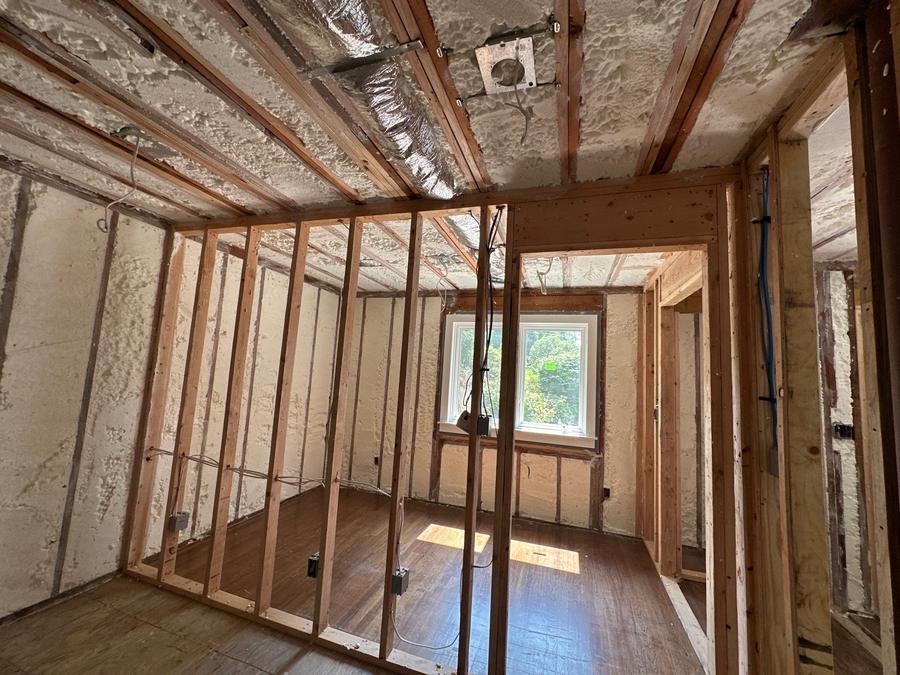
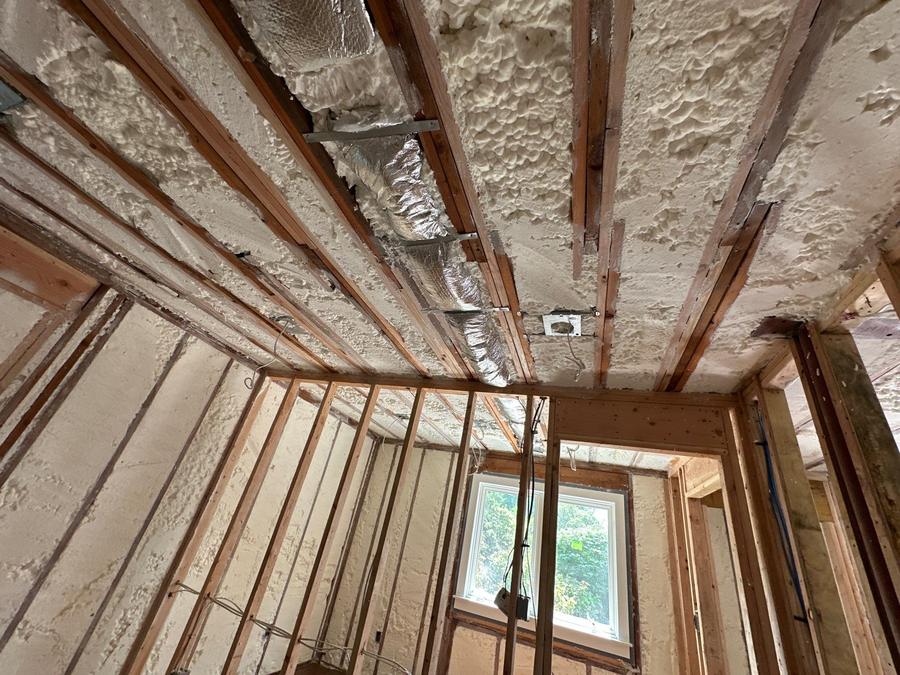
In a pre-1940 Rye house the sequence is: block the tops of the wall bays at the attic and the bottoms at the basement sill; seal the chimney, plumbing stacks and wiring runs; put an air barrier behind the third-floor knee walls and block the joist bays under them; seal the rim. Then insulate the slopes, the knee walls and the attic floor. In a post-2000 house it is the ducts, the air handler platform, the garage ceiling and the bath fans first.
If a quote specifies a depth of insulation and never mentions air sealing, it is half a job.
What insulation costs in Rye
Most of our projects run between $3,500 and $12,500. In an older Rye house the number moves with the third floor: whether its slopes and knee walls can be reached from inside, how many wall bays need blocking, and whether the exterior is stucco or masonry that rules out filling the walls at all. A house built since 2000 is priced on its attic, its ducts and the rooms over its garage. For foam options, see spray foam insulation.
Open cell foam runs R-3.9 to R-4.2 per inch. Closed cell runs R-6.9 to R-7.1 per inch and also acts as a vapor retarder, which is why it costs more and why it is right in some assemblies and unnecessary in others. All products are manufactured in the United States and meet applicable building code and safety standards. ENERGY STAR says sealing air leaks and adding insulation can save up to 10% on annual energy bills.
Insulation rebates in Rye
Rye is Con Edison for both electricity and gas. The electric company sets the program lane, and Con Edison says its Weather Ready program is no longer accepting applications, sends Westchester homeowners to NYSERDA’s Comfort Home program, and says Residential Weatherization incentives are coming for 2027.
Comfort Home pays fixed amounts for set packages: $2,500 for sealing and insulating the attic and rim joist; $3,000 when walls and floors are added, or, under the program manual, basement foundation walls down to at least 18 inches below grade; and $2,000 more toward ENERGY STAR windows. The house has to meet the whole package, and the work goes through a NYSERDA-approved Comfort Home contractor. It covers one- to four-family homes whose owners pay the System Benefits Charge, so a Rye two-family can be eligible; a condominium in a building of more than four units does not. Comfort Home closes when the new utility programs start around January 2027, so do not wait on it.
Households under the income limits go to EmPower+, and renters can apply. For Westchester, a two-person household at or below $81,600 can get air sealing and insulation at no cost up to $14,000; below $108,800, the program can cover half the cost up to $7,000. NYSERDA’s Green Jobs–Green New York loans run from $1,500 to $25,000 over 5, 10 or 15 years, on the utility bill or as a monthly loan.
These programs pay through their participating contractors, and you can check eligibility and find them on the MyEnergy portal. We price the job and point out the programs the house may qualify for. There is no federal insulation credit on a 2026 job: Section 25C ended for work placed in service after 31 December 2025. New York has no state tax credit for insulation. See New York and New Jersey insulation rebates in full.
Code and climate in Rye
71.3% of Rye’s units date from before 1980. New York’s first statewide energy code took effect on 1 January 1979, and the 30.3% built before 1940 went up at least four decades before it. Westchester County is Climate Zone 4.
New construction in Rye answers to the 2025 Energy Conservation Construction Code of New York State, in force since 31 December 2025: R-49 in ceilings, with R-38 accepted where it runs at full, uncompressed height over the wall top plate at the eaves; R-30 floors; basement and crawl space walls at R-15 continuous, R-19, or R-13 plus R-5 continuous; U-0.27 windows; and no more than 3.0 air changes per hour at 50 pascals.
An existing house is not held to that table. The parts of a house left unaltered need not comply, and New York’s code does not require a blower door test when you insulate an existing home. When a flooded lower level is opened to the studs, the exposed cavities have to be insulated to full depth. ENERGY STAR recommends R-60 for an uninsulated attic in this zone and R-49 on top of 3 to 4 inches already there.
Common questions about insulation in Rye
Do you install insulation in Rye, NY?
Yes, across the City of Rye: the pre-1940 shingle, stucco and stone houses, the post-war capes and ranches, the 420 units in two-unit buildings, and the houses built since 2000. We do not retrofit the envelopes of the larger condominium and co-op buildings, which belong to their boards. We also work in the Town of Rye, which is Port Chester, Rye Brook and part of Mamaroneck, a different place from the city.
How much does insulation cost in Rye?
Most projects run $3,500 to $12,500. In a pre-1940 house the drivers are the third floor, how many wall bays need blocking, and whether a stucco or masonry exterior rules out filling the walls. A lower level that floods is priced on the ceiling above it rather than its walls. A house built since 2000 is priced on its attic ducts and the rooms over its garage. The written scope and price come after a free walk-through.
Are there insulation rebates in Rye?
Rye is Con Edison for gas and electric, and Con Edison’s Weather Ready program is closed. NYSERDA’s Comfort Home program pays $2,500 for sealing and insulating the attic and rim joist, $3,000 with walls and floors, and $2,000 more toward ENERGY STAR windows, through a NYSERDA-approved contractor, and a two-family can be eligible. It closes when the new utility programs start around January 2027. Income-eligible owners and renters use EmPower+. The federal 25C credit ended for work placed in service after 31 December 2025.
Our Rye basement flooded. Should the insulation go back the way it was?
Not without a look. Batts and cellulose that sat in floodwater come out, because they do not dry back to their R-value. If the lower level is likely to flood again, as around Blind Brook and Indian Village, the better line is usually the ceiling above it: air seal and insulate the underside of the first floor so the house is closed off from the basement and the insulation stays dry. If the walls are opened to the studs, New York’s code wants those cavities filled to full depth.
Free energy audit in Rye
We walk the third floor and the attic above it, the knee walls and dormers, the tops of the wall bays, the basement rim and the high-water marks in a lower level, and in a newer house the ducts and air handler in the attic. We check the exterior before we talk about walls, because stucco, brick and stone change the answer. You get the scope and price in writing, at no charge and with no obligation.
Call 914-554-2289 or send the details through the contact form. Open 8am–8pm, seven days. We work out of New Rochelle, NY, a family-owned company since 2015 with a 100-plus in-house crew that never subcontracts.
Get my free estimateor call 914-554-2289, 8am–8pm every day