Only 30.1% of Tarrytown’s 5,648 housing units are detached houses. The rest of the village is shared walls: 12.4% attached homes, 7.6% in two-unit buildings, 12.4% in buildings of three or four units and 11.7% in buildings of five to nine, before the larger apartment buildings begin. 60.0% of occupied units are owner-occupied, so a large share of households rent, and in a village of two-families and small buildings an owner living on one floor with a tenant on another is a familiar arrangement.
It is an old village and a working one. 28.9% of units, 1,631 of them, were built before 1940, the 1940s and 50s add 27.6%, and the median unit was built in 1956. By the middle of the 19th century Tarrytown was a trading center on the Albany Post Road and a busy port on the Hudson; the Hudson River Railroad brought a station and factories, and many of the Irish immigrants who built that railroad and the first Croton Aqueduct settled here. The village incorporated in 1870. Utility gas heats 69.0% of homes, fuel oil 16.9% and electricity 9.7%.
Our Tarrytown work follows that mix: the frame houses and two-families of the old streets, the attached homes, and the detached houses in neighborhoods such as Wilson Park, where the Warner family had their estate. Tarrytown is a village inside the Town of Greenburgh. Sleepy Hollow, across Andre Brook to the north, is a separate village in the Town of Mount Pleasant.
The houses we insulate in Tarrytown
A 19th-century Tarrytown house is often balloon framed: its wall studs run in one piece from the sill to the roof, with no plate at the second floor to interrupt them. Every stud bay is a chimney. Cold air enters at the cellar, rises inside the wall past the second-floor joists and exits into the attic, whether the cavity is empty or holds old fill. Before any wall is filled we plug the bays at the top and the bottom. The wiring gets looked at first, because knob-and-tube buried in insulation is a fire risk, and live knob-and-tube is replaced before anything goes into that wall.
The up-and-down two-family has one cellar, one roof and one stair hall shared by two households, and the stair hall is the air highway: open at the top to the roof space, open at the bottom to the cellar, running past both apartments. The top unit sits under a shallow roof with little room for insulation, and the bottom unit sits over a cellar whose rim joist and sill have never been sealed. Closing the top of the stair hall and the cellar rim does more for both households than anything done inside one apartment.
The 701 attached homes are a different assembly. A townhouse or row house shares a wall with its neighbor, and where that party wall rises into the attic it is often unsealed at the top or stops short of the roof deck, so two attics become one air space and heat drifts from the warmer house into the colder one. The fix happens in the attic: close the gap over the party wall with rigid material and sealant, then insulate each side.
16.9% of Tarrytown still heats with oil, and in a two-family with one oil boiler the owner buys every gallon for both floors. That puts the savings from sealing the stair hall and cellar in the owner’s pocket even when a tenant lives upstairs. On gas, which reaches most of the village, units with their own heat split the savings between whichever households pay the bills.
Old streets, shared walls: scoping a Tarrytown building
Tarrytown has lost old housing to the wrecking ball before. Mid-20th-century urban renewal replaced waterfront yards and downtown slums with public housing, parks and boat basins, and it also demolished Orchard Street and lower Main Street with their historic 19th-century houses. In March 1979 the Village Board passed legislation to establish designated historic districts so that would not happen again. The 19th-century houses that survived are the ones owners now want warmer, and the right way to do it leaves the street face alone: the work happens from the attic, the cellar and inside the wall cavities, not by changing siding, trim or windows.
A building with more than one household is scoped as one building. Air in a building with two, three or four apartments ignores the lines on the deed: it rises through the stair hall, crosses between apartments in the floor cavities and leaves through a roof everyone shares. We walk every unit, the cellar and the roof space and write one scope; most of the work happens in the cellar and the attic, not inside the apartments.
A renter’s options depend on the building. 8.1% of Tarrytown’s units are in buildings of twenty to forty-nine and 10.6% in buildings of fifty or more, where only the landlord can act on the envelope. A renter in a two-family or small building is in a different position: the income-eligible program described below accepts renters as well as owners.
We seal before we insulate
A balloon-framed wall full of new cellulose still moves air if its bays are open at the top and bottom, and a two-family with a well-insulated roof still loses heat through a stair hall that vents into that roof space. Insulation handles conduction. It cannot close a pathway.
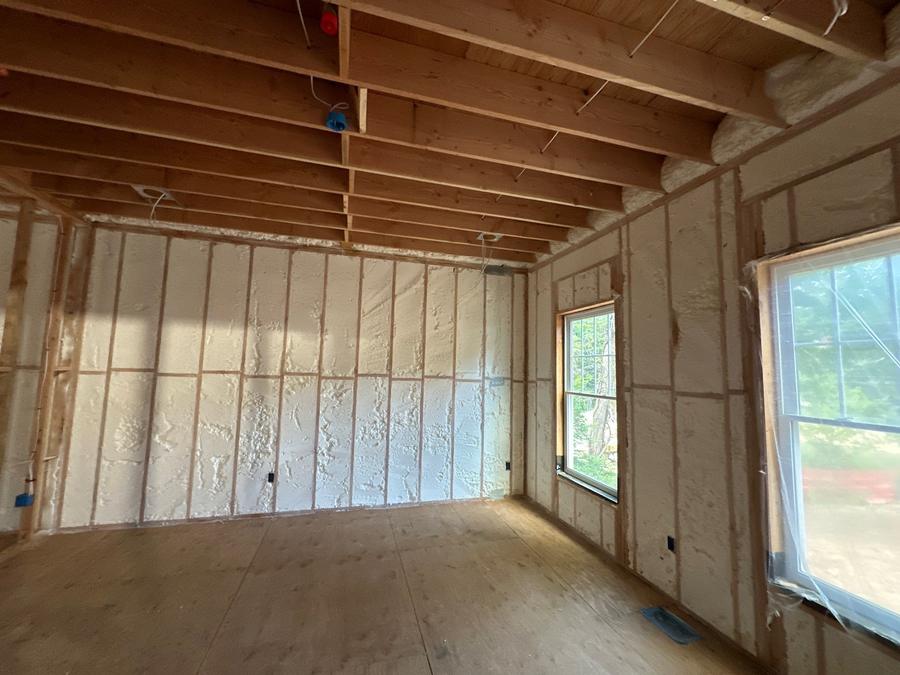
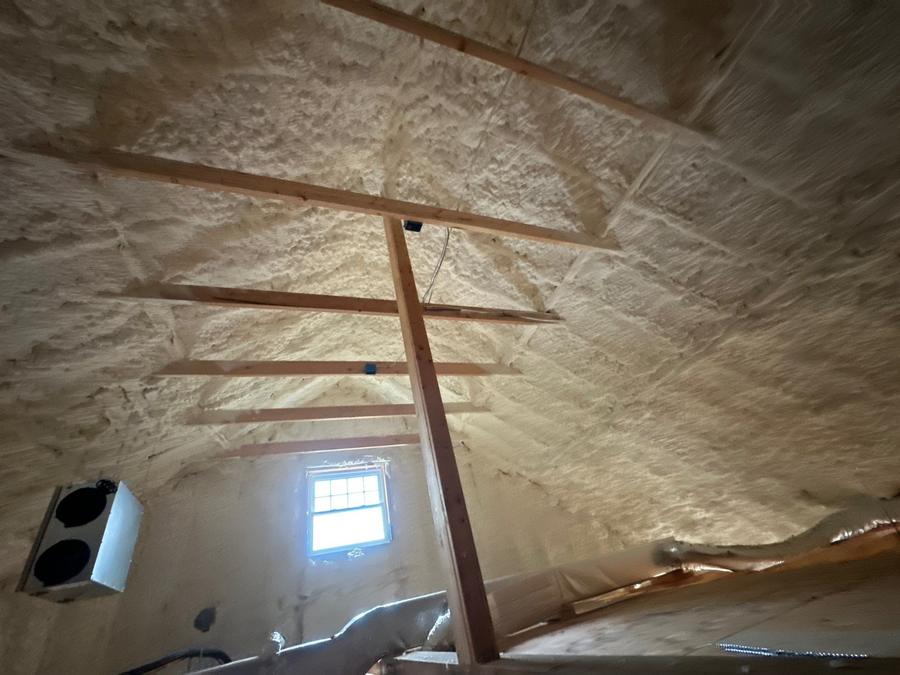
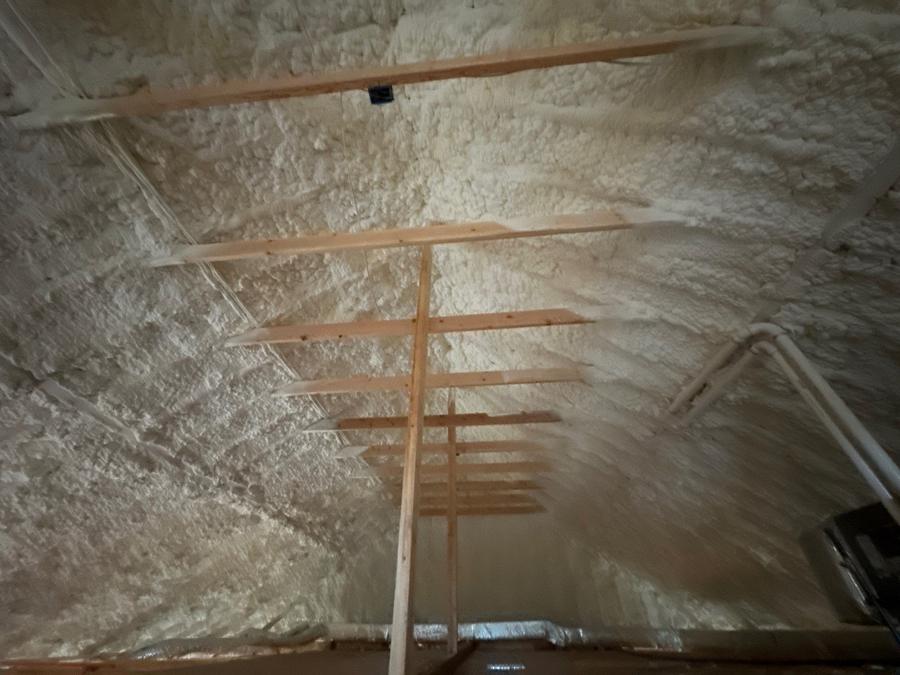
In a Tarrytown two-family the order is set by the stair hall and the frame. Seal the top of the stair hall where it meets the roof space and weatherstrip any hatch there. Block the tops of the balloon-framed stud bays at the attic and the bottoms at the cellar with rigid material and foam. Seal the chimney and plumbing chases. Seal and insulate the cellar rim and sill with closed cell foam. Then insulate the roof space over the top unit, dense-pack the walls once the wiring is cleared, and finish with the floor cavity between the units where it opens to an outside wall.
If a quote specifies a depth of insulation and never mentions air sealing, it is half a job.
What insulation costs in Tarrytown
Most of our projects run between $3,500 and $12,500. A Tarrytown two-family or a three- or four-unit building is priced as one building, and the number moves with the stair hall and chases, the roof area over the top unit, how many wall bays have to be blocked and dense-packed, and whether old wiring must be replaced before the walls can be filled. An attached home is usually a smaller scope: the party wall at the attic, the attic floor and the rim.
Open cell foam runs R-3.9 to R-4.2 per inch. Closed cell runs R-6.9 to R-7.1 per inch and also acts as a vapor retarder, which is why it costs more and why it is right in some assemblies and unnecessary in others. All products are manufactured in the United States and meet applicable building code and safety standards. ENERGY STAR says sealing air leaks and adding insulation can save up to 10% on annual energy bills.
Insulation rebates in Tarrytown
Tarrytown is Con Edison for electricity, and most of the village is on Con Edison gas lines. Con Edison’s Weather Ready insulation rebates are closed; Con Edison sends Westchester homeowners to NYSERDA’s Comfort Home program and says new weatherization incentives are coming for 2027.
Comfort Home fits Tarrytown’s buildings: it is for homes of one to four units, townhomes included, whose owner pays the System Benefits Charge on the electric bill. It pays $2,500 for sealing and insulating the attic and rim joist, $3,000 when walls and floors are added, and $2,000 more toward ENERGY STAR windows, through a NYSERDA-approved Comfort Home contractor. One rule matters in an old village: knob-and-tube wiring can block eligibility, so find out what is in the walls before counting on the money. Comfort Home is open now and closes when the new utility programs start around January 2027.
EmPower+ is the program for income-eligible households, and it is open to renters as well as owners of one- to four-family homes. Lower-income households can get air sealing and insulation at no cost up to $14,000; moderate-income households get half the cost covered up to $7,000, through an EmPower+ contractor. Owners who would rather finance the work can look at NYSERDA’s Green Jobs–Green New York loans: $1,500 to $25,000 over 5, 10 or 15 years, repaid on the utility bill or as a monthly loan.
The federal insulation tax credit (Section 25C) ended for work placed in service after 31 December 2025, so there is no federal credit on a 2026 job, and New York has no state tax credit for insulation. The details are in our New York and New Jersey rebate guide.
Code and climate in Tarrytown
74.9% of Tarrytown’s housing was built before 1980. Almost all of those homes went up before New York’s first statewide energy code took effect on 1 January 1979, and the 28.9% built before 1940 went up generations before it. Westchester County is Climate Zone 4.
The 2025 Energy Conservation Construction Code of New York State has been in force since 31 December 2025. For new work in Zone 4 its table sets R-49 ceilings, met by R-38 across the whole ceiling where that full, uncompressed R-38 reaches over the wall top plate at the eaves; R-30 floors; R-15 continuous, R-19, or R-13 plus R-5 continuous on basement and crawl space walls; U-0.27 windows; and a leakage limit of 3.0 air changes per hour at 50 pascals for new homes.
Renovating one floor of a two-family does not pull the rest of the building under that table, because unaltered parts of an existing building do not have to comply. What the code asks of an alteration is specific: when a wall or ceiling is opened, the exposed cavities must be insulated to full depth, and existing insulation cannot be reduced. New York’s code does not require a blower door test when you insulate an existing home. ENERGY STAR’s advice for an attic in this zone is R-60 if it starts empty and R-49 if it already holds 3 to 4 inches.
Common questions about insulation in Tarrytown
Do you install insulation in Tarrytown, NY?
Yes. Our Tarrytown work is the 19th-century frame houses and two-families, the three- and four-unit buildings, the attached homes and the detached houses in neighborhoods such as Wilson Park. We scope two-families and small buildings as one building, because the stair hall, cellar and roof are shared. The buildings of twenty units and up are a landlord’s or board’s decision rather than ours. Sleepy Hollow, north of Andre Brook, is in the Town of Mount Pleasant, and we work there too.
How much does insulation cost in Tarrytown?
Most projects run $3,500 to $12,500. A two-family is priced as one building, and the cost follows the stair hall and chases, the roof area over the top unit, the number of balloon-framed wall bays to block and dense-pack, and any old wiring that has to be replaced first. An attached home is usually smaller: the party wall where it meets the attic, the attic floor and the rim. The walk-through and the written price are free.
Are there insulation rebates in Tarrytown?
Tarrytown is Con Edison for electricity and gas, and Con Edison’s own insulation rebates are closed. NYSERDA’s Comfort Home pays $2,500 for the attic and rim joist, or $3,000 with walls and floors, on homes of one to four units, through its approved contractors, until the new utility programs begin around January 2027; knob-and-tube wiring can rule a house out. EmPower+ covers income-eligible owners and renters. There is no federal 25C credit on a 2026 job and no New York state insulation credit.
We live in one unit of our Tarrytown two-family and rent the other. Can you insulate just our floor?
We can, but it rarely pays. The leaks that make your floor cold are mostly in the parts both units share: the stair hall open to the roof space, the cellar rim and sill, and wall bays that run past both floors. Sealing only inside your apartment leaves those paths open. We scope the whole building, then phase the work if you need to, starting in the cellar and the attic, which seldom means entering your tenant’s rooms. Comfort Home counts a two-family as one eligible home.
Free energy audit in Tarrytown
In a Tarrytown two-family or old frame house we start in the cellar, at the sill, the rim and the tops of the foundation walls, looking up into the stud bays for balloon framing and at the wiring. Then the stair hall, then the roof space over the top unit and its hatch, and in an attached home the party wall where it meets the attic. You get one written scope and a price, with no charge and no obligation.
Call 914-554-2289 or use the form. Open 8am–8pm, seven days. We are a family-owned contractor based in New Rochelle, NY, with a 100-plus in-house crew that does the work itself.
Get my free estimateor call 914-554-2289, 8am–8pm every day