More than a third of White Plains — 37.2% of all housing units —
sits in a building of fifty units or more. That is the highest share in
Westchester County, and only 30.6% of units here are single-unit buildings at
all.
So most insulation advice written for White Plains is written for the wrong
building. This page starts with the apartment stock.
The houses we insulate in White Plains
The median White Plains unit was built in 1961. Detached houses are 27.8% of
the stock, 51.0% of households own, 29.8% of the city predates 1940, and 15.6%
went up after 2000 — 9.9% in the 2000s, 5.7% in the 2010s. That is 1950s
to 70s brick apartment blocks, pre-war elevator co-ops, a downtown core of
1920s fabric, a recent mid-rise and high-rise wave, and a single-family
remainder at the edges.
In the apartment stock three findings recur. First, the through-wall air
conditioner sleeve: a metal box driven through a masonry wall, uninsulated in
itself, with an unsealed gap around it and often a missing interior cover. In
winter it is a hole to outside behind a grille, and sealing it is the
highest-return hour in the apartment. Second, the perimeter joint where the
floor slab meets the exterior wall — a thermal bridge, and where that
perimeter is framed rather than solid, an unsealed cavity between floors.
Third, the shafts: stair, elevator, trash and plumbing risers running the full
height of the building with unsealed penetrations at every floor. That is the
stack effect that makes lobby doors hard to open and leaves top floors
overheating while the bottom runs cold.
Above all of it is a flat roof with a shallow cavity and no ventilation path.
It cannot be vented, so it gets dense-packed or rigid board above the deck at
the next re-roofing, never vented batts.
In the surviving 1920s fabric and the older frame houses: balloon-framed stud
bays running sill to attic, loose-fill wind-washed thin at the eaves, open
chimney chases, knob-and-tube that has to come out before anything goes into a
wall. The postwar single-family remainder is the easiest work in the city
— R-19 attics and R-11 to R-13 walls that were normal for their day,
plus recessed lights, bath fans and dropped soffits never rated for contact
with insulation. Nothing there is defective. The standard moved.
We seal before we insulate
Insulation slows heat moving through a surface. It does nothing about air
moving through a gap. Pack a leaky attic with cellulose and you have a leaky
attic with cellulose in it — the air still moves, it just moves through
something fluffier.
In a White Plains apartment building that logic is stronger, because the
building is tall enough for the stack effect to do real work. Sealing the
shaft penetrations at each floor, the slab edge joint and the AC sleeves
changes how the whole building behaves. In a house it is the ordinary list:
chimney chase, dropped soffit, plumbing stack, top plates, attic hatch and
recessed lights, sealed before any depth goes down.
If a quote specifies a depth of insulation and never mentions air sealing, it
is half a job.
What insulation costs in White Plains
Most of our projects run between $3,500 and $12,500. A
postwar single-family attic with clear access sits near the bottom; a pre-war
house with a complicated roofline and walls to block and dense-pack sits near
the top. Work in an occupied apartment building is scoped and priced building
by building, because access, staging and board approvals drive it more than
square footage does.
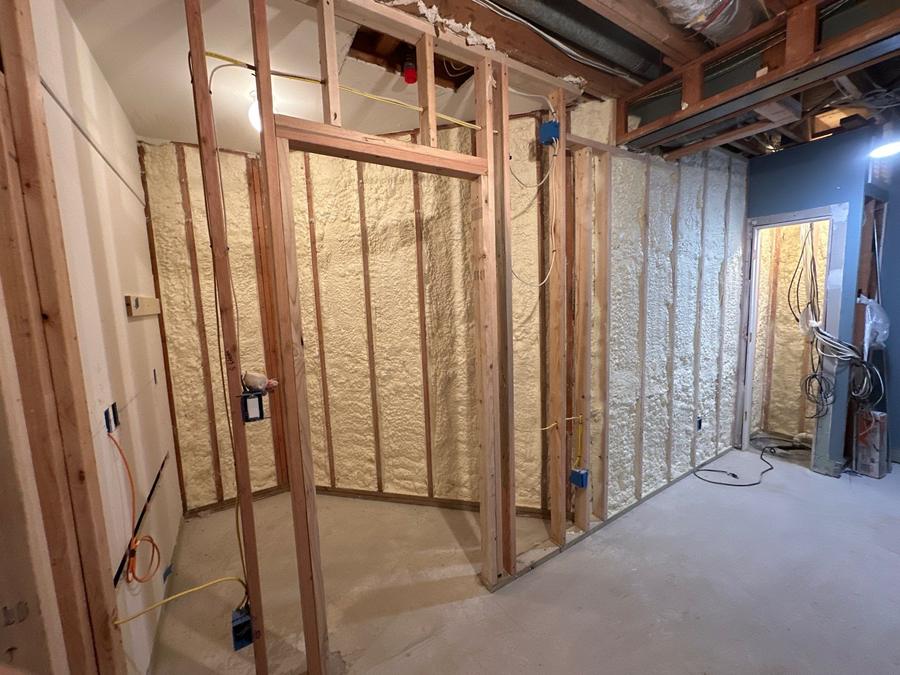
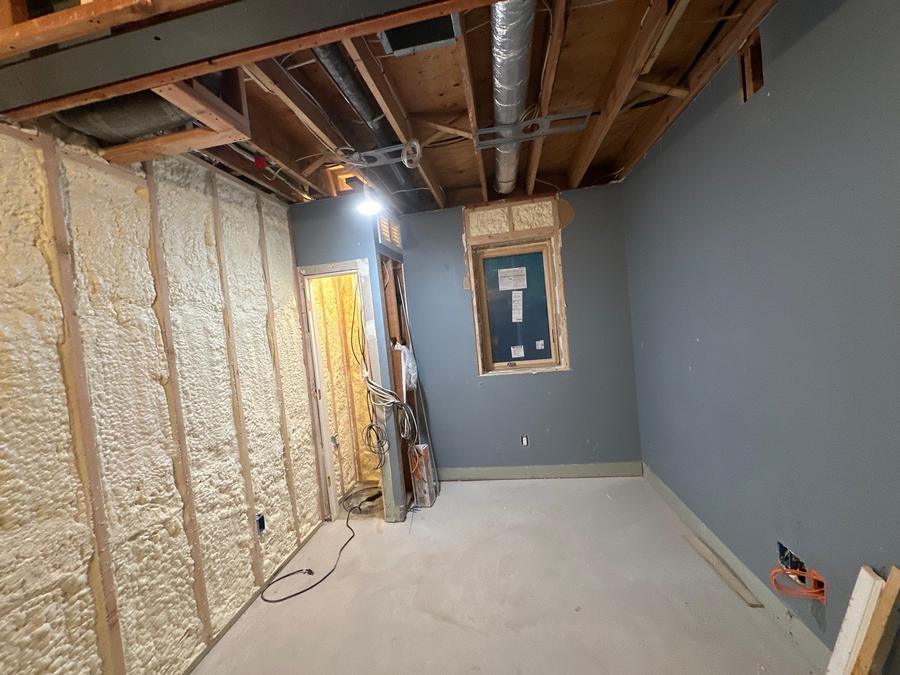
Open cell foam runs R-3.9 to R-4.2 per inch. Closed cell runs R-6.9 to R-7.1
per inch and also acts as a vapor retarder, which is why it costs more and why
it is right in some assemblies and unnecessary in others. Those are the real numbers to compare quotes on, and any contractor who will not put a per-inch range in writing is worth a second look. All products are manufactured in the United States and meet
applicable building code and safety standards. ENERGY STAR says sealing air leaks and adding insulation can save up to 10% on annual energy bills. For spray foam specifically, the national figures by the square foot and the board foot are in our spray foam insulation cost guide.
Insulation rebates in White Plains
White Plains is Con Edison territory for gas and electric.
Con Edison’s residential Weather Ready weatherization program
is not accepting applications, and its own page tells
Westchester customers to expect news about 2027 incentives and use NYSERDA
until then. A “$4,000 from Con Edison” figure on one of their index pages is
out of date.
The live program is NYSERDA Comfort Home:
$2,500 to air seal and insulate the attic and rim joist,
$3,000 if wall and floor insulation is added, and
$2,000 more toward ENERGY STAR windows afterwards. The
contractor must be on the Comfort Home list and the home has to meet the
conditions of the whole package — a program built around a house, which
matters where two-thirds of units are not houses.
EmPower+ is the other route. Households at or below
80% of area median income get the work at no cost up
to $14,000 downstate; moderate incomes pay half the cost up
to $7,000. It is how New York delivers federal HEAR money, and it
changes the arithmetic completely. See
the full New York rebate guide.
The federal Section 25C tax credit ended for anything placed in service after
31 December 2025. There is no federal insulation credit on a
2026 job.
Code and climate in White Plains
With a median build year of 1961 and 29.8% of the city predating 1940, most of
White Plains was put up to a standard that no longer exists, and even what was
built after 2000 predates the current code. Westchester is climate
zone 4, and the rulebook is the 2025 Energy Conservation
Construction Code of New York State, in force since 31
December 2025 and based on the 2024 IECC.
For new construction and additions it sets R-49 ceilings,
R-30 wood-framed walls (R-20 cavity plus R-5 continuous is
the usual alternative), R-30 floors, and R-15 continuous or R-19 cavity in
basement walls. The figures changed at the end of 2025, so anyone quoting R-60
as New York code is quoting Connecticut’s. None of it applies to a
building already standing. The code does not require an existing
building to be altered; it only requires that altering an assembly not leave
less insulation than was there before. ENERGY STAR recommends R-60 for a retrofit attic in this zone, which is guidance, not law.
Common questions about insulation in White Plains
Do you install insulation in White Plains, NY?
Yes, and not only in houses. With 37.2% of units in buildings of fifty or
more, much of our work here is apartment and co-op envelope work: through-wall
AC sleeves, shaft penetrations, slab edges and flat roofs, alongside the
pre-war and postwar single-family stock.
How much does insulation cost in White Plains?
Most projects run $3,500 to $12,500. A postwar attic with clear access is near
the bottom; a pre-war house with a complex roofline and walls to dense-pack is
near the top. Apartment work is priced building by building, because access,
staging and board approval drive it more than area does.
Are there insulation rebates in White Plains?
White Plains is Con Edison territory and Con Edison’s Weather Ready program is
not accepting applications. The live money is NYSERDA Comfort Home —
$2,500 for air sealing plus attic and rim joist, $3,000 with walls and floors
— and EmPower+, at no cost up to $14,000 downstate at or below 80% of
area median income.
I own a co-op apartment in White Plains. What can actually be insulated?
Inside your own unit, more than you would think: the AC sleeve and the gap
around it, the slab perimeter where it is framed and openable, and any riser
chase inside your walls. What you cannot do alone is the roof, the facade or
the shafts, which are common elements and need the board. We will scope both,
so you can fix your apartment now and hand the board a real number for the
building.
Free energy audit in White Plains
We walk the attic, the basement, the roof plane or the apartment, then give
you a written scope and a price. No charge, no obligation. If the honest
answer is that your attic is fine and the problem is two AC sleeves and an
unsealed chase, we will tell you that.
Call 914-554-2289 or use the form on this page. Open
8am–8pm, seven days. We work out of New Rochelle, NY with a 100-plus
in-house crew.
Get my free estimateor call 914-554-2289, 8am–8pm every day