Hoboken has 417 detached houses. That is 1.4% of 29,985 units, and it is the number that tells you what kind of insulation town this is. Another 3.1% is attached one-family, 2.8% is two-unit buildings and 13.2% is three- and four-unit buildings. Everything else — 47.5% of the stock in buildings of twenty or more, 20.5% in buildings of five to nine and 11.4% in ten to nineteen — is a building with a board, a management company or a landlord standing between the resident and the roof.
So we are honest about the market here. The work we can do in Hoboken is the small rowhouse building whose owner controls the whole thing: a three- or four-unit brownstone with the owner on a floor of it, a two-family, one of the few single houses, or a whole building bought and held by one family. Everything above four units is either an association decision or a landlord decision, and in a mile-square city that is most of the housing.
The stock splits cleanly by age. 33.2% predates 1940 and 31.7% has been built since 2000, with 20.8% of the whole city put up in the 2000s alone. The middle is thin: 8.2% from the 1940s and 50s, 12.0% from the 1960s and 70s. 53.4% predates 1980. Gas heats 57.4% of occupied units and electricity 37.4%, the highest electric share of the Hudson County towns we cover, and only 0.9% burns oil.
The houses we insulate in Hoboken
The pre-1940 third of Hoboken came from one plan. Before his death in 1838 Colonel John Stevens founded the Hoboken Land and Improvement Company, which laid out a regular system of streets, blocks and lots and built housing on them, generally masonry row houses of three to five stories. Both the street grid and many of those buildings are still here. That is the building we scope: brick or brownstone front and rear walls, party walls shared with the neighbors on both sides, a flat roof, three to five floors of apartments, a cellar under the sidewalk vault and a stair running the full height.
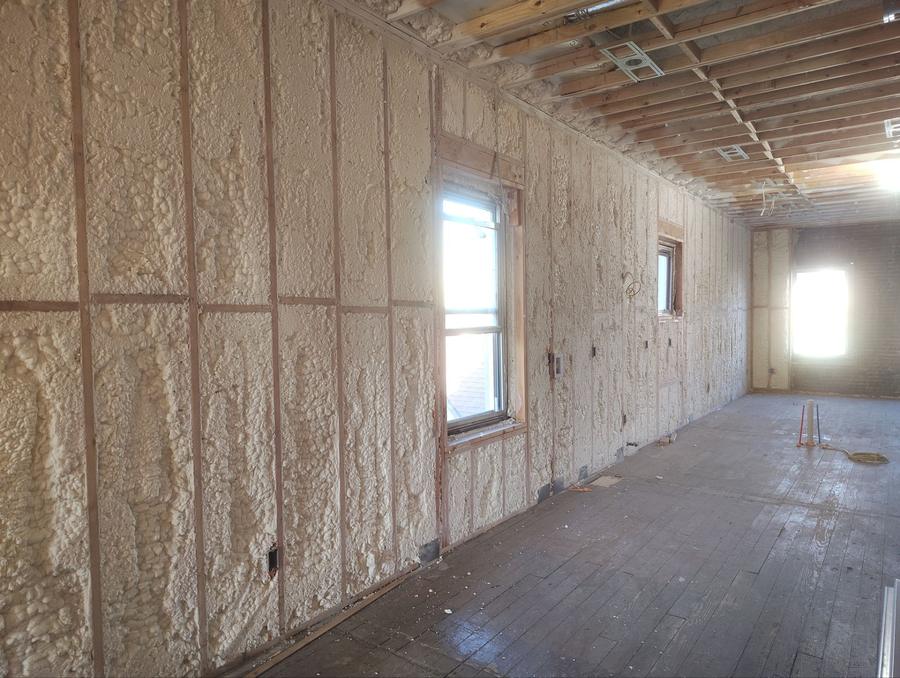
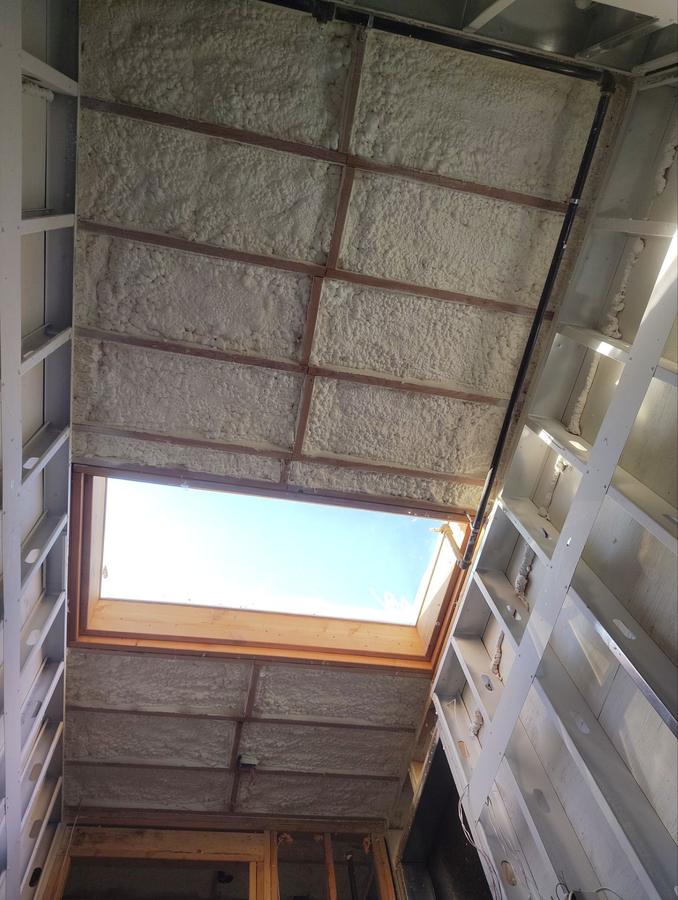
Solid masonry walls have no cavity, so nobody should be drilling the front of your building. The two assemblies that matter are the roof and the cellar. Over the top floor there is normally a cockloft, a shallow space between the ceiling joists and the roof deck. Where it has depth we air seal the top-floor ceiling plane and fill the cavity; where the deck sits nearly on the joists there is no room to work, and the correct answer is rigid insulation above the deck the next time the roof is replaced. Around the roof, the parapet, the stair bulkhead and the skylight curb are all air paths, and so is the light shaft that many of these buildings have between them.
The cellar is the other half of the job and often the faster win in a rowhouse: the rim and the joist pockets where the beams enter the masonry, the openings around the gas line and meter bank, the underside of the first floor above an unheated cellar, and the interior face of the foundation wall where headroom allows. Hoboken was originally an island with tidal land at the foot of the Palisades along its western side, and the low western streets show it — where a cellar has taken water we insulate what can dry and keep closed cell foam off a wall that floods.
The 31.7% built since 2000 is a different building entirely. Those units went up under modern energy codes with full walls, so wall insulation is not the job. In the low-rise new construction and in gut renovations the work is the party wall where it runs past the roof deck, the cathedral or tray ceilings framed without baffles, the ducts and air handler if they sit outside the insulated shell, and bath fans that stop in the roof cavity. In the towers there is no job for us at all.
The rowhouse, the association, and what one owner controls
Most Hoboken buildings above four units are condominium or co-operative associations, and in nearly all of them the roof, the facade, the party walls and the cellar are common elements. A single unit owner cannot authorize work on any of them, however cold the top-floor bedroom is. Anyone who tells you otherwise has not read your master deed.
What that means practically: if you own one apartment, the calls worth making are to your board and its engineer, and the work worth pushing for is a roof-deck insulation upgrade the next time the roof is redone, which costs almost nothing extra on a re-roof and changes the top floor permanently. We are happy to talk a board or a managing agent through a scope for the whole building — that is a job we can do — but it starts with the association, not with one owner.
If you own the whole building, all of it is yours to decide, and the 3,965 units in three- and four-unit buildings are where most of our Hoboken work sits. The rebate line falls in the same place: the utility program is written for owner-occupied buildings of one to four units, so a four-unit brownstone with the owner living in it qualifies and a six-unit one does not.
We seal before we insulate
Insulation slows heat moving through a surface. It does nothing about air moving through a gap. In a five-story rowhouse the stair is a chimney: warm air rises the full height and leaves through the bulkhead, the skylight curb and the ceiling of the top floor, pulling cold air in at the cellar door and the vault. Filling the cockloft without closing that path buys very little.
The order in a Hoboken rowhouse is: seal the top-floor ceiling plane, the top plates, the plumbing stack and the chimney chase; close the stair bulkhead and the skylight curb; seal the party wall where it passes the roof deck and the light shaft where it opens into the cockloft; vent the bath fans outside rather than into the roof cavity. Then the cellar: rim, joist pockets, the gas and meter penetrations, and the first-floor deck. Then insulate the cockloft or roof plane and the cellar assemblies.
If a quote specifies a depth of insulation and never mentions air sealing, it is half a job.
What insulation costs in Hoboken
Most of our projects run between $3,500 and $12,500. A rowhouse is priced as one building, because the stair, the cockloft and the floor cavities cross every apartment. What moves the number is the number of floors, whether the cockloft has depth enough to fill from inside, the amount of parapet, bulkhead and skylight detail at the roof, the length of rim in the cellar, and access on a street with no driveway and no side yard. For the foam side of the pricing, see what spray foam insulation costs.
Open cell foam runs R-3.9 to R-4.2 per inch. Closed cell runs R-6.9 to R-7.1 per inch and also acts as a vapor retarder, which is why it costs more and why it is right in some assemblies and unnecessary in others. All products are manufactured in the United States and meet applicable building code and safety standards. ENERGY STAR says sealing air leaks and adding insulation can save up to 10% on annual energy bills.
Insulation rebates in Hoboken
Hoboken is PSE&G territory for both electric and gas. With 37.4% of occupied units heating with electricity and 57.4% with gas, a lot of households here will be looking at the electric bill rather than the gas bill, and PSE&G bills both.
PSE&G Whole Home Energy Solutions offers up to $7,500 in rebates toward air sealing, insulation and related envelope work, plus 0% on-bill repayment of up to $25,000 — 7 years for projects of $10,000 or less, 10 years above that or for income-qualified customers. It is written for owner-occupied homes of one to four units, which in Hoboken means the 16.0% of the stock in two- to four-unit buildings and the 4.5% that is one-family. It starts with a home energy assessment by a BPI-certified contractor participating in PSE&G’s program, who sets the fee for it; PSE&G does not publish per-measure rebate amounts.
Income-qualified work costs nothing. PSE&G Home Weatherization performs insulation, air sealing and duct sealing free for households between 250% and 400% of the federal poverty level, and New Jersey Comfort Partners reaches at or below 250% of the federal poverty guidelines, $82,500 a year for a family of four, in buildings of 1 to 14 individually metered units — a wider net than the four-unit rebate ceiling, which matters in a city of five- and six-unit rowhouses. The Whole Home Energy Assessment from PSE&G is free in buildings of fewer than five units.
New Jersey’s IRA Home Energy Rebates have not opened — the state lists them as in development and is not accepting applications. The federal Section 25C tax credit ended for anything placed in service after 31 December 2025, so there is no federal credit on a 2026 job. Everything current is in our New York and New Jersey rebate guide.
Code and climate in Hoboken
53.4% of Hoboken was built before 1980, and the 33.2% that predates 1940 went up long before New Jersey’s first statewide energy subcode of 1 January 1978. A rowhouse from the Hoboken Land and Improvement Company era was built with masonry mass and nothing else between the apartments and the weather. Hudson County is climate zone 4A.
The 2024 IECC took effect in New Jersey on 17 August 2026. New construction gets R-49 ceilings in place of the R-60 the 2021 edition required, walls at R-30 in the cavity or R-20 plus R-5 continuous, windows at U-0.30 and a tested 3.0 air changes per hour at 50 pascals. A complete application under the older edition is still good until about 16 February 2027. R-49 is what we design to.
An existing rowhouse is regulated under New Jersey’s Rehabilitation Subcode. Insulating a cockloft under it does not require the rest of the building to be brought to current code, and no blower-door test is called for. Blown-in and batt material against the interior finish is ordinary maintenance needing no permit; spray foam and other foam plastic insulation need a permit, which we pull.
Common questions about insulation in Hoboken
Do you install insulation in Hoboken, NJ?
Yes, in buildings one owner controls: the 3,965 units in three- and four-unit buildings, the two-unit buildings, the 417 detached houses and the attached one-family houses. We do not work inside single apartments in larger buildings, where the roof, party walls and cellar are common elements and only the association or the landlord can authorize work. If you own the whole building, or you are a board looking at the roof, that is a job we can scope.
How much does insulation cost in Hoboken?
Most projects run $3,500 to $12,500, and a rowhouse is priced as one building because the stair, the cockloft and the floor cavities cross every apartment. The drivers are the number of floors, whether the cockloft has depth enough to fill from inside, how much parapet, bulkhead and skylight detail sits at the roof, the rim length in the cellar, and access on a street with no driveway. You get a written scope and a price after a free walk-through.
Are there insulation rebates in Hoboken?
Hoboken is PSE&G territory for gas and electric. PSE&G Whole Home Energy Solutions pays up to $7,500 in rebates and offers 0% on-bill repayment of up to $25,000 for owner-occupied buildings of one to four units, starting with an assessment by a participating BPI-certified contractor. PSE&G Home Weatherization and New Jersey Comfort Partners do the work at no cost for income-qualified households, and Comfort Partners reaches buildings up to 14 metered units. New Jersey’s IRA rebates have not launched, and 25C ended after 31 December 2025.
We own the top-floor condo in a brownstone and the ceiling is freezing. What can we do?
Check the master deed first. In most Hoboken associations the roof and the space under it are common elements, so the fix is a building decision rather than a unit decision. The best version of it is cheap: when the roof is next replaced, rigid insulation goes above the deck. Inside your own unit you can still seal the ceiling penetrations, the light fixtures and the bath fan, and insulate any interior soffit. We will put a scope in writing for your board.
Free energy audit in Hoboken
We start on the top floor: the ceiling plane, the stair bulkhead, the skylight curb and whatever depth the cockloft has. Then the party wall and the light shaft, then down the stair to the cellar for the rim, the joist pockets and the first-floor deck. Then you get a written scope and a price with the items that pay first at the top, and a plain answer about which parts belong to your association. No charge, no obligation.
Call 914-554-2289 or message us through the site; someone answers 8am–8pm, seven days. The crew is our own, 100-plus people out of New Rochelle, NY, never subcontracted.
Get my free estimateor call 914-554-2289, 8am–8pm every day