33.3% of Meriden’s occupied housing units heat with fuel oil. Gas heats 41.9%, electricity 18.7% and bottled gas 3.6%. Where that many households buy heat by the delivery, sealing and insulating is counted in gallons, and the saving shows up as fewer trips by the oil truck.
The Silver City has 26,804 housing units and a median year built of 1960. 48.6% of units are detached houses and 6.8% attached, while 13.1% are in two-unit buildings and 10.6% in three- and four-unit buildings, the multifamily houses of a manufacturing town. 59.9% of occupied units are owner-occupied. Buildings of fifty units or more hold 8.7% of the city’s housing, and in those the roof and the exterior walls belong to the owner or the association.
The houses we insulate in Meriden
By era, 26.7% of Meriden predates 1940, 23.8% is from the 1940s and 50s, 23.9% from the 1960s and 70s, 19.1% from the 1980s and 90s and 6.5% has been built since 2000. The decades are lopsided: the 1950s built 15.9% of today’s stock and the 1980s 14.6%, while the 1990s built only 4.5%.
The pre-1940 city is the one the silver, lamp, glass and musical-instrument factories built after Meriden became a city in 1867. The entrepreneurs’ mansions and houses of note went up particularly on Broad Street, and the two- and three-family houses of the same era housed the people who worked in the factories. In any of them we assume balloon framing, with stud bays open from the cellar to the attic, and knob-and-tube wiring until we see otherwise. No wall gets filled until live knob-and-tube has been taken out of service. A large Victorian house loses heat through a steep attic with little in it, walls with nothing in them, a porch roof framed into the wall, and a cellar rim open to the outside.
The 1940s and 50s houses are capes and small ranches. The cape fails at the knee wall, with no air barrier behind it and the joist bays under it open to the eave, and at an unbaffled slope that leads to a shallow flat attic. The 1960s and 70s brought raised ranches and splits, with a family room at grade, a bedroom over the garage and a long attic of settled loose-fill.
The 1980s boom left colonials, contemporaries with cathedral ceilings, and townhouses. A cathedral ceiling of that era has batts packed tight to the roof deck with no vent space, and the ridge shows it in snow melt and ice. Townhouses share a party wall that often runs open into a common attic, and the attic air handler and ductwork sit outside the insulation.
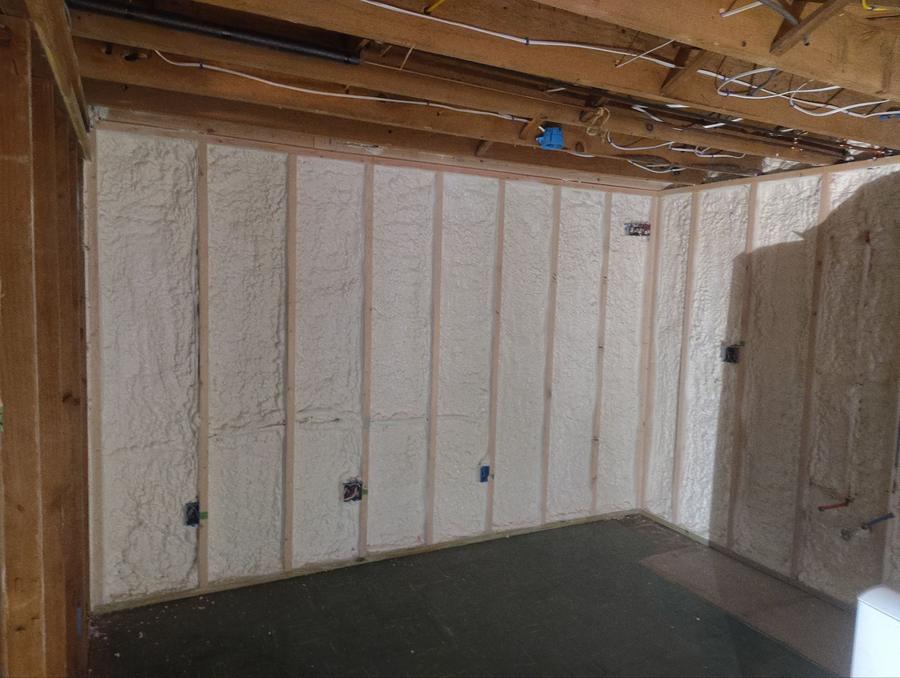
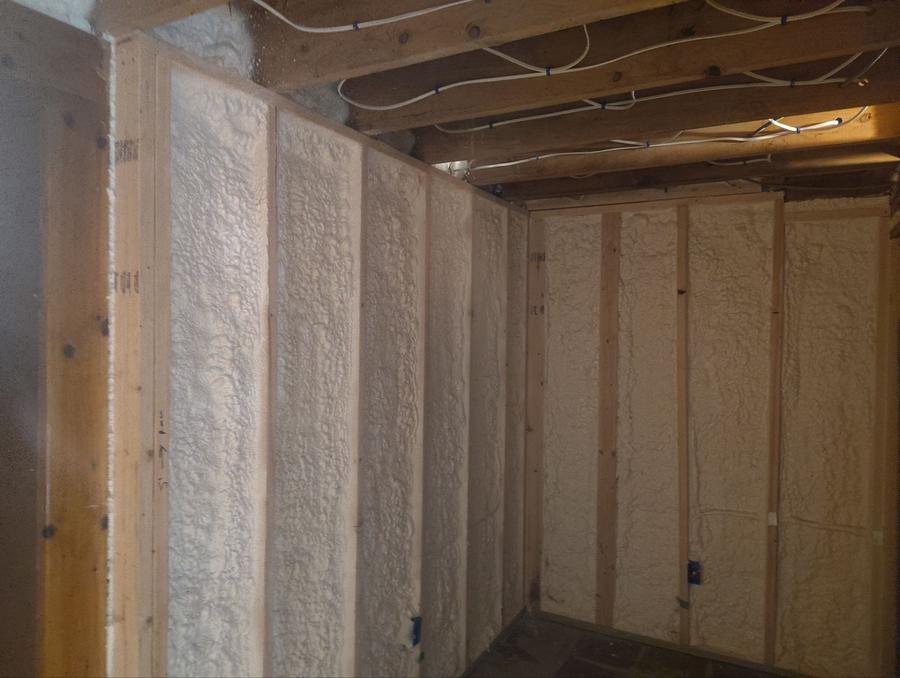
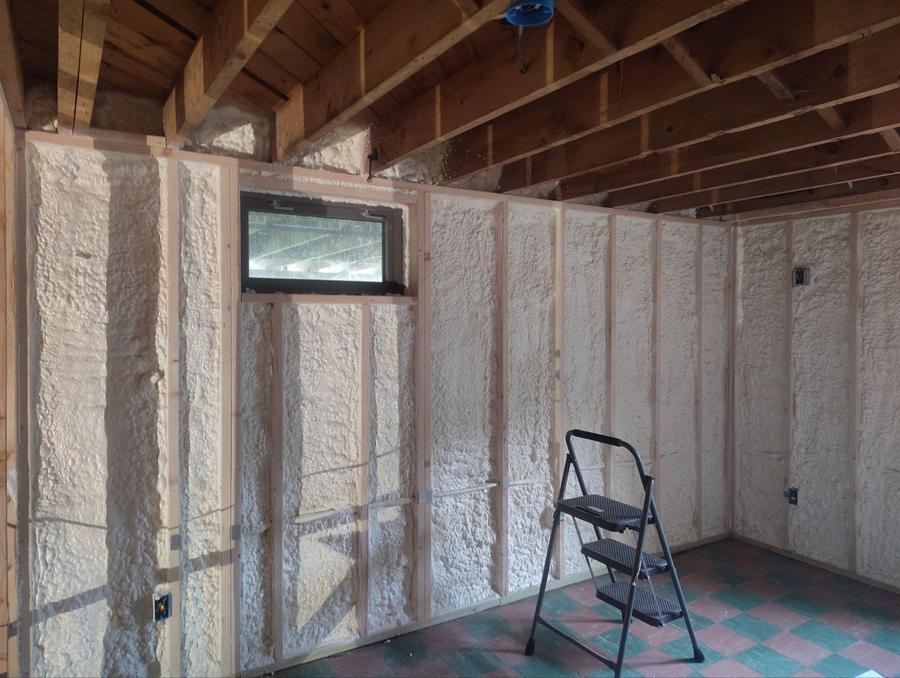
South Meriden takes in the southwest of the city, where the Quinnipiac River runs through a gorge, and Harbor Brook crosses Meriden to Hanover Pond. Wherever a cellar stays damp, it gets closed cell foam at the rim and the first-floor deck rather than anything fibrous.
Oil heat, chimneys and the order of the work
An oil-heated Meriden house raises two questions a gas-heated suburb seldom asks. The first is payback. Oil is bought by the delivery, so every leak closed and every inch of attic insulation added reduces the number of deliveries across a winter. The house that loses the most heat through its attic, rim and walls sees the biggest change, which usually means the older the house, the faster the return.
The second is the chimney. An oil boiler or furnace venting up a masonry chimney depends on the house’s air to draft properly, and the chimney chase is also one of the biggest holes between the cellar and the attic. We close the gap around a chimney with sheet metal and fire-rated sealant, never foam, and keep insulation back from the flue. After a house has been tightened, the heating system should be checked for safe draft; the Home Energy Solutions visit also begins with health and safety tests.
None of that changes eligibility. Home Energy Solutions is open whatever fuel heats the house, so an oil-heated Meriden home can apply through its Eversource electric account.
We seal before we insulate
Insulation slows heat moving through a ceiling or wall. It does not stop air, and air carries more heat out of an old house than conduction does. Blow insulation over an unsealed attic floor and the warm air keeps rising through it.
In a pre-war Meriden house the order is: seal the chimney chase with sheet metal and fire-rated sealant, then the top plates, the plumbing stack, the light boxes and the attic hatch; block the balloon-frame stud bays at the attic floor and the cellar sill; seal the rim joist; then insulate the attic floor and dense-pack the walls. In a 1950s cape it starts at the knee walls and the eave.
If a quote specifies a depth of insulation and never mentions air sealing, it is half a job.
What insulation costs in Meriden
Most of our projects run between $3,500 and $12,500. In a Victorian or a two-family the number moves with the wall area to dense-pack, the height and shape of the attic, the porch tie-ins and any knob-and-tube wiring. A cape is priced on knee walls, slopes and the flat attic; a 1980s house on the attic area, a cathedral ceiling and the ductwork. See what spray foam costs for the foam side of the price.
Open cell foam runs R-3.9 to R-4.2 per inch. Closed cell runs R-6.9 to R-7.1 per inch and also acts as a vapor retarder, which is why it costs more and why it is right in some assemblies and unnecessary in others. All products are manufactured in the United States and meet applicable building code and safety standards. ENERGY STAR says sealing air leaks and adding insulation can save up to 10% on annual energy bills.
Insulation rebates in Meriden
Eversource delivers both electricity and gas in Meriden. Its efficiency offers are part of Energize Connecticut. Home Energy Solutions is open to customers of Eversource, United Illuminating, Connecticut Natural Gas and Southern Connecticut Gas, whatever fuel heats the house; the program is ideally suited to one- to four-unit homes, and a home that received its services within the last six years has to wait.
An authorized contractor performs the Home Energy Solutions assessment, and since 1 April 2026 the homeowner pays a $40 copay for it. Safety testing opens the visit. A blower door pinpoints drafts and air leaks, homes with forced hot air or central air get their ducts tested, and the contractor air-seals for up to seven hours at no charge, charging $10 an hour if a larger or older home needs longer. A house built prior to 1985 may be put on a two-visit schedule, which is mandatory for two- to four-unit buildings. Expect the possibility of a waiting list; the program runs on available funding.
The 2026 Energize CT insulation rebate covers attic floors, floored-over attics, walls, rim joists and garage and basement ceilings at up to $2.00 per square foot, but never more than 75% of the total cost and never more than $10,000 in all. Every address in Meriden is in a state-designated environmental justice community, which can raise the Energize CT insulation incentive to $2.50 per square foot, up to $15,000. Three steps are required: the insulation is recommended during the Home Energy Solutions visit, the project is approved before installation, and the installation is performed by an approved contractor from the Energize CT Insulation Installers Network. The qualifying list does not include foam on the underside of a roof deck, so check with the program before you count on a rebate there.
Income decides which of three tiers applies. On Energize CT’s 2026–2027 figures for a one-person household, $48,714 or less is Income Eligible, with a no-cost visit and up to 100% of insulation costs covered; $48,715 to $64,953 is Enhanced Incentives, with a no-cost visit and insulation at up to $2.50 per square foot, the actual range depending on the zip code; $64,954 and above is the standard visit. A household near one of those limits should find out its tier before paying anything, since the middle tier gets a no-cost visit and a higher insulation incentive.
To spread the cost, the Connecticut Green Bank’s Smart-E Loan lends as much as $50,000, with no money down, to the owner-occupant of a one- to four-unit Connecticut home. Rates are 6.99% APR on 5-, 7- and 10-year terms, 7.49% on 12 years and 7.99% on 15 years, though not every lender offers 15. The loan is set up by the Green Bank’s participating contractors; ask whether your contractor participates.
The Home Energy Solutions visit is done by the program’s own contractors, and the rebate is paid only when a network installer does the work. Ask any installer who quotes, including us, whether they are in that network, and compare prices after any rebate before you decide. On the federal side, Section 25C stopped applying to anything placed in service after 31 December 2025. There is no federal tax credit for insulation installed in 2026, whatever an old ad says. Every Connecticut program is laid out in our Connecticut rebate guide.
Code and climate in Meriden
74.3% of Meriden’s housing was built before 1980. Meriden, like every Connecticut town, is in climate zone 5A.
Since 1 October 2022 the 2022 Connecticut State Building Code has been in force, taking its energy rules from the 2021 International Energy Conservation Code plus Connecticut’s amendments. On a new house or addition, the ceiling calls for R-60, and R-49 is accepted where it runs at full height, uncompressed, over the top plate at the eaves. Walls take R-20 plus R-5 continuous, R-13 plus R-10 continuous or R-30 in the cavity. Floors take R-30, basement walls R-15 continuous or R-13 plus R-5 continuous, and windows U-0.30. The finished house has to test at 3.0 air changes per hour at 50 pascals on the prescriptive path, and never worse than 5.0. Connecticut’s next code, based on the 2024 IECC, has been adopted in draft, but its effective date has been delayed.
Common questions about insulation in Meriden
Do you install insulation in Meriden, CT?
Yes. In Meriden we insulate the pre-war Victorians and two- and three-family houses, the 1950s capes and ranches, the raised ranches and splits of the 1960s and 70s, and the 1980s colonials, contemporaries and townhouses, from Meriden Center to South Meriden. Detached houses are 48.6% of the stock, and we treat each two- or three-family as a single building.
How much does insulation cost in Meriden?
Most projects run $3,500 to $12,500. For a Victorian or a two-family the drivers are the wall area to dense-pack, the attic’s height and shape, porch tie-ins and any knob-and-tube wiring. A cape is priced on knee walls, slopes and the flat attic, and a 1980s house on the attic area, any cathedral ceiling and the ductwork. We walk the house for free first and put the scope and price in writing.
Are there insulation rebates in Meriden?
Yes. Meriden is Eversource for electric and gas, and the Energize Connecticut assessment, Home Energy Solutions, is $40 unless your income puts you in a no-cost tier. Because the whole city is a state-designated environmental justice community, the insulation incentive can reach $2.50 per square foot and $15,000, provided the work was recommended at that assessment, approved in advance and installed by a member of the Energize CT Insulation Installers Network. No federal tax credit applies to insulation installed in 2026.
Our Meriden house heats with oil. Is insulation still worth it, and do the programs apply?
Yes to both. Home Energy Solutions and the Energize CT insulation rebate are open whatever fuel heats the house, and an oil-heated home can apply through its Eversource electric account. The payback is counted in deliveries: less heat lost through the attic, rim and walls means fewer fills over a winter. In an oil-heated house we seal the chimney chase with sheet metal and fire-rated sealant, keep insulation clear of the flue, and recommend checking the heating system’s draft once the house is tighter.
Free estimate in Meriden
We start in the cellar at the boiler or furnace, the chimney base and the rim joist, then go up to the attic to look at the chimney chase, the top plates and what insulation is left. In an older house we check the walls for balloon framing and wiring; in a cape, the knee walls. Then a written scope and a price, free and without obligation. That walk-through is our free estimate. It is separate from the program’s Home Energy Solutions assessment and does not make a house eligible for a rebate.
Reach us at 914-554-2289 between 8am and 8pm, seven days a week, or through the contact form. The Home Insulators is family-owned, runs out of New Rochelle, NY, and sends its own 100-plus in-house crew rather than subcontractors.
Get my free estimateor call 914-554-2289, 8am–8pm every day