New Britain has more homes in two-, three- and four-family houses than in detached ones. Of its 32,499 housing units, 5,770 are in two-unit buildings and 6,138 in buildings of three or four, 17.8% and 18.9% of the city, against 10,084 detached houses at 31.0%. The Hardware City grew around The Stanley Works, P&F Corbin, Landers, Frary & Clark and North & Judd, and the housing it left behind is old: 29.8% predates 1940, the median unit dates from 1956, and 82.2% was standing before 1980.
Only 43.6% of occupied units are owner-occupied, 12,771 of them, so in much of the city the household living inside is not the one who decides what gets done to the building. Buildings of fifty or more units hold 9.4% of the stock and buildings of five to nine another 9.9%; their owners are landlords and boards, and Energize Connecticut steers buildings of five or more units to a separate Multifamily Initiative.
Gas heats 66.1% of occupied units, electricity 16.3%, fuel oil 12.1% and bottled gas 4.1%. For most owners the saving shows on the gas bill; for a household on oil or bottled gas it shows as fewer deliveries over a winter.
The houses we insulate in New Britain
Beyond the 29.8% that predates 1940, 27.3% of New Britain is from the 1940s and 50s, 25.1% from the 1960s and 70s, 13.1% from the 1980s and 90s and 4.7% has been built since 2000. By 1930 a quarter of the city was ethnically Polish, and the Broad Street area, designated “Little Poland” by the city council in 2008, has been home to Polish families and businesses since 1890.
The pre-1940 two- and three-family is the center of our New Britain work. It is usually wood frame, with a stair hall running the full height of the house, a porch stacked on each floor, and a cellar holding one boiler for the building or one per apartment. The walls are balloon-framed: stud bays open from the cellar sill to the attic, usually empty, often behind vinyl, aluminum or asbestos siding laid over the original clapboard. Until we have seen inside, we treat the wiring as knob-and-tube, and any live knob-and-tube is retired before a bay is filled.
The leaks in that house are predictable: the tops of the open wall bays, the stair hall where it meets the roof, the porch roofs that tie into the wall cavities, the chimney chase, and a cellar rim of bare wood on stone. The top-floor apartment is the coldest in January and the hottest in July, and the fix for that apartment is in the roof cavity above it.
The 1950s and 60s, 18.8% and 14.1% of the city, added the capes and ranches of the single-family streets. A cape loses heat at its knee walls, insulated on the bedroom side with nothing behind them, with joist bays open to the eave under the floor and unbaffled slopes above. A ranch loses it across a long, low attic of settled loose-fill, with an open hole around every ceiling light and vent pipe.
Then a burst of building that did not last: 10.5% of New Britain went up in the 1980s and only 2.7% in the 1990s. Those houses have insulation in the walls already, so the job is air sealing at the attic hatch, top plates, recessed lights and bath fans, over an attic that often holds R-19 or less. In the city’s 1,383 attached single-family homes, add the party wall where it rises into a shared attic.
The New Britain two-family: who owns it, who heats it
In a two- or three-family the first question is not the attic. It is who can say yes, and who pays for the heat. The owner who lives there can decide for the whole building. A tenant cannot, and Home Energy Solutions requires a renter to get the landlord’s approval. If you rent and your apartment is cold, call your landlord.
The second question decides the payback. Where each apartment has its own boiler and its own gas account, the tenants’ bills fall when the walls and roof are done, and the owner’s return is a building that is easier to rent and cheaper to keep. Where one boiler in the cellar heats every floor, the whole saving lands on the owner’s bill. Either way the building is scoped as one job, because the stair hall, the porches and the wall bays run through every apartment.
We seal before we insulate
Insulation resists heat soaking through a wall or ceiling. It cannot stop air, and in a balloon-framed house moving air is the bigger loss, because every open stud bay works like a flue from the cellar to the attic.
In a New Britain two- or three-family we work from the bottom up: close the stud bays at the cellar sill and seal the rim; cap the bays and top plates from the attic or roof cavity; seal the stair hall ceiling, the chimney chase and the plumbing stack; block the spots where porch roofs open into the walls; only then dense-pack the walls, floor by floor, and insulate over the top apartment.
If a quote specifies a depth of insulation and never mentions air sealing, it is half a job.
What insulation costs in New Britain
Most of our projects run between $3,500 and $12,500. One price covers a two- or three-family, driven by how many stories of wall need filling, whether the bays are reached under vinyl or aluminum siding or through plaster, how big and how reachable the roof cavity over the top floor is, and any knob-and-tube that has to be dealt with first. A 1950s cape or ranch is usually a smaller scope. Foam numbers are on the spray foam cost page.
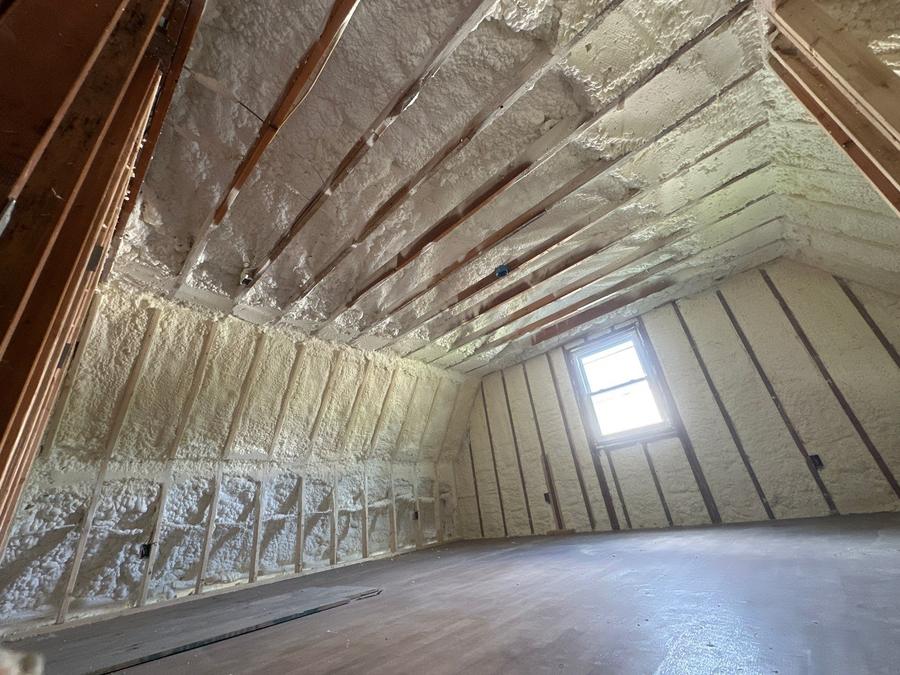
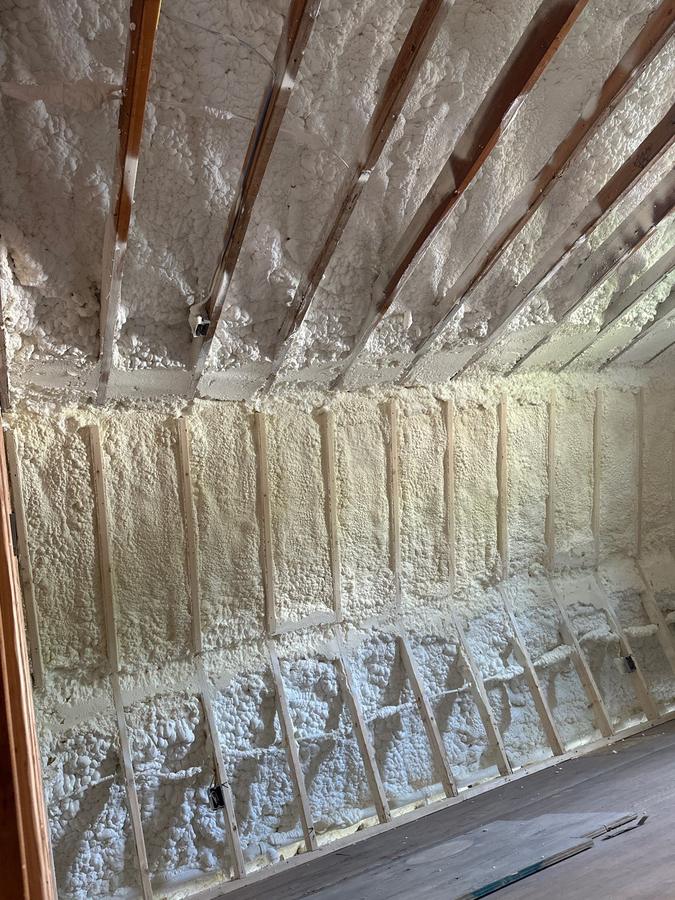
Open cell foam runs R-3.9 to R-4.2 per inch. Closed cell runs R-6.9 to R-7.1 per inch and also acts as a vapor retarder, which is why it costs more and why it is right in some assemblies and unnecessary in others. All products are manufactured in the United States and meet applicable building code and safety standards. ENERGY STAR says sealing air leaks and adding insulation can save up to 10% on annual energy bills.
Insulation rebates in New Britain
Electricity in New Britain comes from Eversource and gas from Connecticut Natural Gas (CNG). Home Energy Solutions is open to customers of Eversource, United Illuminating, Connecticut Natural Gas and Southern Connecticut Gas, and the heating fuel does not change that, so the owner of a two-family on oil can enroll with the Eversource account. The program covers buildings of one to four units.
Step one is the Home Energy Solutions assessment. An authorized contractor comes out for a $40 copay, in effect since 1 April 2026, checks health and safety, uses a blower door to find the leaks, tests the ducts where there is forced hot air or central air, and does up to seven hours of air sealing free, charging $10 an hour past that. A two- to four-unit building always takes two visits. Expect a possible waiting list; the program runs on available funding.
Step two is the 2026 Energize CT insulation rebate. It pays $2.00 per square foot or 75 percent of total cost, whichever is less, up to $10,000, for insulation in attic floors, floored-over attics, walls, basement and garage ceilings and rim joists, and a wall qualifies when it holds R-4 or less and ends at R-13 or more, which describes an empty balloon-framed wall. Every address in New Britain is in a state-designated environmental justice community, which can raise the Energize CT insulation incentive to $2.50 per square foot, with a ceiling of $15,000. Three rules are fixed: the assessment must recommend the insulation, the program must approve it before anyone installs it, and the installer must be an approved contractor from the Energize CT Insulation Installers Network. The underside of a roof deck is not a listed area, so before counting on money for foam there, ask the program.
Where a household falls depends on income. Take a household of five on Energize CT’s 2026–2027 figures: up to $108,669 is Income Eligible, with no-cost service and up to 100 percent coverage of insulation costs; $108,670 to $144,893 is Enhanced Incentives, a no-cost assessment and up to $2.50 per square foot, in a default band that moves with the zip code; $144,894 or more is the standard tier. A household close to a line should ask for its tier before paying anything.
One more question comes before signing anything: is the installer in the Insulation Installers Network? The rebate is paid only on network work, so ask everyone who quotes, us too. For the balance, the Connecticut Green Bank’s Smart-E Loan offers no-money-down financing up to $50,000 on owner-occupied homes of one to four units: 6.99% APR for 5, 7 or 10 years, 7.49% for 12 and 7.99% for 15 where the lender offers that term, arranged through participating contractors. Federal help is over. Section 25C does not cover anything placed in service after 31 December 2025, so no federal tax credit applies to insulation installed in 2026. The rest is in our Connecticut insulation rebate guide.
Code and climate in New Britain
New Britain had built 82.2% of its housing before 1980. The whole state, Hartford County included, is climate zone 5A.
What a new house or addition must meet is set by the 2022 Connecticut State Building Code, the 2021 International Energy Conservation Code as amended by the state, for applications filed from 1 October 2022 on. Ceilings: R-60, or R-49 when its full uncompressed thickness runs out over the top plate at the eaves. Wood-frame walls: R-30 in the cavity, R-20 in the cavity plus R-5 continuous, R-13 plus R-10 continuous, or R-20 continuous. Floors: R-30. Basement walls: R-15 continuous, R-19 in the cavity, or R-13 in the cavity plus R-5 continuous. Windows: U-0.30. Air leakage: 3.0 air changes per hour at 50 pascals in a blower-door test on the prescriptive path, and never more than 5.0 on any path. An update based on the 2024 IECC has been adopted in draft, but its effective date has been delayed.
Common questions about insulation in New Britain
Do you install insulation in New Britain, CT?
Yes. We insulate New Britain’s two-, three- and four-family houses, 17.8% of the city’s units in two-unit buildings and 18.9% in buildings of three or four, and its single-family capes, ranches and newer houses. In a larger building the roof and the outside walls belong to the owner or the association, and in a rental it is the owner, not a tenant, who decides; one phone call settles what your building needs.
How much does insulation cost in New Britain?
Most of our projects fall between $3,500 and $12,500. For a pre-1940 two- or three-family, one price covers the building, set by how many stories of empty wall need dense-packing, how the bays are reached, under a lifted course of siding or through plaster, how much roof cavity sits over the top apartment, and whether old wiring has to be retired first. A 1950s cape or ranch usually lands lower: knee walls or attic floor, the bypasses and the cellar rim.
Are there insulation rebates in New Britain?
Yes. New Britain homes have Eversource electricity and Connecticut Natural Gas, and either account can book an Energize Connecticut Home Energy Solutions assessment for $40, or at no cost for income-qualified households. Because the entire city is a state-designated environmental justice community, the insulation incentive can rise to $2.50 per square foot, to $15,000, provided the assessment recommends the work, the program approves it first and an Energize CT Insulation Installers Network contractor installs it. No federal tax credit applies to insulation installed in 2026.
Our New Britain two-family has vinyl siding over the old clapboard. Can the walls still be filled?
Usually. Vinyl and aluminum siding come off in courses and go back on, so we lift a course, drill through the clapboard beneath, dense-pack each bay, plug the holes and rehang the siding. Before any of that we check three things: that the bays are open and not already filled, that no live knob-and-tube wiring runs in them, and that the top and bottom of each bay can be sealed so warm air stops rising through the wall. Asbestos shingles are different. We do not drill them, and those walls are filled from inside.
Free estimate in New Britain
We call it our free estimate, and it is only that: not a Home Energy Solutions assessment, and no route to a rebate. In a two- or three-family it runs bottom to top, from the sill and rim in the cellar, past the stair hall and porches, to the roof cavity over the top apartment, checking under a siding course for empty bays and old wiring. You get a written scope and price, free, with nothing to sign.
Reach us at 914-554-2289 from 8am to 8pm, seven days a week, or through the contact form. The Home Insulators has been family-owned since 2015 and is based in New Rochelle, NY, and the 100-plus people who do the work are our own crew, never subcontractors.
Get my free estimateor call 914-554-2289, 8am–8pm every day