1,523 of Old Saybrook’s 5,983 housing units were counted vacant, against 4,460 occupied. The town sits on the west bank of the Connecticut River where it flows into Long Island Sound, and in a shoreline town a vacant count that size usually means second homes: houses lived in for part of the year and closed for the rest. That changes what insulation is for.
86.3% of units are detached houses, two-unit buildings are only 0.5%, and 85.4% of occupied homes are owner-occupied. The median unit dates from 1967. The 1950s built 15.9% of today’s stock and the 1960s 16.0%, and 19.1% predates 1940. Fuel oil heats 54.6% of occupied homes, with electricity at 13.8%, utility gas 13.7% and bottled gas 13.6% close behind one another. In an oil-heated house the savings show up as a tank that lasts longer between fills.
The houses we insulate in Old Saybrook
The Saybrook Colony was established here in late 1635, at the mouth of the Connecticut River, and its seal gave Connecticut its flag. The Collegiate School that became Yale was chartered in Old Saybrook in 1701 before moving to New Haven in 1716. The National Register list runs from the Black Horse Tavern, the Humphrey Pratt Tavern and the General William Hart House to the Old Saybrook South Green and the Lynde Point and Saybrook Breakwater lighthouses.
In the 1,142 homes built before 1940 we expect old assemblies. A colonial-era house may have a large central chimney with open gaps beside it at every floor, a timber frame whose walls hold little or nothing, and an attic floor with no air barrier at all. A later house brings balloon framing, stud bays open from sill to attic. We block those bays top and bottom before filling them, dense-pack walls from inside or behind lifted clapboards, and treat knob-and-tube wiring as live until an electrician has retired it.
The 1950s and 60s, 954 and 956 units, are the largest block of the town, the era of capes and ranches. A cape from those years loses its heat at the knee walls, where the small attic spaces behind the upstairs rooms open into the floor below through unblocked joist bays. A ranch loses it through a ceiling full of light boxes and pipe holes into an attic whose original insulation has settled thin. A house of either kind set over a crawl space or on piers near the water adds a floor that is cold from below.
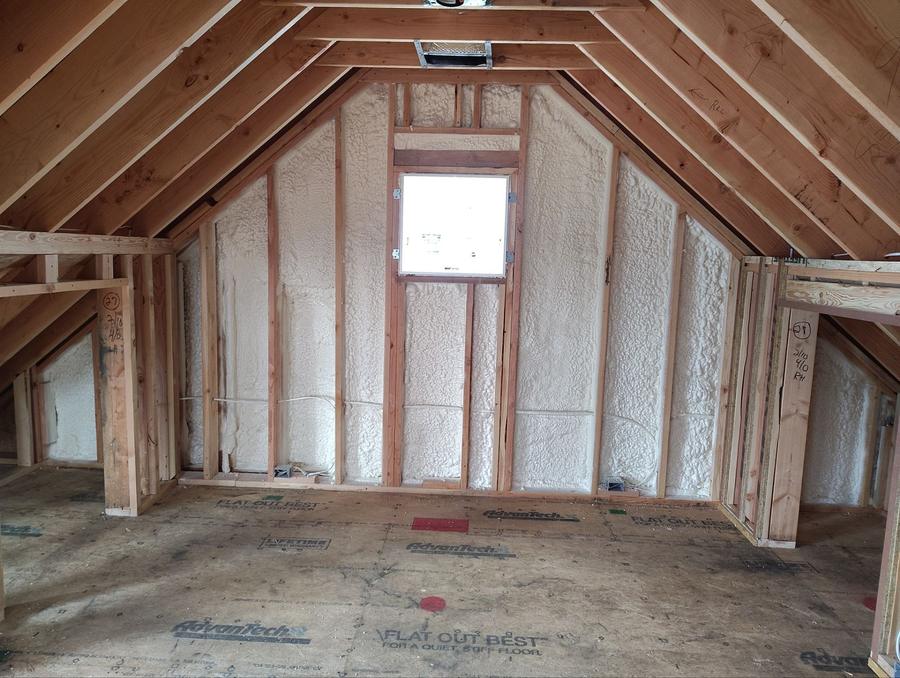
The 1970s added 14.0% of units and the 1980s 14.3%. Those houses were built with insulated walls, so their losses are attic bypasses, cathedral ceilings with no vent space, bonus rooms over garages and ductwork run through a hot attic. These types turn up across the town’s communities, from the Borough of Fenwick, where Katharine Hepburn lived, to Chalker Beach, Cornfield Point and Saybrook Manor.
Houses that sit empty part of the year
Before we scope an Old Saybrook house we ask how it is used in winter, because a second home can be in one of three situations, and each calls for different work.
Heated low all winter. A house kept at a setback temperature still burns fuel every empty day, and a leaky one burns a lot. Air sealing and attic insulation cut that standing cost, and the rooms recover faster when someone arrives. The weak point is the plumbing: pipes in an exterior wall, under a cantilever or in a vented crawl space can freeze even with the thermostat set well above freezing. Those runs have to end up on the warm side of the insulation, or the crawl space has to be brought inside it.
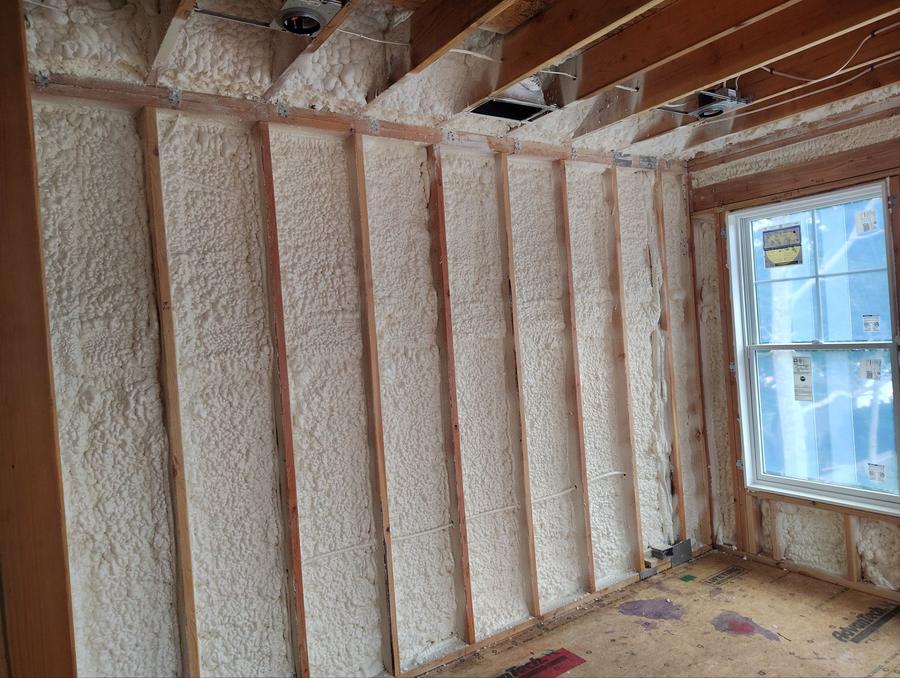
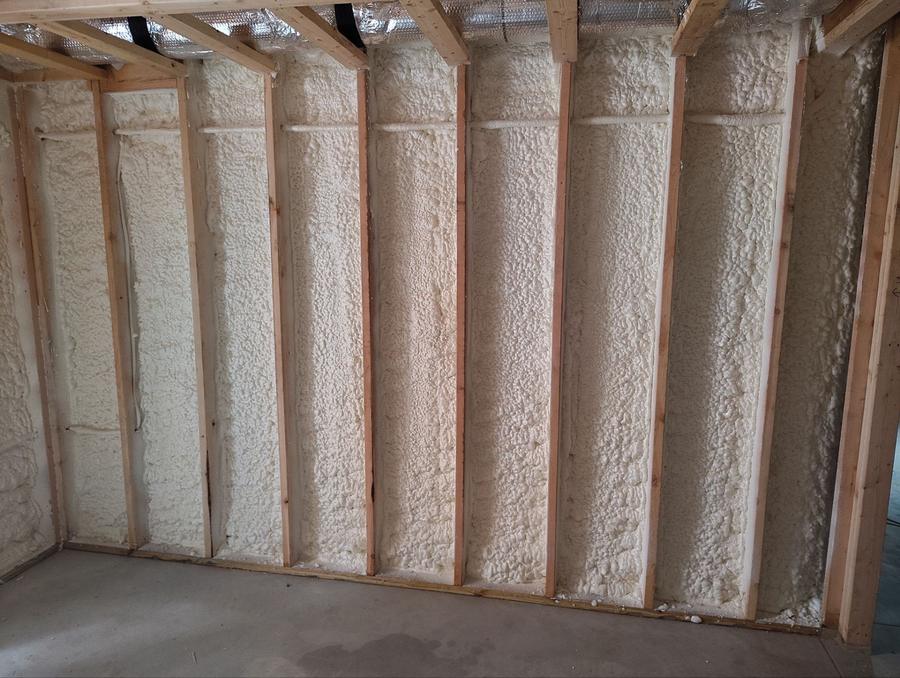
Drained and shut. A house winterized and left unheated gains little from insulation in January. Its risk is summer. A closed house in a humid shoreline summer holds moisture, and a vented crawl space under it can stay damp enough to wet the floor framing and the fiberglass hanging between the joists. For that house the useful work is often to close the crawl space, cover the ground, insulate the crawl space walls with closed cell foam and plan how the space will be kept dry.
Becoming a year-round home. When a summer house becomes a primary residence, everything built for July is tested in January: thin walls, a floor over piers or a crawl space, a low roof with little attic, and additions built one at a time over the decades. The conversion is the moment to insulate walls and rafters while they are open, and an addition built along the way falls under the new-construction values in the code section below.
We seal before we insulate
Insulation resists heat moving through a surface. It does not stop air, and at the mouth of the river, wind off the Sound finds every gap a house has.
In a 1950s cape the order is: put a rigid air barrier on the attic side of the knee walls, block the joist bays where they open to the eave under the upstairs floor, close the chimney at each floor with sheet metal, seal the top plates and the plumbing and wire holes in the flat attic above, baffle the rafter slopes from soffit to ridge, then insulate the knee walls, slopes and flat attic, and finish at the rim joist or the crawl space below.
If a quote specifies a depth of insulation and never mentions air sealing, it is half a job.
What insulation costs in Old Saybrook
Most of our projects run between $3,500 and $12,500. A 1950s cape is priced on its length of knee wall and eave and the slopes above; a ranch on its attic area. A second home turns on the crawl space: whether the floor above it is insulated or the crawl space is closed and its walls foamed. A pre-1940 house is priced on its walls, its chimney and whether old wiring must be retired first. Our spray foam cost guide covers foam pricing.
Open cell foam runs R-3.9 to R-4.2 per inch. Closed cell runs R-6.9 to R-7.1 per inch and also acts as a vapor retarder, which is why it costs more and why it is right in some assemblies and unnecessary in others. All products are manufactured in the United States and meet applicable building code and safety standards. ENERGY STAR says sealing air leaks and adding insulation can save up to 10% on annual energy bills.
Insulation rebates in Old Saybrook
Old Saybrook is Eversource for electricity and Southern Connecticut Gas (SCG) for gas, both inside Energize Connecticut. Home Energy Solutions is open to customers of Eversource, United Illuminating, Connecticut Natural Gas and Southern Connecticut Gas, whatever fuel heats the house, and with utility gas in 13.7% of homes most households will apply through their Eversource electric account. The program is ideally suited to one- to four-unit homes, a renter needs the landlord’s approval, and a home that received these services within six years has to wait.
A standard Home Energy Solutions visit carries a $40 copay, effective 1 April 2026. An authorized contractor does health and safety tests, a blower-door test to pinpoint drafts and air leaks and a duct test where there is forced hot air or central air conditioning, air-seals at no cost for up to seven hours with a $10 hourly fee after that, and leaves a report of recommended upgrades, rebates and financing. The program may recommend two visits for a home built before 1985. There may be a waiting list, and the program is subject to available funding.
The 2026 Energize CT insulation rebate pays up to $2.00 per square foot or 75 percent of the total cost, whichever is less, with a maximum of $10,000, on attic floors, floored-over attics, walls, basement and garage ceilings and rim joists. Neither the underside of a roof deck nor a floor over a crawl space appears on that list by name, so ask the program before counting on a rebate for either. The insulation must be recommended during a Home Energy Solutions visit, the project approved before installation, and the work performed by an approved contractor from the Energize CT Insulation Installers Network.
Income sets the tier. On Energize CT’s 2026–2027 figures for a household of two, $63,703 or less is Income Eligible, with a no-cost visit and up to 100 percent coverage of insulation costs; $63,704 to $84,939 is Enhanced Incentives, with a no-cost visit and up to $2.50 per square foot, a range that depends on zip code; $84,940 and above is the standard tier. Near a limit, confirm the tier before paying a copay.
The rebate is paid only on work by network installers, so ask any installer, including us, whether they are in that network before you sign. The Connecticut Green Bank’s Smart-E Loan lends up to $50,000 with no money down, at 6.99% APR over 5, 7 or 10 years, 7.49% over 12 and 7.99% over 15 where the lender offers it, for an owner-occupied home of one to four units; for a second home, ask the lender how that rule applies. It goes through the Green Bank’s participating contractors, so ask whether yours participates. The Energize CT Micro Loan from Capital for Change lends up to $3,000 at 0% interest over 36 months to Eversource customers who own and occupy a one- to four-unit home, vacation homes included, for improvements recommended through Home Energy Solutions and installed by an approved contractor. There is no federal tax credit for insulation installed in 2026: Section 25C ended for anything placed in service after 31 December 2025. Our Connecticut rebate guide has more.
Code and climate in Old Saybrook
68.8% of Old Saybrook’s housing was built before 1980. The town averages about 90 days a year with freezing temperatures, about the same as Baltimore, and southern magnolias and windmill palms grow in its gardens, but under the building code it is climate zone 5A, like every town in Connecticut. The 2022 Connecticut State Building Code, which adopts the 2021 IECC with state amendments, covers applications filed from 1 October 2022.
New homes and additions need R-60 ceilings, with R-49 allowed where its full uncompressed depth extends over the wall top plate at the eaves; wood-frame walls of R-30 in the cavity, R-20 plus R-5 continuous, R-13 plus R-10 continuous or R-20 continuous; R-30 floors; basement and crawl space walls of R-15 continuous, R-19 in the cavity or R-13 plus R-5 continuous; and U-0.30 windows. A new home must pass a blower-door test at 3.0 air changes per hour at 50 pascals on the prescriptive path, and never worse than 5.0. Connecticut’s next code, based on the 2024 IECC, has been adopted in draft, but its effective date has been delayed.
Common questions about insulation in Old Saybrook
Do you install insulation in Old Saybrook, CT?
Yes. We insulate the capes and ranches of the 1950s and 60s, the older houses from colonials to balloon-framed village homes, the 1970s and 80s houses with their attic bypasses and cathedral ceilings, and homes in Fenwick, Chalker Beach, Cornfield Point, Saybrook Manor and the town’s other communities. A second home is planned around how it is used in winter: kept heated, drained and shut, or becoming a year-round house.
How much does insulation cost in Old Saybrook?
Most projects run $3,500 to $12,500. A 1950s cape is priced on its knee walls, eaves and slopes, a ranch on its attic area. For a second home the crawl space often decides the number: insulating the floor above it costs differently from closing it and foaming its walls. A pre-1940 house depends on its walls, its chimney and any old wiring. The walk-through is free, and the scope and price are written down.
Are there insulation rebates in Old Saybrook?
Yes, through Energize Connecticut. Old Saybrook is Eversource for electricity and Southern Connecticut Gas for gas, and Home Energy Solutions accepts any heating fuel, with a $40 copay on the standard visit. The 2026 insulation rebate pays up to $2.00 per square foot or 75 percent of cost, whichever is less, to $10,000, on work recommended at that visit, approved before installation and done by an Energize CT Insulation Installers Network contractor. There is no federal tax credit for insulation installed in 2026.
We own an older colonial in Old Saybrook. Can the walls be insulated without harming the house?
Often, with care. We look inside a wall before promising anything: some old walls have plank or brick-filled framing and no cavity worth filling, while stud and balloon-framed walls can be dense-packed through small holes from inside or behind lifted clapboards. Old walls dry through their surfaces, so nothing goes in that traps moisture on the cold side. The chimney, attic floor and rim usually come first, because they leak more air than the walls, and any knob-and-tube wiring is retired before the walls are touched.
Free estimate in Old Saybrook
An Old Saybrook walk-through starts with a question: how is the house used in winter? Then the attic or knee walls, the chimney, the crawl space or cellar and its pipes, the rim joist and the walls. You get a written scope and a price, at no charge. This is our free estimate; it is not the Home Energy Solutions visit and does not qualify a house for any rebate.
Call 914-554-2289, 8am–8pm, seven days, or use the contact form. We are based in New Rochelle, NY, and our 100-plus in-house crew never subcontracts.
Get my free estimateor call 914-554-2289, 8am–8pm every day