Ridgefield’s Main Street is 18th century. Your house probably is not, and that
is good news for what this costs. Only 12.1% of the town’s housing predates
1940 — roughly seven in eight Ridgefield houses went up after it —
and the median build year is 1973.
Which means the work here is mostly the unglamorous, cost-effective kind:
attic planes, rim joists and the surfaces around an attached garage.
The houses we insulate in Ridgefield
Ridgefield has 9,836 housing units, 78.2% detached and 84.2% owner-occupied.
36.7% went up in the 1960s and 70s, 61.5% predates 1980, and only 12.1%
predates 1940. There is more attached and multifamily housing here than in
Wilton or Weston — 380 one-unit attached homes and 697 units in two- to
four-unit buildings. The bulk of the town is 1960s to 80s colonials and raised
ranches in Ridgebury and the outlying subdivisions.
In those houses the same findings repeat. R-11 or R-13 in a 2×4 wall. Attic
loose-fill settled to four or five inches and wind-washed thin where the
rafters meet the top plate. And an attic plane that was never air sealed at
all: open top plates, a chimney chase running from the basement to the ridge,
and a pull-down stair with no insulated box over it and no weatherstrip
— which is a two-foot by four-foot hole in the ceiling of a heated
house.
Then the surfaces nobody quotes. Attached garages are close to universal here,
and the common wall between garage and house is rarely sealed at the top
plate, so a room above the garage ends up sitting over unconditioned space
with open framing on two sides of it. The 1970s and 80s contemporaries have
cathedral ceilings with insulation packed hard against the roof deck and no
vent channel behind it. And on the walk-out foundations the rim joist band is
usually bare, a continuous gap around the entire perimeter at the one line
where framing meets concrete.
There is a genuine antique stock in Ridgefield and we work on it:
post-and-beam frames with no cavity worth filling, center chimneys with open
framing gaps at every floor, additions from several eras. Those are air
sealing and attic-floor jobs, not dense-pack jobs. But they are one house in
eight. In the attached homes and the two- to four-unit buildings, the
recurring find is a party wall running straight up into a shared attic.
We seal before we insulate
Insulation slows heat moving through a surface. It does nothing about air
moving through a gap. Pack a leaky attic with cellulose and you have a leaky
attic with cellulose in it — the air still moves, it just moves through
something fluffier.
In a Ridgefield colonial the three that matter most are the pull-down stair,
the top plate above the garage common wall, and the rim joist. All three are
continuous openings between conditioned and unconditioned space, and all three
are routinely left alone by contractors who quote attic depth by the square
foot. We close them, along with the chimney chase, the framing above a dropped
soffit and the recessed lights. Then we insulate.
If a quote specifies a depth of insulation and never mentions air sealing, it
is half a job.
What insulation costs in Ridgefield
Most of our projects run between $3,500 and $12,500. The
common Ridgefield job is a favorable one: a 1970s colonial or raised ranch
with an open attic sits near the bottom of that range, because there is
nothing unusual to work around. What pushes a number up is a cathedral ceiling
with no vent channel, a room over the garage, or a finished third floor.
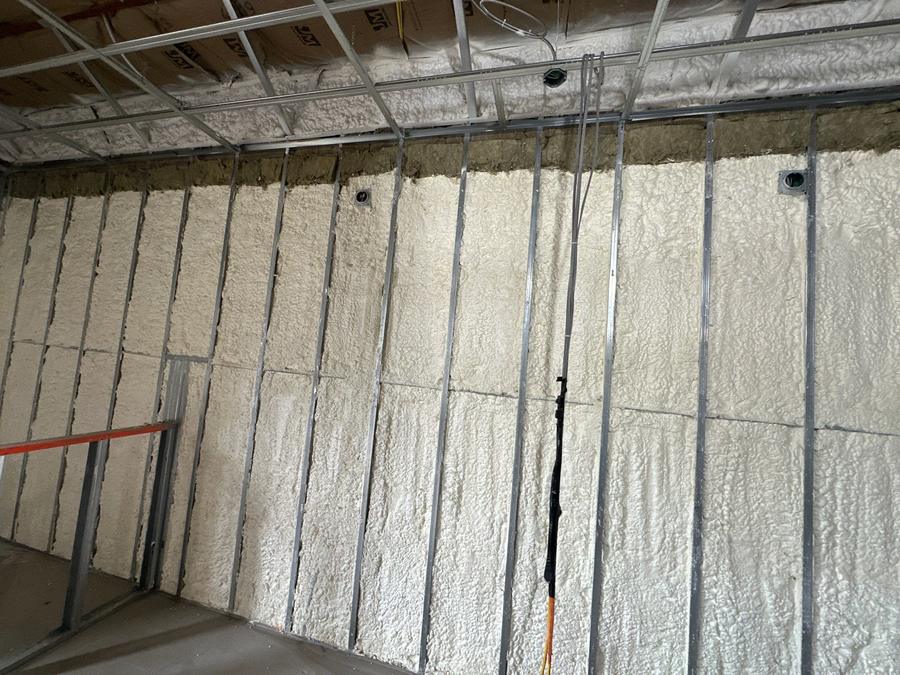
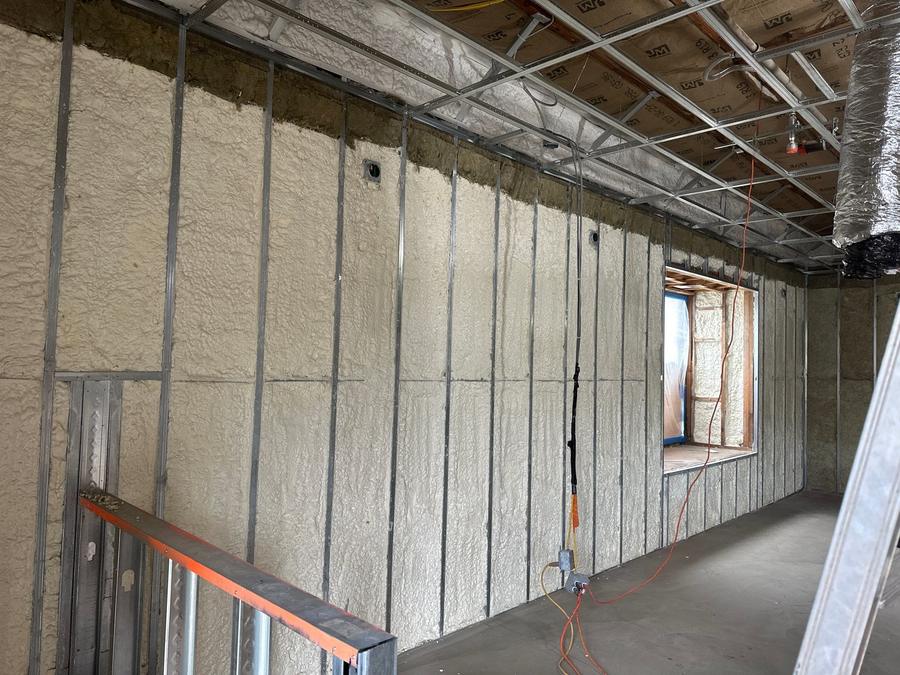
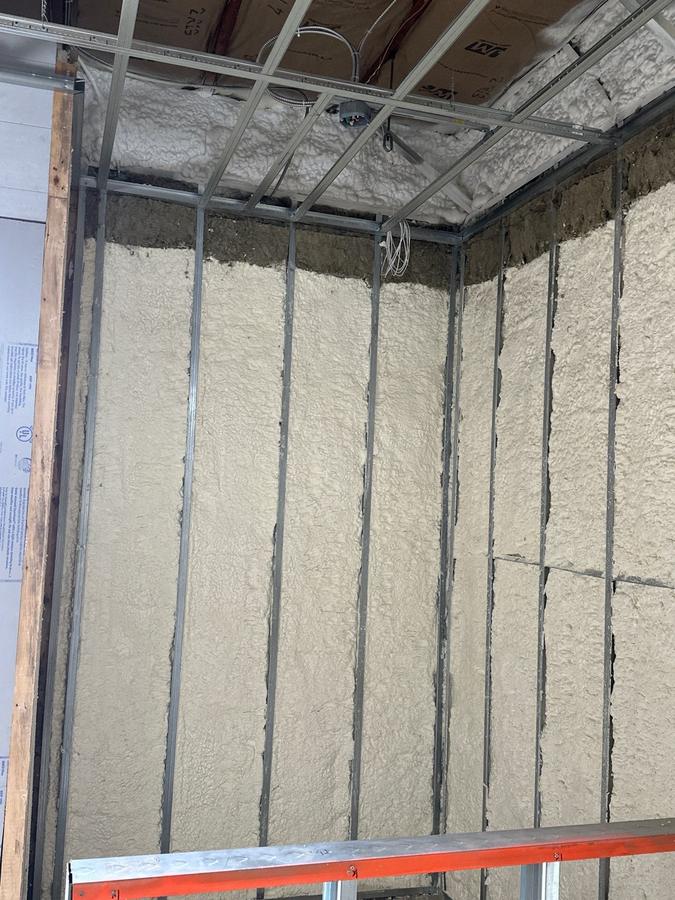
Open cell foam runs R-3.9 to R-4.2 per inch. Closed cell runs R-6.9 to R-7.1
per inch and also acts as a vapor retarder, which is why it costs more and why
it is right in some assemblies and unnecessary in others. All products are
manufactured in the United States and meet applicable building code and safety
standards. ENERGY STAR says sealing air leaks and adding insulation can save up to 10% on annual energy bills.
Insulation rebates in Ridgefield
Ridgefield is Eversource territory, so incentives here run
through Energize Connecticut. The order is not negotiable: a Home
Energy Solutions visit first (the homeowner copay has been
$40 since April 2026), insulation recommended during that
visit, the project approved before anyone installs anything, and a contractor
on the Energize CT Insulation Installers Network.
The rebate is $2.00 per square foot or 75% of the job, whichever is
less, up to $10,000, and $2.50 per square foot up to
$15,000 for income-qualified households and homes in designated
environmental justice communities. Households under 60% of state median income
can qualify for HES-Income Eligible, which covers approved insulation up to
100%.
The scope rule works in Ridgefield’s favor, because the measures this town
actually needs are the covered ones. Attic floors, floored-over attics, above- and below-grade walls, basement and garage ceilings and rim joists qualify, which takes in the attic
plane, the garage ceiling under a bedroom and the basement ceiling.
Attic roof decks and rafters do not qualify — so if the
fix for your 1970s cathedral ceiling is foam at the rafters, that is a real
measure but not a rebated one. Crawl spaces are not on that list either. A crawl space ceiling may or may not be accepted as a floor over unconditioned space depending on how the job is written up, so if the crawl is the work, confirm it with the program before installation rather than after. See the full Connecticut rebate guide
for the mechanics.
The federal Section 25C tax credit ended for anything placed in service after
31 December 2025. There is no federal insulation credit on a
2026 job.
Code and climate in Ridgefield
The median Ridgefield house dates from 1973 and 61.5% of the town predates
1980, so the code that governs new construction here has had very little to do
with the houses people own. That code is the 2022 Connecticut State
Building Code, in force since 1 October 2022 and based on the 2021
IECC; the next edition was expected in July 2026 and has been delayed.
Fairfield County is climate zone 5A — you will see 4A
quoted in places, but that comes from an ASHRAE addendum Connecticut never
adopted.
For new construction and additions the code sets R-60 in the
ceiling, R-30 in wood-framed walls (or R-20 cavity plus R-5
continuous), R-30 in floors, and R-19 or R-15 continuous in basement and crawl
space walls. None of that applies to a house that is already
standing. The code only requires that altering an assembly not leave
you with less insulation than you started with — a benchmark, not an
obligation. ENERGY STAR recommends R-60 for a retrofit
attic in this zone.
Common questions about insulation in Ridgefield
Do you install insulation in Ridgefield, CT?
Yes, and most of it is the 1960s to 80s stock in Ridgebury and the outlying
subdivisions: colonials and raised ranches with settled attic fill, an
unsealed attic plane, an attached garage and a bare rim joist. We also work
the antiques near the center and the attached and two- to four-unit buildings.
How much does insulation cost in Ridgefield?
Most projects run $3,500 to $12,500, and the typical Ridgefield house sits
toward the lower half. A 1970s colonial with an open attic is a
simple job. What adds cost is a cathedral ceiling with no vent
channel, a room over the garage, or a finished third floor that has to be
worked around.
Are there insulation rebates in Ridgefield?
Yes, through Energize Connecticut. Ridgefield is Eversource territory. The
rebate is $2.00 per square foot or 75% of the job, whichever is less, capped
at $10,000, and $2.50 per square foot up to $15,000 for income-qualified
households. A Home Energy Solutions visit has to come first and the project
approved before installation. Attic roof decks and rafters are excluded.
Our Ridgefield house is from the 1970s and the attic already has insulation. Is there anything left to do?
Almost always, and usually not more depth. Check three things: whether the
loose-fill has settled to four or five inches and thinned at the eaves,
whether the attic plane was ever sealed at the top plates and chimney chase,
and what is over the pull-down stair. Then look at the rim joist and the wall
the attached garage shares with the house. Those are the leaks, and depth
alone does not close them.
Free energy audit in Ridgefield
We walk the attic, the basement and the garage, find where the house is losing
air and heat, and give you a written scope and a price. No charge, no
obligation. If the right answer is a day of air sealing and an insulated hatch
cover rather than a full attic job, we will say so.
Call 914-554-2289 or use the form on this page. Open
8am–8pm, seven days. We work out of New Rochelle, NY with a 100-plus
in-house crew.
Get my free estimateor call 914-554-2289, 8am–8pm every day