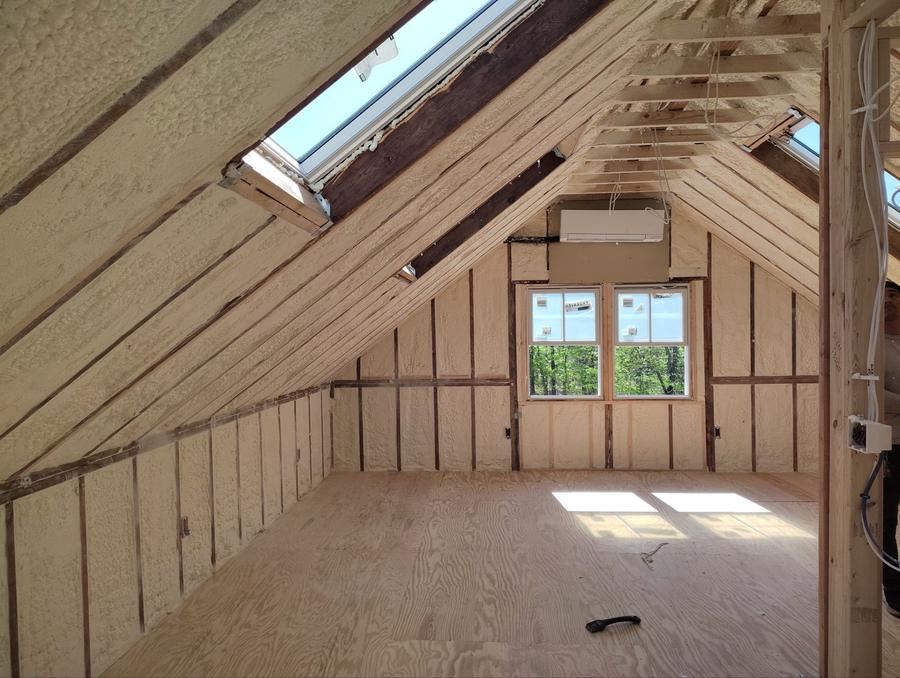
Fuel oil heats 70.5% of East Haddam’s occupied homes. Bottled gas heats another 13.5%, wood 7.0% and electricity 5.2%, and no local gas company serves the town, so nearly every house here buys its heat by the delivery or by the cord. In an oil or propane house, every leak closed in the attic pays back as fewer deliveries over a winter.
East Haddam is the Connecticut River town of Moodus, Hadlyme, Millington, Leesville, Bashan, North Plain, Little Haddam and East Haddam Center, where a ferry crossed the river from 1695 until the swing bridge opened in 1913. It takes its name from Haddam, the town it was part of until 1734. It is not East Hampton, a separate Middlesex County town with its own page.
The town has 4,294 housing units. 89.6% are detached houses and 85.9% of occupied homes are owner-occupied. The median unit dates from 1975, but the stock is split at both ends: 19.7% predates 1940, while the 1980s and 90s together built 33.0%. 659 units were counted vacant, in a town that has had summer houses since resort building began at its lakes in the early 1900s.
The houses we insulate in East Haddam
In the nineteenth century Moodus ran twelve mills and was known as the Twine Capital of America. Among the 845 homes built before 1940 we expect two kinds of house. The first is a farmhouse with a heavy timber frame, walls holding little but air, a central chimney with open gaps beside it at every floor, and an attic floor of boards laid straight over the joists. The second is a later village house, balloon framed, its stud bays running unbroken from the cellar to the attic, where they act as flues for heated air.
In a balloon-framed wall each bay is blocked at the top and bottom before anything is blown in, or the insulation ends up in the cellar. Timber-frame walls are checked through a small hole first, because some hold plank sheathing with no cavity at all. Knob-and-tube wiring is treated as live until an electrician retires it, and the chimney gap is closed with sheet metal before the attic floor is touched.
The 1950s built 12.9% of today’s units, 552 homes, and the 1960s and 70s another 17.2%. Those are the capes and ranches. A cape leaks where its upstairs rooms meet the roof: behind the knee walls, through joist bays that open from the eave into the floor below, and along rafter slopes with no baffle. A ranch leaks upward through light boxes, the attic hatch and the top plates of its interior walls into an attic whose original fiberglass has thinned and shifted.
Then the largest group. The 1980s built 15.3% of units and the 1990s 17.7%, 760 homes, mostly colonials and contemporaries. Those went up with insulated walls, so their losses run through the top of the house: a bonus room over the garage with its floor cavity open to cold air, cathedral ceilings packed tight to the roof deck, recessed lights, and an air handler in an unconditioned attic.
Summer cottages at Lake Hayward, Bashan Lake and Moodus Reservoir
The resort trade at Lake Hayward, Bashan Lake and Moodus Reservoir began in the early 1900s and was a booming business for the next fifty years. Lake Hayward, first called Long Pond, is a private community of about 120 families, most there only in summer. A cottage from that boom was built for July. It may have two-by-four walls or thinner, some with nothing between the siding and the interior boards, a floor framed over piers or a shallow crawl space, and a ceiling fastened to the rafters with no attic above it.
Before we price one, we ask what the house will do in February. A cottage becoming a year-round home should be insulated during the conversion, while walls and rafters are open: closed cell foam puts the most R-value into shallow framing and stops air in the same pass. Under a cottage that will be heated, the crawl space is better sealed and insulated at its walls than left vented, so the supply pipes stay on the warm side.
A converted cottage often runs on a propane heater or a wood stove. Tightening the shell changes how a fuel-burning appliance gets its air, so the heater and any stove are tested before the sealing begins and tested again at the end.
We seal before we insulate
Heat leaves a house two ways: through the materials, which insulation slows, and with air escaping through gaps, which insulation barely touches.
In a 1990s East Haddam colonial the order is: seal the attic hatch or pull-down stair; seal the top plates, wire holes and plumbing stack; box and seal the recessed lights and bath fan housings and run the fan ducts outdoors; seal the ductwork where an air handler sits in the attic; close the floor cavity under the bonus room where it opens to the garage roof; baffle the eaves; then blow the attic to depth. The basement rim joist is sealed and foamed last.
If a quote specifies a depth of insulation and never mentions air sealing, it is half a job.
What insulation costs in East Haddam
Most of our projects run between $3,500 and $12,500. A 1990s colonial is priced on its attic area, the bonus room and the recessed lights to seal. A 1950s cape turns on its length of knee wall and slope. A cottage becoming a year-round house depends on open walls and rafters and the crawl space beneath, and a pre-1940 farmhouse on what its walls hold and whether old wiring must come out first.
Open cell foam runs R-3.9 to R-4.2 per inch. Closed cell runs R-6.9 to R-7.1 per inch and also acts as a vapor retarder, which is why it costs more and why it is right in some assemblies and unnecessary in others. All products are manufactured in the United States and meet applicable building code and safety standards. ENERGY STAR says sealing air leaks and adding insulation can save up to 10% on annual energy bills.
Insulation rebates in East Haddam
Eversource delivers East Haddam’s electricity, and no local gas company serves the town. Home Energy Solutions is open to customers of Eversource, United Illuminating, Connecticut Natural Gas and Southern Connecticut Gas, so an East Haddam household applies through its Eversource electric account, whatever fuel heats the house. It covers homes of one to four units; renters need landlord approval, and a home served within six years must wait.
The standard Home Energy Solutions visit costs a $40 copay, effective 1 April 2026. The program’s authorized contractor starts with health and safety tests, runs a blower-door test to pinpoint drafts and air leaks, and tests the ducts if the house has forced hot air or central air conditioning. Air sealing is included at no cost for up to seven hours, then $10 an hour. A report of results, recommended upgrades, rebates and financing follows. There may be a waiting list, and the program is subject to available funding.
The 2026 Energize CT insulation rebate covers attic floors, floored-over attics, walls, garage ceilings, rim joists and basement ceilings at up to $2.00 per square foot or 75 percent of the total cost, whichever is less, with a maximum of $10,000. An attic floor holding R-19 or less must finish at R-49 or more. Neither foam on the underside of a roof deck nor a floor over piers or a crawl space is named, so ask the program before counting on a rebate for a cottage. Three steps come in order: the insulation is recommended during a Home Energy Solutions visit, the project is approved before installation, and the work is performed by an approved contractor from the Energize CT Insulation Installers Network.
The tier depends on household income. On Energize CT’s 2026–2027 figures, a four-person household with $93,681 or less a year is Income Eligible, where the visit carries no charge and coverage of insulation costs can reach 100 percent. At $93,682 to $124,908 the same household is in Enhanced Incentives, which also waives the visit charge and raises the insulation incentive to as much as $2.50 per square foot; those Enhanced limits are defaults that shift with zip code. From $124,909 up is the standard tier. Near a line, confirm the tier before paying a copay. Parts of East Haddam are designated environmental justice communities; the state’s map shows whether a specific address qualifies, and inside one the incentive can reach $2.50 per square foot, up to $15,000.
Only insulation installed by the program’s network installers earns the rebate, so ask any installer who quotes, including us, whether they are in that network, and compare prices after any rebate before you decide. For financing, Smart-E, the Connecticut Green Bank’s loan, needs no money down and lends as much as $50,000 on an owner-occupied home of one to four units. Its rates are 6.99% APR for 5, 7 and 10 years, 7.49% for 12 years and 7.99% for 15, a term not every lender offers. Projects are submitted by the Green Bank’s participating contractors, so ask yours whether it participates. Insulation installed in 2026 earns no federal tax credit, because Section 25C stopped covering property placed in service after 31 December 2025. Our Connecticut rebate guide has the rest.
Code and climate in East Haddam
54.4% of East Haddam’s housing was built before 1980. The town is in climate zone 5A, and the state’s own code table sets a winter design temperature of 7 degrees Fahrenheit and a frost line 42 inches deep. Building applications filed since 1 October 2022 fall under the 2022 Connecticut State Building Code, which adopts the 2021 IECC with Connecticut amendments.
A new house, or a heated wing added to a converted cottage, has to reach R-60 in the ceiling, though R-49 is enough where it keeps its full uncompressed thickness out over the top plate of the exterior wall. A wood-frame wall can comply four ways: R-30 in the cavity alone, R-20 in the cavity with R-5 of continuous insulation, R-13 with R-10 continuous, or R-20 continuous by itself. Floors need R-30; basement walls need R-15 continuous, R-19 in the cavity or R-13 plus R-5 continuous; windows need U-0.30. The blower-door standard for a new home is 3.0 air changes per hour at 50 pascals on the prescriptive path, with 5.0 as the limit on any path. A successor code built on the 2024 IECC has been adopted in draft, and its effective date has been delayed.
Common questions about insulation in East Haddam
Do you install insulation in East Haddam, CT?
Yes, in East Haddam, the river town of Moodus, Hadlyme, Millington and its other villages. East Hampton is a different town with its own page. We insulate timber-frame farmhouses and balloon-framed village houses from before 1940, capes and ranches from the 1950s through the 70s, colonials and contemporaries from the 1980s and 90s, and cottages at Lake Hayward, Bashan Lake and Moodus Reservoir, whether they stay seasonal or are becoming year-round homes.
How much does insulation cost in East Haddam?
Most projects run $3,500 to $12,500. A 1990s colonial is priced on its attic area, the bonus room over the garage and the recessed lights and fan housings to seal. A 1950s cape depends on its knee walls and slopes. A cottage being made year-round turns on open walls and rafters and the crawl space underneath, and a pre-1940 farmhouse on what is inside its walls and any wiring to retire. The walk-through costs nothing, and the scope and price come in writing.
Are there insulation rebates in East Haddam?
Yes. With no gas company in town, East Haddam households reach Energize Connecticut through their Eversource electric account, whatever fuel the house burns. On the standard tier the Home Energy Solutions visit has a $40 copay. Insulation that visit recommends, approved in advance and installed by an Energize CT network installer, can earn up to $2.00 per square foot or 75 percent of the total cost, whichever is less, capped at $10,000. Some East Haddam addresses fall in environmental justice communities, where the rate can be higher.
Our Lake Hayward cottage is only used in summer. Is it worth insulating?
Not much, while it stays that way. An unheated cottage saves no fuel in January, and insulating its floor while pipes sit in a vented crawl space below only makes the pipes colder. The useful summer work is moisture: cover the crawl space ground and drain the lines each fall. If you plan to live there year-round, insulate during the conversion, when walls and rafters are open and closed cell foam can fill shallow framing.
Free estimate in East Haddam
Our free estimate in East Haddam starts at the bottom of the house, with the boiler or furnace, the oil tank or propane line, the rim joist and the cellar walls. Then up to the chimney, the attic hatch and the top plates; in a cottage, under the floor. You get a written scope and price, at no charge. It is separate from the Home Energy Solutions visit and does not count toward any rebate.
To book it, call 914-825-6824 any day from 8am to 8pm, or send a note through the contact form. The Home Insulators is based in New Rochelle, NY, and every job is done by our own 100-plus in-house crew; we never subcontract.
Learn more
- Insulation contractors across Middlesex County
- Insulation contractors in Haddam
- Insulation contractors in East Hampton
- Insulating older homes
- Crawl space insulation
- Attic insulation