Half of Simsbury heats with oil. Fuel oil or kerosene heats 50.5% of occupied homes, against 29.7% on utility gas, 13.5% on electricity, 4.2% on bottled gas and 1.7% on wood. Every leak in a Simsbury house is measured in gallons delivered, and the tighter the house, the longer each fill of the tank lasts.
The town’s 9,557 housing units have a median build year of 1973. 39.1% went up in the 1960s and 70s, the 1970s alone building 20.5%, while 21.5% is from the 1980s and 90s, 16.7% from the 1940s and 50s, 14.1% from 2000 on and 8.6% from before 1940; 64.4% was standing before 1980. 71.8% of units are detached houses, and 73.9% of occupied homes are owner-occupied.
The houses we insulate in Simsbury
Simsbury lies at the northern end of the Farmington Valley, with Talcott Mountain on its east side and the Farmington River running through the Tariffville Gorge. It is often called a bedroom community for Hartford, a 20 to 25 minute drive from Simsbury Center. Its communities include Simsbury Center, Tariffville, Weatogue and West Simsbury, and the older settlements of East Weatogue and Terry’s Plain date from the resettlement after 1676.
The 1,224 homes of the 1950s are capes and ranches with thin attic floors and knee walls that have never had an air barrier. The 1,386 homes of the 1980s are mostly colonials with insulated walls, where the losses sit in the attic: recessed lights, a pull-down stair, a flue chase and a bonus room over the garage with open joist bays under its floor. The 969 units built between 2010 and 2019 usually have full walls, and in those the work, if any, is air sealing and ducts.
Simsbury has 825 homes from before 1940. The town was burned to the ground in March 1676 during King Philip’s War, so its colonial houses date from the rebuilding. The John Humphrey House on East Weatogue Street is a two-story frame house built around 1760; the Capt. Elisha Phelps House on Hopmeadow Street dates from 1771 and served as a tavern from 1786 to 1849. The Simsbury Center, Tariffville, Terry’s Plain and East Weatogue historic districts are all on the National Register. Houses like these are worked from inside: the attic floor sealed at the chimney and wall tops, then insulated; the cellar sill and rim; any later wing. We do not drill old clapboards.
The 570 units in buildings of ten to nineteen, 325 in buildings of twenty to forty-nine and 305 in buildings of fifty or more are apartment and condominium buildings, where the roof and walls belong to the building. That work starts with the owner or the association.
The 1960s and 70s house, heated with oil
The 1,770 homes of the 1960s and 1,963 of the 1970s are the heart of Simsbury’s housing: raised ranches, split-levels, center-hall colonials and, in the 1970s, contemporaries with cathedral ceilings and large glass. All of them were insulated when new, to the thin standard of the time, and the insulation has settled and been disturbed since.
Each fails in its own place. The raised ranch loses heat through a rim joist that stands above grade around the lower level, and through a garage ceiling under a bedroom. The split-level loses it at the band joist where the upper level steps over the lower, and through the floor of the bedroom wing over the garage. The colonial loses it at the attic hatch, the top plates and the rim. The contemporary loses it in the cathedral slopes, where batts sit against the roof deck with no vent space, and through the ridge and every light fixture in the ceiling.
On oil, that loss becomes a delivery schedule. The boiler or furnace burns until the house is warm, so a house that leaks less needs fewer gallons to get there and holds heat longer between cycles. That makes the order of work matter: stopping air leaks at the attic floor and the rim comes first, because warm air escaping through the top of the house pulls cold air in at the bottom, and a leak stopped there keeps paying every hour the boiler would have run. Deeper attic insulation follows, then the garage ceiling and overhangs, and walls last, if they need it at all.
We seal before we insulate
Insulation slows heat through a surface. Air leaking around it takes heat out anyway, and in a 1970s Simsbury split-level the leaks are spread over three levels.
In that house the order runs: from the attic, seal the top plates, the plumbing and flue chases, the light boxes and the hatch, and set baffles at the eaves; close the band joist where the upper level steps over the lower, from inside the lower-level ceiling or the adjoining attic; seal and insulate the floor over the garage; then the rim joist around the basement. With the air stopped, the attic is brought up to depth.
If a quote specifies a depth of insulation and never mentions air sealing, it is half a job.
What insulation costs in Simsbury
Most of our projects run between $3,500 and $12,500. In a Simsbury split-level or raised ranch the number follows the attic area, the band joist or above-grade rim, and the floor over the garage. In a 1970s contemporary it moves with the cathedral slopes and whether they are opened or foamed. In a colonial from the 1700s it depends on what the attic and cellar allow from inside. The spray foam cost guide covers foam pricing.
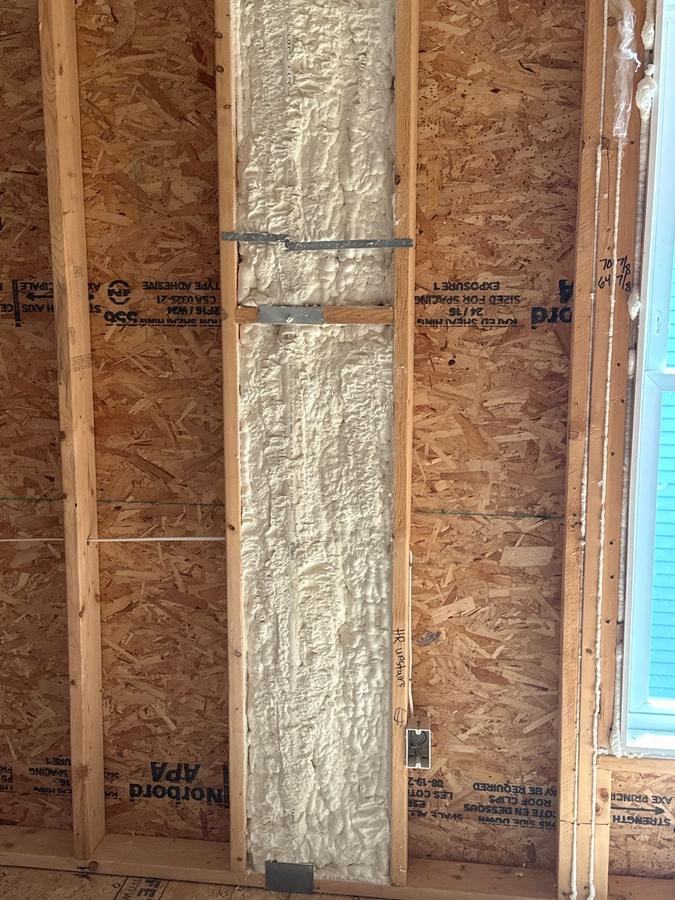
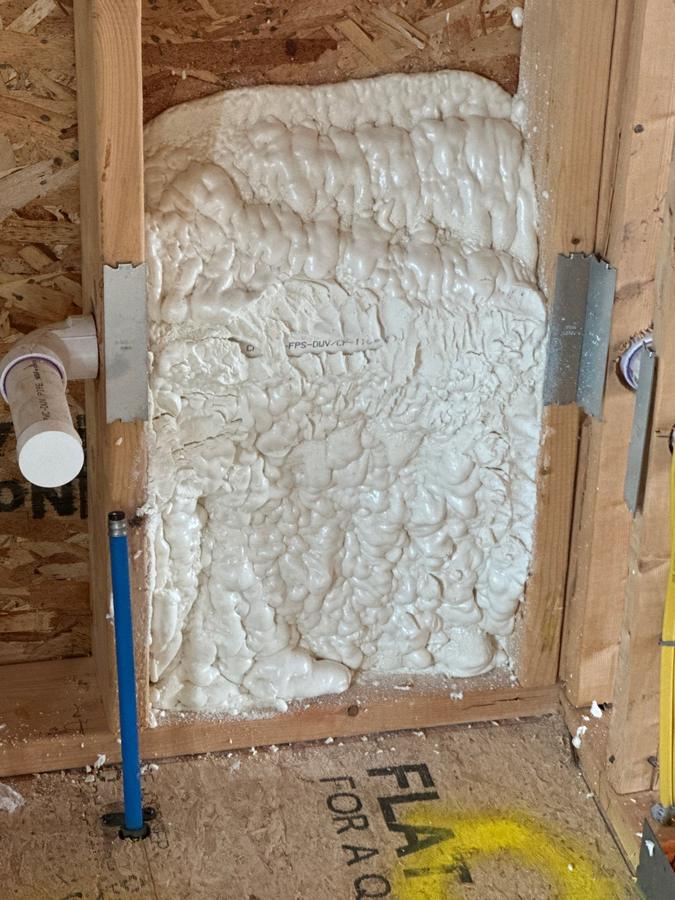
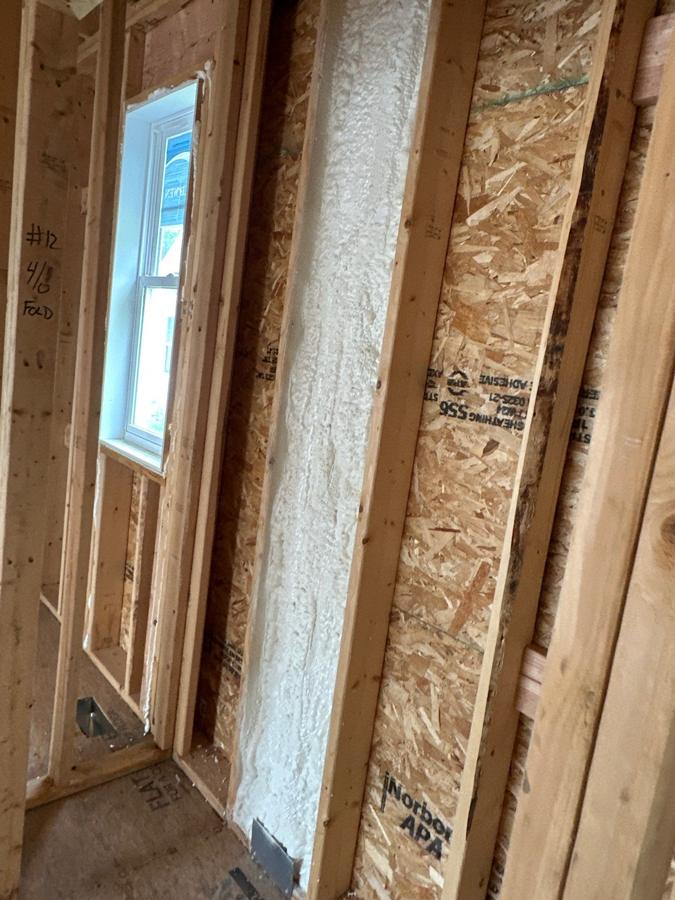
Open cell foam runs R-3.9 to R-4.2 per inch. Closed cell runs R-6.9 to R-7.1 per inch and also acts as a vapor retarder, which is why it costs more and why it is right in some assemblies and unnecessary in others. All products are manufactured in the United States and meet applicable building code and safety standards. ENERGY STAR says sealing air leaks and adding insulation can save up to 10% on annual energy bills.
Insulation rebates in Simsbury
Simsbury is served by Eversource for electricity and Connecticut Natural Gas (CNG) for gas. With half the town on oil, it matters that Home Energy Solutions is open to customers of Eversource, United Illuminating, Connecticut Natural Gas and Southern Connecticut Gas whatever fuel heats the house: an oil-heated Simsbury home applies through its Eversource account. The program suits homes of one to four units, renters need their landlord’s approval, and a home served in the last six years is not eligible again yet.
The Home Energy Solutions visit costs a $40 copay, effective 1 April 2026, and is done by an authorized contractor. It runs health and safety tests, a blower-door test to pinpoint drafts and air leaks, and a duct test where there is forced hot air or central air conditioning, and it closes with a report of the blower-door results, recommended upgrades, and rebate and financing information. Air sealing is included at no cost for up to seven hours, and larger or older homes that need extra time pay $10 an hour. There may be a waiting list, and the program is subject to available funding.
The 2026 Energize CT insulation rebate pays up to $2.00 per square foot or 75 percent of the total cost, whichever is less, up to a maximum of $10,000, on attic floors, floored-over attics, walls, basement and garage ceilings and rim joists. The insulation has to be recommended during a Home Energy Solutions visit, the project approved before installation, and the work done by an approved contractor from the Energize CT Insulation Installers Network. An attic floor with R-19 or less must finish at R-49 or greater, or R-38 where R-49 is not structurally practicable, and a garage ceiling at R-6 or less must finish at R-19 or more. A contemporary’s cathedral ceiling foamed against the roof deck is a different matter: foam on the underside of a roof deck is not on the list, so ask the program before counting on a rebate for it.
Income sets the tier. On Energize CT’s 2026–2027 figures, a two-person household with $63,703 or less is Income Eligible, with no-cost service and up to 100 percent coverage of insulation costs; one with $63,704 to $84,939 is in Enhanced Incentives, with a no-cost visit and up to $2.50 per square foot, a range that varies by zip code; and $84,940 or more is the standard program. If you are near a limit, ask which tier you are in before you pay a copay. Parts of Simsbury are designated environmental justice communities; the state’s map shows whether a specific address qualifies for up to $2.50 per square foot, up to $15,000.
The rebate is paid only when a contractor in the Insulation Installers Network does the work, so ask any installer, including us, whether they are in that network before you sign. If the rebate matters most, book the visit first and use a network contractor. If you want foam where the rebate does not reach, or would rather not wait for the program, we will price the job on its own merits.
The Connecticut Green Bank’s Smart-E Loan finances insulation with no money down, up to $50,000, for an owner-occupied home of one to four units, at 6.99% APR over 5, 7 or 10 years, 7.49% over 12 and 7.99% over 15 where the lender offers it. It goes through the Green Bank’s participating contractors, so ask whether yours participates. There is no federal tax credit for insulation installed in 2026: Section 25C ended for anything placed in service after 31 December 2025. Our Connecticut rebate guide has the rest.
Code and climate in Simsbury
64.4% of Simsbury’s housing was built before 1980. The whole state, Simsbury included, is climate zone 5A.
New houses and additions with applications filed since 1 October 2022 are built under the 2022 Connecticut State Building Code, which adopts the 2021 IECC with state amendments. Its prescriptive minimums: ceilings R-60, with R-49 accepted where it runs full and uncompressed over the wall top plate at the eaves; wood-frame walls of R-30 in the cavity, R-20 cavity plus R-5 continuous, R-13 plus R-10 continuous or R-20 continuous; floors R-30; basement walls of R-15 continuous, R-19 cavity or R-13 cavity plus R-5 continuous; and windows at U-0.30. New homes must pass a blower-door test at 3.0 air changes per hour at 50 pascals on the prescriptive path, and never worse than 5.0. Connecticut’s next code, based on the 2024 IECC, has been adopted in draft, but its effective date has been delayed.
Common questions about insulation in Simsbury
Do you install insulation in Simsbury, CT?
Yes, in Simsbury Center, Weatogue, West Simsbury, Tariffville and the rest of town: the raised ranches, split-levels, colonials and contemporaries of the 1960s and 70s that make up 39.1% of the housing, the 1950s capes and ranches, the 1980s colonials, and the older houses of the historic districts, which we work from inside. In apartment and condominium buildings the roof and walls belong to the building, so the owner or association decides.
How much does insulation cost in Simsbury?
Most projects run $3,500 to $12,500. In a split-level or raised ranch the drivers are the attic area, the band joist or above-grade rim, and the floor over the garage. In a 1970s contemporary it is the cathedral slopes and how they are treated. A 1980s colonial is priced on its attic, recessed lights and bonus room floor, and a house from the 1700s on what the attic and cellar allow.
Are there insulation rebates in Simsbury?
Yes, through Energize Connecticut. Simsbury is Eversource for electricity and Connecticut Natural Gas for gas, and either account can open a Home Energy Solutions visit, with a $40 standard copay, including for the half of the town heated with oil. Insulation recommended at the visit, approved before installation and installed by an Energize CT Insulation Installers Network contractor can earn up to $2.00 per square foot or 75 percent of cost, whichever is less, to $10,000. Some addresses qualify for a higher environmental justice rate. A 2026 job carries no federal tax credit.
We heat with oil. Which part of our Simsbury house should we fix first?
Almost always the top and bottom of the house before the walls. Warm air leaving through the attic floor pulls cold air in at the rim joist and the garage ceiling, so sealing those comes first, then deeper attic insulation. In a split-level add the band joist; in a raised ranch, the above-grade rim. Walls come last, and in many 1970s and 80s houses they are not the problem. A blower-door test shows where the leaks actually are.
Free estimate in Simsbury
Our free estimate is separate from Home Energy Solutions and does not qualify a house for any rebate. In a 1960s or 70s house we start in the attic at the plates, chases, lights and hatch, then look at the band joist or rim, the floor over the garage and any cathedral slopes. In a house in one of the historic districts we go from the cellar sill to the attic and say plainly which walls to leave alone. A written scope and price follow, with no charge and no obligation.
Call 914-825-6824, 8am–8pm, seven days, or use the contact form. We work out of New Rochelle, NY, with a 100-plus in-house crew that never subcontracts.
Learn more
- Insulation contractors across Hartford County
- Granby, part of Simsbury until 1786
- Canton, part of Simsbury until 1806
- Avon, south in the Farmington Valley
- Attic insulation
- Air sealing
- Insulating older homes