41.4% of Bristol’s occupied homes heat with oil and 27.4% with electricity. Utility gas heats only 23.4% and bottled gas 4.6%. That fuel mix shapes the case for insulation here more than anything else about the housing, because most of the city buys its heat by the delivery or by the kilowatt-hour.
The housing itself spans every era. Of 26,744 units, 17.2% predate 1940, 22.5% are from the 1940s and 50s, 31.2% from the 1960s and 70s, 21.8% from the 1980s and 90s and 7.3% from 2000 on. The median unit dates from 1967, and 70.9% was built before 1980. 54.3% of units are detached houses, 4.9% attached, 9.0% in two-unit buildings, 11.4% in three- and four-unit buildings and 6.0% in buildings of five to nine. 64.7% of occupied homes are owner-occupied.
The houses we insulate in Bristol
Bristol’s first permanent homes went up along King Street from 1728, and the first church stood on Federal Hill, the spot picked as the center of a scattered settlement. From 1790, when Gideon Roberts began making clocks, this was an industrial town: clocks first, then brass, springs, bearings and hardware, with many ethnic groups arriving to work in the shops, and a city charter in 1911. The 2,401 units in two-unit buildings and 3,047 in three- and four-unit buildings reflect that history.
A stacked two- or three-family from the early 1900s is one building with shared weak points. The front and back stairs run top to bottom as open chases. Porch roofs tie into the wall framing. The side walls are often balloon-framed, and the top apartment sits under a low attic or a nearly flat roof that is the coldest ceiling in the building. Each floor may have its own boiler and oil tank, but the air moves through all of them, so we scope the whole building.
The 1940s and 50s, 22.5% of the stock, run to capes and small ranches. The cape leaks where the knee wall meets the floor framing and the ranch across a thin, settled attic. The 1960s and 70s are Bristol’s largest era at 31.2%, and the raised ranch and split-level are its typical houses: the lower level half out of the ground with a bare rim joist above grade, a garage tucked under a bedroom, and a top-level attic with a few inches of insulation left. Townhouses and buildings of five to nine units are the kind of housing where electric baseboard heat is common.
The 1980s alone added 14.3% of the city, and with the 1990s that era holds 21.8%: colonials, contemporaries with cathedral ceilings, and more townhouses. Their walls have code-minimum batts, and their failures are in the attic: insulation pushed aside by later wiring, cathedral slopes packed tight with no vent space, and party walls left open into a shared attic.
Bristol’s Code Enforcement Committee, formed in 2008, can act on loose shingles, holes and cracked or damaged siding. When we fill a wall from outside, every hole is plugged and sealed and the siding goes back tight, which is how it should be done anywhere; in Bristol it is also on the city’s list.
Oil, electric baseboard and payback in Bristol
An oil-heated house pays for every air leak in gallons. With 41.4% of Bristol heating that way, the order of work matters: air sealing at the attic plane and the rim joist comes first, then attic insulation, then walls, because the heat that stays in is the heat you did not have delivered. The saving shows up as a tank that lasts longer between fills. We do not put a dollar figure on it, because that moves with the price of oil.
Electric resistance heat, in 27.4% of homes, works differently from what most people expect. A baseboard heater turns every watt into heat in the room, so there is nothing to gain at the heater; the only way to lower the bill is to lose less heat. In a condominium heated that way the top-floor ceiling and the outside walls are where the heat goes, but those usually belong to the association, so that conversation starts with the board. And if a house is moving from oil or baseboard to a heat pump, sealing and insulating first lets the new system be sized to a smaller load.
We seal before we insulate
Insulation resists heat flowing through a ceiling or a wall. It does not stop air, and air leaking through a gap carries heat out no matter how deep the insulation above it is.
In a Bristol three-family the sequence starts at the top. Seal the top-floor ceiling plane: light boxes, plumbing vents, the chimney and the head of the stair chase. Block the stair chase where the framing allows, seal the porch roof connections at the wall, then finish in the cellar at the rim joist and sill. Only then insulate the attic or the roof over the top unit. In a raised ranch the order runs the other way: rim joist and garage ceiling first, then the attic.
If a quote specifies a depth of insulation and never mentions air sealing, it is half a job.
What insulation costs in Bristol
Most of our projects run between $3,500 and $12,500. A three-family is priced as one building, and the number moves with the roof area over the top unit, the stair chase and the length of cellar rim. A raised ranch or split-level is usually smaller: rim joist, garage ceiling and attic. In a townhouse, the party wall and the attic above it drive the price. For foam in more detail, see what spray foam costs.
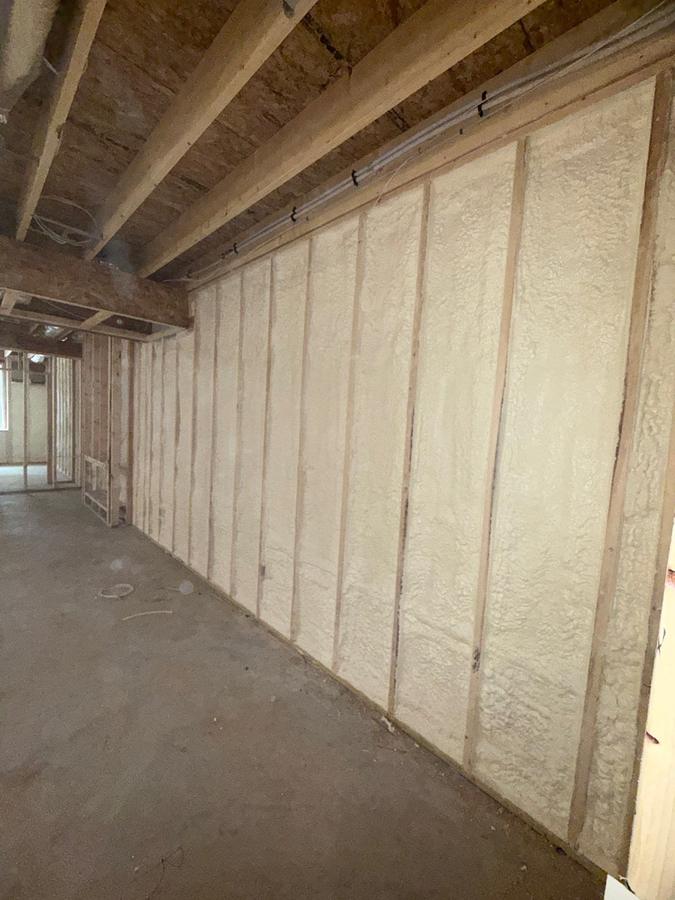
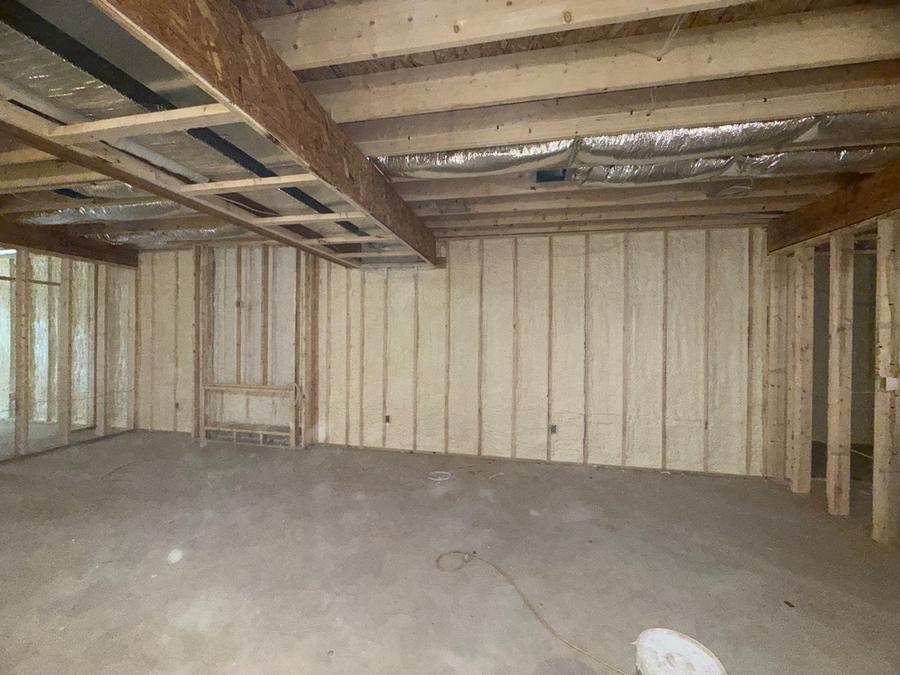
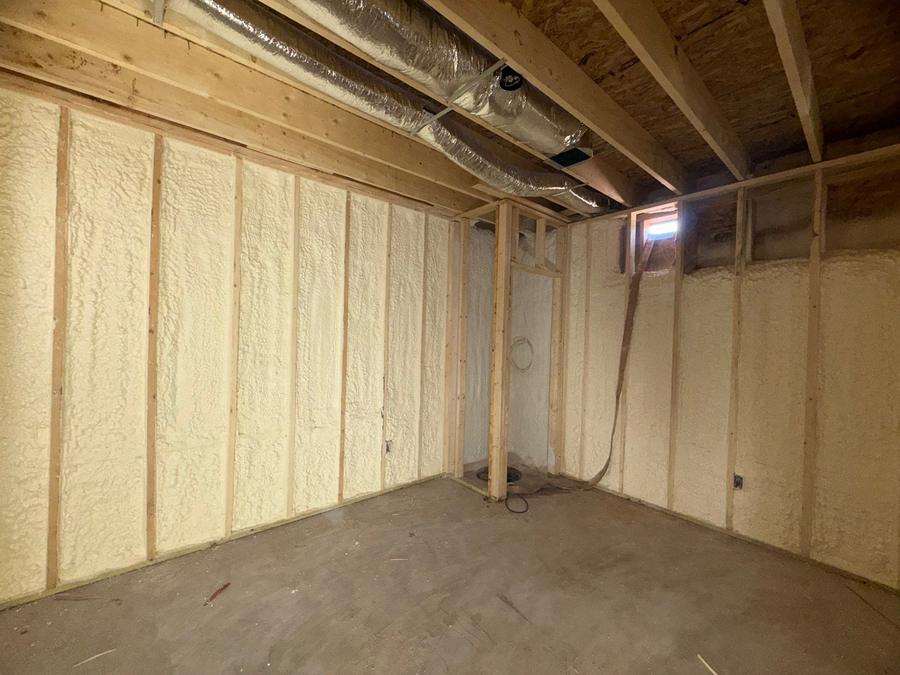
Open cell foam runs R-3.9 to R-4.2 per inch. Closed cell runs R-6.9 to R-7.1 per inch and also acts as a vapor retarder, which is why it costs more and why it is right in some assemblies and unnecessary in others. All products are manufactured in the United States and meet applicable building code and safety standards. ENERGY STAR says sealing air leaks and adding insulation can save up to 10% on annual energy bills.
Insulation rebates in Bristol
Bristol is Eversource territory for both electricity and natural gas. Home Energy Solutions is open to customers of Eversource, United Illuminating, Connecticut Natural Gas and Southern Connecticut Gas, and the heating fuel does not matter, so a home on oil or electric heat can apply through its Eversource account as readily as a gas-heated one. The program fits buildings of one to four units, which takes in the two- and three-families; a renter needs the landlord’s approval, and a home served in the past six years is not eligible again yet.
The first step is the Home Energy Solutions visit. An authorized contractor comes for a $40 copay, effective 1 April 2026, runs the health and safety tests, uses a blower-door test to find the air leaks, tests the ducts where there is forced hot air or central air, installs water-saving measures, and air seals at no cost for up to seven hours, with a $10 hourly fee beyond that. A two- to four-unit building always takes two visits. There may be a waiting list, and the program is subject to available funding.
For 2026 the Energize CT insulation rebate pays up to $2.00 per square foot or 75 percent of the total cost, whichever is less, with a maximum of $10,000. The insulation has to be recommended at the Home Energy Solutions visit, approved before any work starts, and installed by an approved contractor from the Energize CT Insulation Installers Network. The qualifying areas are attic floors, floored-over attics, walls, basement and garage ceilings and rim joists. A wall has to start at R-4 or less and finish at R-13 or more; a basement or garage ceiling has to start at R-6 or less and finish at R-19 or more. Foam on the underside of a roof deck is not on the list, so ask the program before counting on a rebate for it.
Every address in Bristol is in a state-designated environmental justice community, which can raise the Energize CT insulation incentive to $2.50 per square foot, up to $15,000. The state updates that designation each December or January, so confirm it when you apply. Income can lower the cost further. On Energize CT’s 2026–2027 figures, a household of three with $78,692 or less is in the Income Eligible tier, with a no-cost visit and up to 100 percent coverage of insulation costs; one between $78,693 and $104,924 is in Enhanced Incentives, with a no-cost visit, and that range varies by zip code. Ask which tier you are in before you pay a copay.
Only work by a contractor in the Insulation Installers Network earns the rebate. Ask any installer who quotes, including us, whether they are in that network, and compare prices after any rebate before you decide.
The Connecticut Green Bank’s Smart-E Loan covers insulation for owner-occupied buildings of one to four units, and individually metered condominiums, up to $50,000 with no money down: 6.99% for 5, 7 or 10 years, 7.49% for 12 and 7.99% for 15 where the lender offers that term. Ask whether your contractor participates. There is no federal tax credit for insulation installed in 2026; the Section 25C credit does not apply to anything placed in service after 31 December 2025. More in the Connecticut rebate guide.
Code and climate in Bristol
70.9% of Bristol’s housing was built before 1980. Bristol is a Hartford County city in the Naugatuck Valley Planning Region, and like every part of Connecticut it is climate zone 5A.
New homes and additions are built to the 2022 Connecticut State Building Code, the 2021 IECC with Connecticut amendments, for applications filed since 1 October 2022. Its new-home values are R-60 for ceilings, or R-49 where that full depth runs uncompressed over the wall top plate at the eaves; R-30 for floors; wood-frame walls of R-30 in the cavity, R-20 plus R-5 continuous, R-13 plus R-10 continuous or R-20 continuous; basement walls of R-15 continuous, R-19 in the cavity or R-13 plus R-5 continuous; and U-0.30 windows. A new home must pass a blower-door test of 3.0 air changes per hour at 50 pascals on the prescriptive path, and never worse than 5.0. The next edition of the Connecticut code, based on the 2024 IECC, has been adopted in draft; its effective date has been delayed.
Common questions about insulation in Bristol
Do you install insulation in Bristol, CT?
Yes, in every part of the city: the older houses around Federal Hill and King Street, the two- and three-families, Forestville’s suburban neighborhoods and Edgewood, Chippens Hill and Cedar Lake. The biggest single era is the 1960s and 70s, 31.2% of the city, with its raised ranches and split-levels. We do not insulate single units inside condominium or apartment buildings where the association owns the envelope; the call there starts with the board.
How much does insulation cost in Bristol?
Most projects run $3,500 to $12,500. A two- or three-family is priced as one building, driven by the roof area over the top unit, the stair chase and the cellar rim. A raised ranch or split-level is usually a smaller scope: rim joist, garage ceiling and attic. In an oil- or electric-heated house we put air sealing at the top of the scope, because that is where the fastest return is. The written scope and price come after a free walk-through.
Are there insulation rebates in Bristol?
Yes. Bristol is Eversource for electricity and gas, and Home Energy Solutions takes any heating fuel, with a $40 copay for the standard visit. The 2026 insulation rebate pays up to $2.00 per square foot or 75 percent of cost, to $10,000, and every Bristol address is in a designated environmental justice community, which can raise it to $2.50 per square foot, up to $15,000. The work must be recommended at the visit, approved first and done by a network installer. There is no federal credit for 2026.
We own a three-family in Bristol and live on one floor. Can the whole building be done at once?
Yes, and it should be, because the stair chase, the floor cavities and the roof over the top unit are shared. We scope the building as one job: top-floor ceiling and attic, stair chase, porch connections, cellar rim. On the program side, Home Energy Solutions is written for buildings of one to four units and always takes two visits for a two- to four-unit building, and the Smart-E Loan covers owner-occupied buildings of up to four units.
Free estimate in Bristol
Our free estimate is separate from Home Energy Solutions and does not stand in for it. In a multi-family we walk the top-floor ceiling or attic, the stair chase, the porches and the cellar; in a raised ranch, the rim joist, the garage ceiling and the attic. We also note the heating fuel, because in an oil or electric house it changes what should come first. You get a written scope and a price, and there is no charge and no obligation.
Call 914-554-2289 or send a note through the contact form. Open 8am–8pm, seven days. We work out of New Rochelle, NY with a 100-plus in-house crew that never subcontracts.
Get my free estimateor call 914-554-2289, 8am–8pm every day