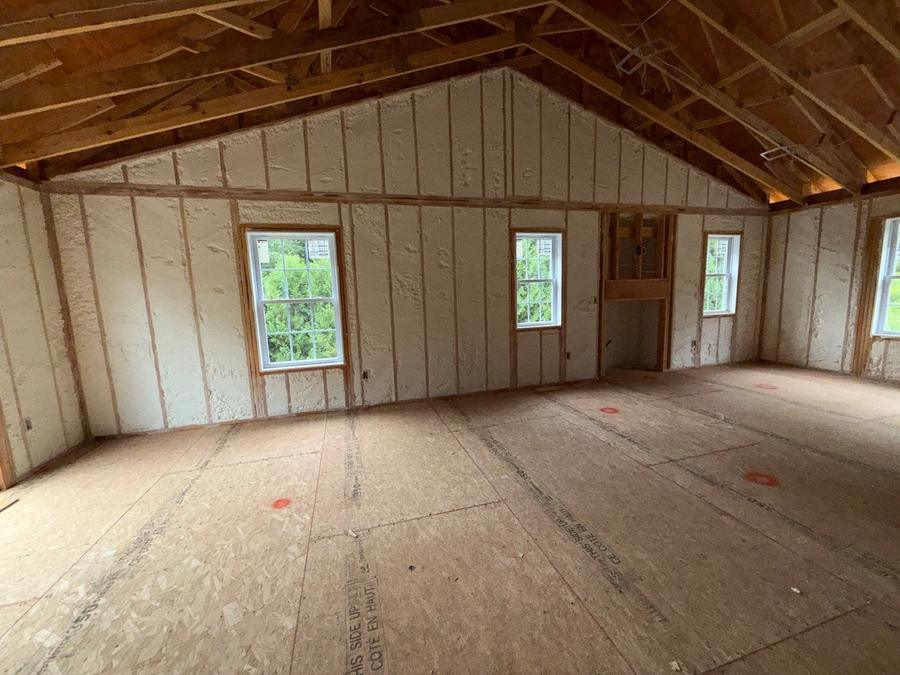
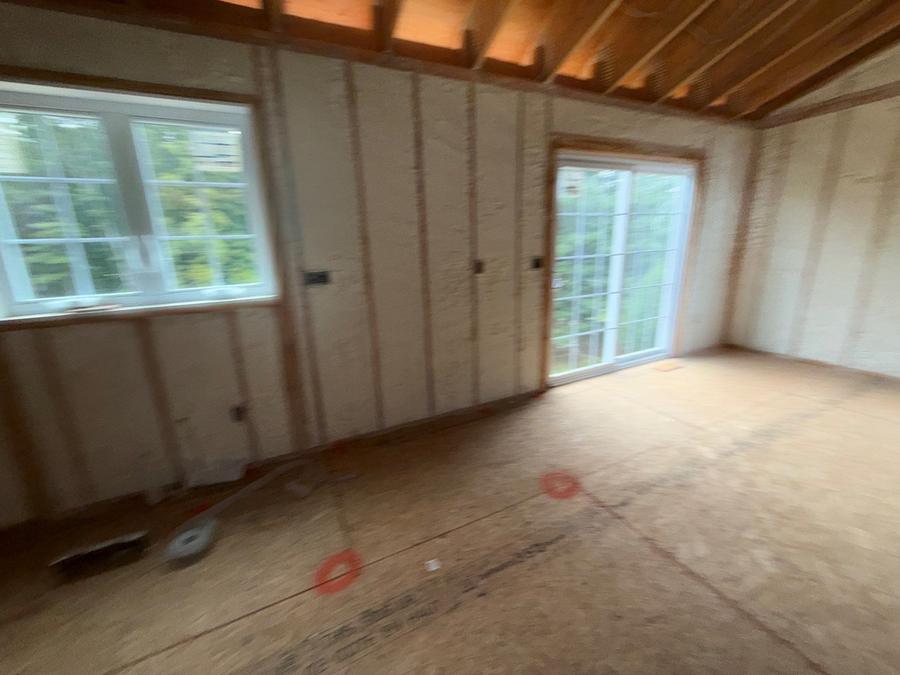
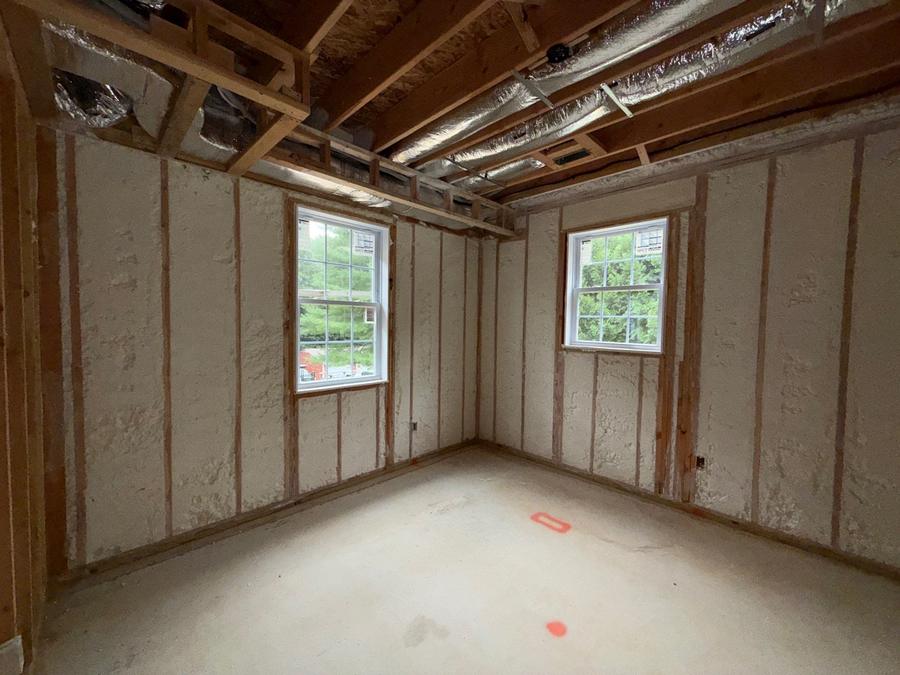
The 1980s built 27.1% of Colchester’s housing, 1,737 of its 6,410 units, and the median unit dates from 1984. No other decade comes close: the 1990s added 15.8% and the 1970s 13.8%. Together the 1980s and 90s account for 42.9% of the town, and only 39.6% went up before 1980.
So most Colchester houses had insulation from the day they were built, and the job here is less often an empty wall than a forty-year-old attic, a cathedral ceiling or a room over the garage. 76.3% of units are detached houses and 78.0% of occupied homes are owner-occupied. The one sizable block of multifamily housing is the 8.6% of units in buildings of five to nine, 552 in all, and whoever owns or governs those buildings decides on their envelopes.
Utility gas heats just 3.2% of occupied homes. Fuel oil heats 61.8%, bottled gas 16.0%, electricity 12.7% and wood 3.0%. Most households buy their heat by the gallon, so a sealed and insulated house pays back as a smaller oil or propane bill over the season, and fastest where the house leaks most.
The houses we insulate in Colchester
By era, 9.2% of Colchester predates 1940, 9.6% is from the 1940s and 50s, 20.8% from the 1960s and 70s, 42.9% from the 1980s and 90s and 17.5% has been built since 2000.
Jeremy Adams settled “Jeremiah’s Farme” in 1661 on land given by Uncas, and Colchester became a town in 1699. Its recorded houses run from the Foote family house, finished in 1702, to the Nathaniel Hayward house of 1775, whose lawn was the original town green, and the Henry Champion House of 1790. The former borough at the center is now the Colchester Village Historic District. Houses of that age are timber-framed, with wall cavities that are irregular, partly filled or absent, so we start where loss is easiest to stop: the attic floor, the chimney, the cellar sill and the rim. The wiring is checked before any cavity is touched.
Through the 20th century much of Colchester’s farmland was developed in a suburban style, and the 1950s through the 70s built capes, ranches and raised ranches. The cape leaks behind its knee walls, where the bedroom side is insulated and the attic side is open, and through joist bays running to the eave. The ranch has a single low attic whose fill has sunk to a few inches around unsealed wires, pipes and ceiling boxes. The raised ranch has a rim joist exposed along its lower level and a bedroom over the garage.
The 1980s and 90s built colonials, raised ranches and contemporaries with cathedral ceilings and skylights, and the 2000s and 2010s, at 12.0% and 4.9%, added larger colonials with ducts in the attic and bonus rooms over garages.
The 1980s house, forty years on
A Colchester house from the 1980s went up with insulation in its walls and on its attic floor. Four decades have done three things to it. The attic insulation has been compressed by storage and walked flat by roofers, electricians and cable installers. Each trade that came through cut a hole and left it: a bath fan venting into the attic, a recessed light, a new cable, a flue for a replacement boiler. And the house was rarely air-sealed to begin with, because builders of that era seldom sealed top plates and chases.
The period’s designs leak too. A cathedral ceiling was framed with batts packed against the roof deck, sometimes with no vent space, and recessed lights cut through it. A skylight well rises through the attic with thin insulation on its sides. A two-story foyer has a tall wall facing the attic. A bonus room over the garage leaks where its floor meets the eave. None of these is fixed by blowing more insulation over the top.
The work is mostly sealing and topping up. Pull back the flattened fill over the problem areas, seal the top plates, chases and fan housings, build fire-safe covers over old recessed lights, insulate the skylight wells and the attic side of the foyer wall, then bring the attic floor to depth. Cathedral ceilings are a harder call: some can be dense-packed, and some are best left until the roof is replaced and the cavity can be reached from above.
We seal before we insulate
Insulation resists heat moving through it. Air goes around it, and a Colchester house that looks well insulated from the attic hatch can still lose much of its heat through holes nobody sealed.
In a 1980s colonial the order runs like this. Seal the attic hatch or pull-down stair and give it insulation of its own. Seal the top plates along every wall. Close the flue chase with sheet metal and fire-rated sealant. Seal around wires, pipes and the bath fan, and duct the fan outdoors. Cover the old recessed lights and seal the tops of the skylight wells. Then the attic floor gets its depth, with baffles at the eaves, and the rim joist in the cellar is sealed and insulated last.
If a quote specifies a depth of insulation and never mentions air sealing, it is half a job.
What insulation costs in Colchester
Most of our projects run between $3,500 and $12,500. In a Colchester colonial or contemporary from the 1980s or 90s the number moves with the attic area, how much old fill has to come out rather than be topped up, the count of recessed lights and skylight wells, and whether a cathedral ceiling or bonus room is in scope. A raised ranch adds its rim joist and garage ceiling; an 18th-century village house is scoped attic and cellar first. What spray foam costs has its own page.
Open cell foam runs R-3.9 to R-4.2 per inch. Closed cell runs R-6.9 to R-7.1 per inch and also acts as a vapor retarder, which is why it costs more and why it is right in some assemblies and unnecessary in others. All products are manufactured in the United States and meet applicable building code and safety standards. ENERGY STAR says sealing air leaks and adding insulation can save up to 10% on annual energy bills.
Insulation rebates in Colchester
Colchester’s electricity comes from Eversource, which is also the town’s gas company. Home Energy Solutions is open to customers of Eversource, United Illuminating, Connecticut Natural Gas and Southern Connecticut Gas, whatever fuel heats the house, so an oil- or propane-heated Colchester home signs up through its Eversource electric account. The program suits homes of one to four units that have not had its services in the last six years.
The visit costs a $40 copay, effective 1 April 2026, and an authorized Home Energy Solutions contractor carries it out: health and safety tests first, then a blower-door test to pinpoint drafts and air leaks, a duct test where there is forced hot air or central air, and air sealing at no cost for up to seven hours, with $10 an hour for homes that need longer. There may be a waiting list, since the program is subject to available funding.
Insulation the visit recommends can earn the 2026 Energize CT insulation rebate: $2.00 per square foot or 75% of the total cost, whichever is less, up to $10,000, on attic floors, floored-over attics, walls, basement and garage ceilings and rim joists. For a 1980s attic the fine print matters. The existing insulation can be no better than R-19, and the finished attic must reach R-49 or more, or R-38 where the space cannot structurally take more. The project must be approved before installation and installed by an approved contractor from the Energize CT Insulation Installers Network. Foam under a roof deck, as in a cathedral ceiling, is not a listed area, so ask the program before relying on a rebate for it.
Income sets the tier. At or below 60% of state median income a household is Income Eligible, with no-cost service and up to 100% of insulation costs covered; above that but below 80% of its area’s median it is in Enhanced Incentives, with a no-cost visit and up to $2.50 per square foot. For a household of four, Energize CT’s 2026–2027 figures put those lines at $93,681 and $124,908, though zip code sets the Enhanced range. Check the tier before paying a copay.
Eversource customers who own and live in a one- to four-unit home can use Energize CT’s Micro Loan from Capital for Change: up to $3,000 interest-free over 36 months, subject to credit approval, for improvements recommended through Home Energy Solutions and installed by an approved contractor. For a larger job the Connecticut Green Bank’s Smart-E Loan lends up to $50,000 with no money down on owner-occupied homes of one to four units, at 6.99% APR for 5, 7 or 10 years, 7.49% for 12 and 7.99% for 15 where a lender offers it. Smart-E runs through participating contractors, so ask whether yours is one.
The Energize CT rebate is paid only when a contractor in the Insulation Installers Network does the work, so before you sign with anyone, including us, ask whether the installer is in that network, and weigh the prices after any rebate. The federal Section 25C credit is finished for anything placed in service after 31 December 2025, so 2026 insulation earns no federal tax credit. Everything else is in our Connecticut rebate guide.
Code and climate in Colchester
Only 39.6% of Colchester’s housing was built before 1980. The town is in climate zone 5A, as all of Connecticut is.
A house or addition filed for on or after 1 October 2022 is held to the 2022 Connecticut State Building Code, whose energy provisions are the 2021 International Energy Conservation Code with Connecticut’s amendments. It calls for R-60 in ceilings, or R-49 that keeps its full uncompressed height over the top plate at the eaves; R-30 in floors; U-0.30 windows; wood-frame walls at R-30 cavity, R-20 cavity with R-5 continuous, or R-13 cavity with R-10 continuous; and basement walls at R-15 continuous, R-19 cavity, or R-13 cavity with R-5 continuous. A new home is tested with a blower door and must come in at 3.0 air changes per hour at 50 pascals on the prescriptive path, and never above 5.0 on any path. A successor code built on the 2024 IECC exists in draft, but its effective date has been delayed and none is set.
Those are numbers for new work. In an existing Colchester attic, the rebate’s finish line of R-49 is the practical aim.
Common questions about insulation in Colchester
Do you install insulation in Colchester, CT?
Yes, in the center village, Westchester, North Westchester and the rest of town. Most of our Colchester work is the colonials, contemporaries and raised ranches of the 1980s and 90s, 42.9% of the town, where the fix is air sealing, attic depth, cathedral ceilings and rooms over garages. We also insulate the capes and ranches of the 1950s through the 70s and houses built since 2000, and we scope the oldest village houses attic and cellar first. Apartment buildings are for their owners to decide.
How much does insulation cost in Colchester?
Most projects run $3,500 to $12,500. For a 1980s or 90s house the price turns on the attic area, whether the old fill is topped up or partly removed, the number of recessed lights and skylight wells to seal, and whether a cathedral ceiling or bonus room is included. A raised ranch adds its rim joist and garage ceiling, and an 18th-century house is scoped from the attic and cellar. The visit is free, and the scope and price come in writing.
Are there insulation rebates in Colchester?
Yes. Eversource supplies Colchester’s electricity, so even an oil- or propane-heated home enrolls in Energize Connecticut’s Home Energy Solutions through its electric account, for a $40 copay or free for income-qualified households. Recommended, pre-approved insulation installed by an Insulation Installers Network contractor can earn up to $2.00 per square foot or 75% of cost, to $10,000. An attic floor qualifies only if its existing insulation is R-19 or less. No federal credit applies to 2026 work.
Our Colchester colonial was built in the 1980s with insulation. Why is it still drafty?
Because the insulation went in and the air sealing mostly did not. After four decades the attic batts have been flattened by storage and by every trade that came through, each new fan, light and cable left a hole, and the top plates, flue chase and hatch were never sealed. Skylight wells, a two-story foyer wall and a room over the garage leak on their own. The fix is to seal those paths first and then top up the attic, not to pile more insulation over the leaks.
Free estimate in Colchester
In a Colchester colonial our free estimate starts at the attic hatch: the depth and condition of the fill, the top plates, the flue chase, the bath fan, and any recessed lights, skylight wells or foyer wall. Downstairs we look at the rim joist, the boiler or furnace, and the garage ceiling under a bonus room. You get a written scope and price. It is our free estimate, not a Home Energy Solutions visit, and it does not qualify a house for the rebate.
Phone 914-554-2289, 8am to 8pm every day, or send the contact form. The Home Insulators works from New Rochelle, NY, and its own 100-plus in-house crew does the work, never subcontractors.
Get my free estimateor call 914-554-2289, 8am–8pm every day