61.3% of Fort Lee’s 19,764 housing units are in buildings of twenty or more, and 9,455 of them are in buildings of fifty-plus. The towers are not a retrofit market. Their envelopes are masonry or curtain wall, their heat comes through a sleeve in the wall, there is no attic, and the envelope belongs to a board working through a capital plan, not to the owner of one apartment.
This page is for the rest: roughly 4,700 units in detached houses and two- to four-family buildings on the low-rise streets, Coytesville, Palisade, Linwood and Taylorville, the 1,532 units in two-unit buildings, and the side-by-side duplexes replacing older houses one lot at a time.
The houses we insulate in Fort Lee
The median Fort Lee unit dates from 1970 and 37.3% of the stock is 1960s and 70s, but both numbers are the towers talking. The shape of the low-rise market: 13.7% of units are detached houses, 6.6% attached, 9.9% in two- to four-family buildings and 8.0% in buildings of five to nineteen. 5.2% of the stock predates 1940, 23.9% is 1940s and 50s, 20.1% is 1980s and 90s and 13.4% has been built since 2000. 57.5% of units are owner-occupied. Gas heats 60.6% of units and electricity 30.0%, and the electric share is mostly the towers’ through-wall units.
Coytesville is the oldest neighborhood, laid out in the mid-1840s on narrow hilly streets north of the Palisades Interstate Parkway overpass, and it stayed more rural than the rest of Fort Lee into the 1970s. With Palisade, Linwood and Taylorville it holds the post-war detached houses that are most of our Fort Lee work: capes and story-and-a-half houses from the 1940s and 50s, ranches and splits from the 50s into the 70s. The cape fails at the knee wall, with no air barrier on its back side, joist bays open to the eave, an unbaffled slope and a shallow flat attic above. The ranch and the split fail across a long low attic of settled loose-fill and unsealed bypasses, with wind-washed eaves and a cold bedroom over the garage.
The 1,532 units in two-unit buildings are up-and-down two-families of the 1910s to 50s: a shared stair chase, a low-slope roof over the top unit, one heating plant in the cellar, and balloon-framed side walls in the older ones. We scope those as one building, because the stair chase and the floor cavity between the units run through both apartments and sealing half of them does not work.
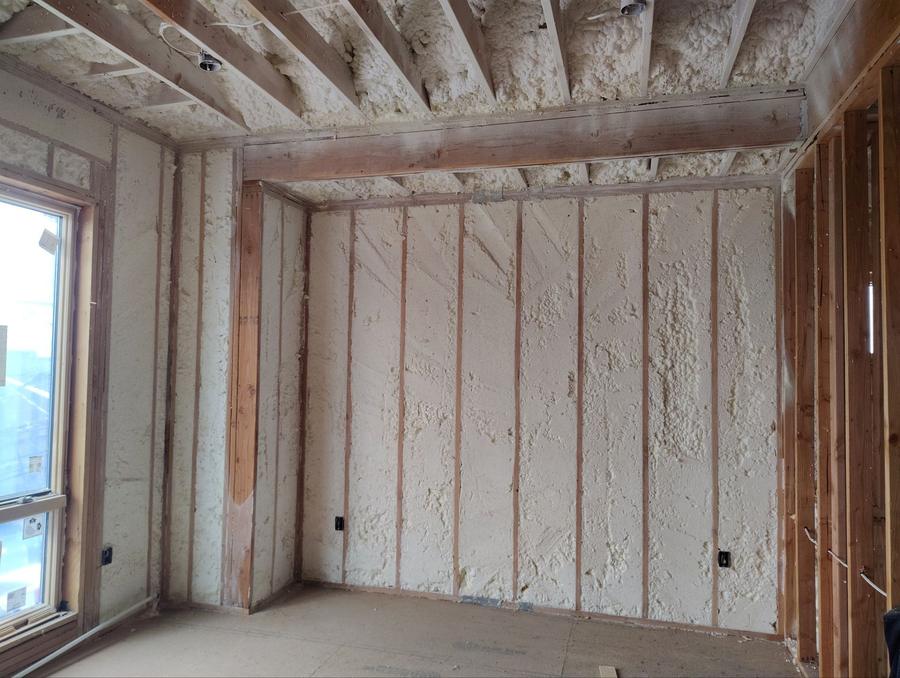
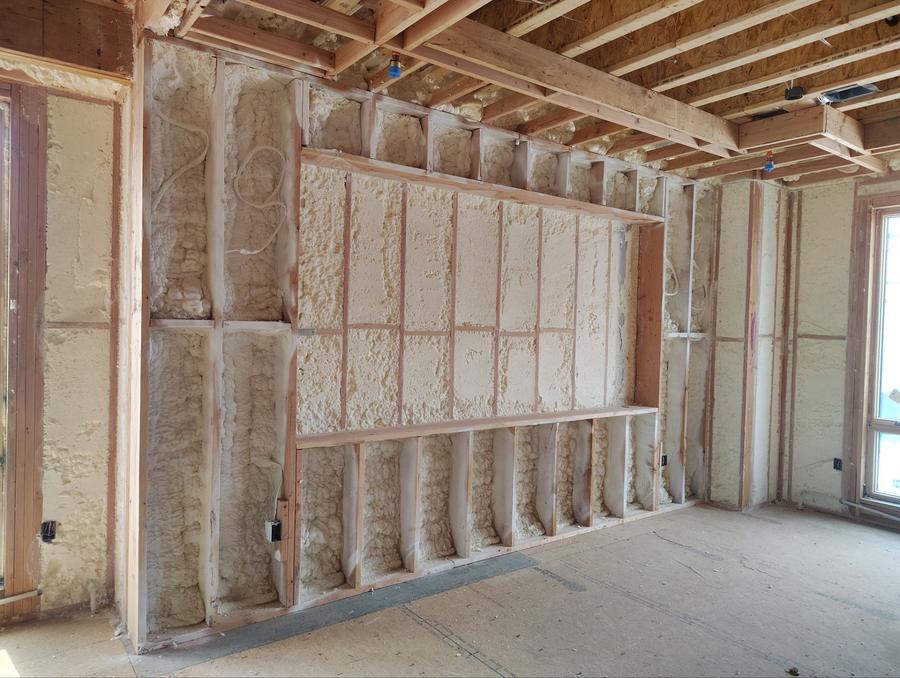
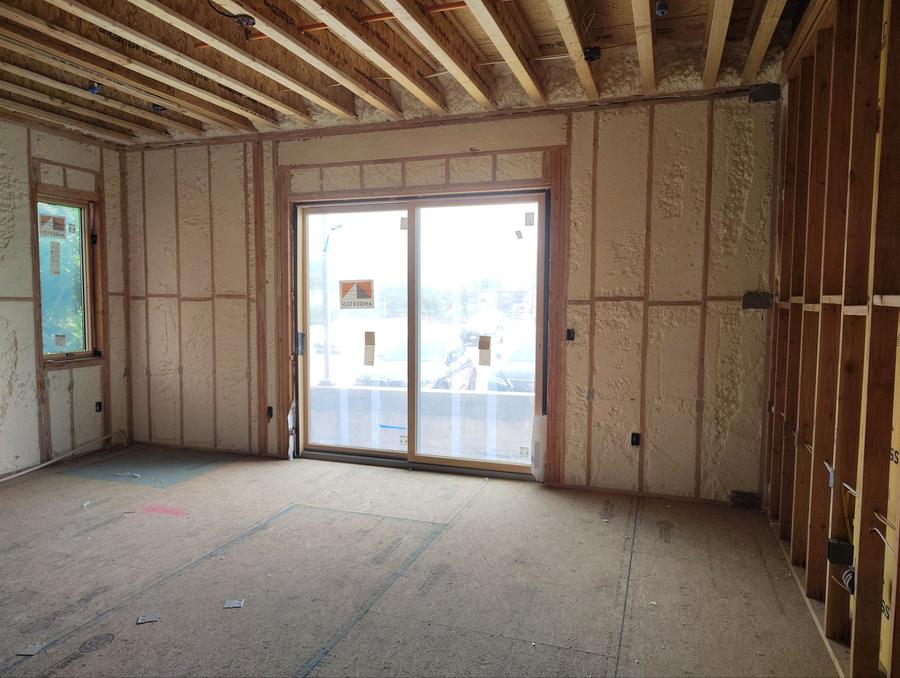
Then the rebuilds. A 19th-century house on Hammett Avenue came down around 2002 for two large duplexes, and that cycle has repeated across the low-rise streets: a side-by-side duplex on the old lot, counted by the Census as two attached one-unit houses. Those went up under the 2000–2015 energy codes, so the walls are already insulated and blowing more in is not the job. The job is the party wall, often unsealed and open to both attics; the garage-under first floor; the cantilevered bays; a flat or low-slope roof with no ventilation path; the air handler in the attic and the bath fans that vent into it.
In the 5.2% of village houses that predate 1940 we assume balloon framing and knob-and-tube until we see otherwise, and the wiring comes out before anything goes into a wall.
Towers and streets: what we do in Fort Lee and what we do not
The skyline started with the George Washington Bridge in 1931 and filled in after the 1960s. Ten buildings stood over 300 feet by 2019; the Palisades Amusement Park site went to towers after the park closed on 12 September 1971; Horizon House alone is a six-building co-op on 32 acres. None of it is a job we can sell the owner of one unit. A tower’s envelope is masonry or curtain wall with no cavity and no attic, its heating and cooling come through a wall sleeve in each apartment, and the envelope belongs to the co-op or condominium, whose board makes capital decisions for the whole building. If you own a unit in one, the useful call is to your board and its engineer, not to an insulation contractor.
The streets are different. A Coytesville cape, a Linwood split, a two-family on a side street or one half of a new duplex has an attic, a rim, knee walls or a party wall, and an owner who can say yes. If you are not sure which side of that line your building is on, we will tell you on the phone before anyone drives out.
We seal before we insulate
Insulation slows heat moving through a surface. It does nothing about air moving through a gap. Pack a leaky attic with cellulose and you have a leaky attic with cellulose in it.
In a Fort Lee two-family or duplex the sequence starts at the party wall and the stair. Close the party wall where it runs into the attic so one unit’s air stops crossing into the other; seal the stair chase and the floor cavity between units at each level; seal the top plates, stack and chimney at the attic plane; seal the garage-under ceiling; then the rim. Then insulate. In a Coytesville cape it starts at the knee walls: air barrier on the back side, blocking in the joist bays, baffles in the slopes, then the flat.
If a quote specifies a depth of insulation and never mentions air sealing, it is half a job.
What insulation costs in Fort Lee
Most of our projects run between $3,500 and $12,500. A two-family is priced as one building because the stair chase, floor cavity and roof are shared; what moves the number is the roof area over the top unit, the count of wall bays to block and dense-pack, and cellar access. A duplex half or a post-war cape is usually smaller: party wall or knee walls, attic plane, rim. Our Fort Lee spray foam cost page has more detail.
Open cell foam runs R-3.9 to R-4.2 per inch. Closed cell runs R-6.9 to R-7.1 per inch and also acts as a vapor retarder, which is why it costs more and why it is right in some assemblies and unnecessary in others. All products are manufactured in the United States and meet applicable building code and safety standards. ENERGY STAR says sealing air leaks and adding insulation can save up to 10% on annual energy bills.
Insulation rebates in Fort Lee
Fort Lee is PSE&G territory for both electric and gas, towers and streets alike. PSE&G’s whole-home program is written for one- to four-unit homes, which is to say the streets.
The live money is PSE&G Whole Home Energy Solutions: up to $7,500 in rebates toward air sealing, insulation and related work, plus 0% on-bill repayment of up to $25,000 over 7 or 10 years. It starts with PSE&G’s home energy assessment, and the work must be done by a BPI-certified contractor participating in PSE&G’s program. PSE&G does not publish what each measure pays, so “up to $7,500” is as precise as anyone can be.
PSE&G’s Whole Home Energy Assessment is free for any PSE&G gas or electric customer, once a year. PSE&G Home Weatherization installs insulation, air sealing and duct sealing at no cost for households above 250% and below 400% of the federal poverty level. New Jersey Comfort Partners does the same at no cost for households at or below 250% of the federal poverty guidelines, $82,500 for a family of four, and refers homes heated with oil or propane to the state weatherization office; 4.4% of Fort Lee still heats with oil.
The New Jersey IRA Home Energy Rebates have not launched. The state’s page says “under development,” so they are not available yet.
The federal Section 25C tax credit ended for anything placed in service after 31 December 2025. There is no federal insulation credit on a 2026 job. The full picture is in our New York and New Jersey rebate guide.
Code and climate in Fort Lee
66.5% of Fort Lee’s units went up before 1980, and the streets this page is about predate New Jersey’s first statewide energy subcode of 1 January 1978. Bergen County is climate zone 5A; Essex, Hudson and Union next door are 4A.
New Jersey adopted the 2024 IECC on 17 August 2026. For new construction it sets R-49 ceilings — the 2021 edition it replaced called for R-60, and a permit application filed under the old code is still accepted for six months, until about mid-February 2027 — with walls at R-20 plus R-5 continuous, windows at U-0.28, and air leakage of 3.0 air changes per hour at 50 pascals. Existing homes fall under New Jersey’s Rehabilitation Subcode: insulating an attic does not require bringing the rest of the house to code and does not require a blower-door test. Blown-in or batt insulation installed against the interior finish is ordinary maintenance with no permit; spray foam and other foam plastic insulation need a permit, which we pull as part of the job. R-49 is the number the state considers right for this climate, and it is what we design to.
Common questions about insulation in Fort Lee
Do you install insulation in Fort Lee, NJ?
Yes, on the low-rise streets: the detached houses and two- to four-family buildings of Coytesville, Palisade, Linwood and Taylorville, the 1,532 units in two-unit buildings, and the newer side-by-side duplexes, roughly 4,700 units in all. We do not work on the towers, where the envelope is masonry or curtain wall and belongs to a board, and we will tell you which side of the line you are on when you call.
How much does insulation cost in Fort Lee?
Most projects run $3,500 to $12,500. A two-family is priced as one building, and the drivers are the roof area over the top unit, the number of wall bays to block and dense-pack, and cellar access. A post-war cape or one half of a new duplex is usually a smaller scope: knee walls or the party wall, the attic plane and the rim. We give a written scope and price after a free walk-through.
Are there insulation rebates in Fort Lee?
Fort Lee is PSE&G territory for gas and electric. PSE&G Whole Home Energy Solutions offers up to $7,500 in rebates plus 0% on-bill repayment of up to $25,000 for one- to four-unit homes, and it starts with a PSE&G home energy assessment. Comfort Partners and PSE&G Home Weatherization do the work at no cost for income-qualified households. New Jersey’s IRA rebates have not launched, and the federal 25C credit ended for anything placed in service after 31 December 2025.
We own an apartment in a Fort Lee co-op tower. Can you insulate it?
No, and we would rather say so now than after a visit. A tower’s envelope is masonry or curtain wall with no cavity to fill and no attic above your ceiling, the heating and cooling come through a wall sleeve, and the envelope belongs to the co-op, so any change to it is a capital decision for the board. Take the question to the board and its engineer. If your building is a two-family, a duplex or a house, call us.
Free energy audit in Fort Lee
We walk the attic or the roof cavity over the top unit, the knee walls or the party wall, the garage ceiling, the cellar and the rim, then give you a written scope and a price. No charge, no obligation. If the attic is fine and the real work is the party wall and the garage ceiling, we will tell you that.
Call 914-554-2289 or use the form on this page. Open 8am–8pm, seven days. We work out of New Rochelle, NY with a 100-plus in-house crew.
Get my free estimateor call 914-554-2289, 8am–8pm every day