Greenwich is four different insulation problems wearing one town name. A
backcountry masonry house from 1910, a balloon-framed frame house off Greenwich
Avenue, a 1955 ranch in Riverside, and the 8,000 square foot rebuild that
replaced the ranch next door all fail in completely different ways, and a
contractor who quotes them the same way is guessing.
We work all four. Here is what we actually find.
The houses we insulate in Greenwich
The median Greenwich house was built in 1963, and roughly seven in ten
predate 1980 — but the median hides the real shape of the town. A quarter
of the housing stock went up before 1940, and another 15% has been built since
2000, most of it replacing something smaller on the same lot.
In the pre-1930 frame houses of central Greenwich, Byram and Chickahominy,
the recurring finding is balloon framing: stud bays running uninterrupted from
the sill plate to the attic, so the wall cavity works as a chimney. Dense-packing
those bays is the fix, but only after the top and bottom plates are blocked and
sealed — blow cellulose into an open bay and you have insulated a
chimney. Knob-and-tube wiring is common enough in this stock that we check for
it before quoting, because it has to be remediated before anything goes into
the walls.
The backcountry estate houses are a different building altogether. Solid or
veneered masonry walls with furring strips behind the plaster give you no cavity
worth filling, so anyone promising to dense-pack them is selling you something
that will not work. The real gains there are the attic floor, the rim joist, the
basement, and air sealing the junctions of a complicated roofline — often
under a slate roof, which puts roof-deck work out of economic reach and pushes
the whole job down to the attic floor.
In Riverside, Old Greenwich and Cos Cob, the mid-century ranches and splits
have loose-fill settled to four or five inches and wind-washed thin at the
eaves, an open chimney chase, and a cantilevered floor or garage ceiling nobody
ever insulated. Closer to the water, the houses raised after Sandy lose heat
straight down through an uninsulated floor deck — batts stapled into an
open crawl fall out within a few winters, and closed cell foam to the underside
of the subfloor with the rim fully sealed is the assembly that lasts.
We seal before we insulate
Insulation slows heat moving through a surface. It does nothing about air
moving through a gap. Pack a leaky attic with cellulose and you have a leaky
attic with cellulose in it — the air still moves, it just moves through
something fluffier.
So the first half of a real job is closing the holes: the chimney chase, the
open framing above a dropped soffit, the plumbing stack, the top plates, the
attic hatch, the recessed lights. In a balloon-framed Greenwich house that also
means blocking the stud bays at the top plate before anything is blown in. It
is unglamorous work, it photographs badly, and it decides whether the insulation
you paid for actually performs. Then we insulate.
If a quote specifies a depth of insulation and never mentions air sealing,
it is half a job.
What insulation costs in Greenwich
Most of our spray foam projects run between $3,500 and
$12,500. Where a Greenwich house lands inside that depends mostly on
whether we are working an attic floor or a roof deck, how much has to be cleared
out first, and how complicated the roofline is — the multi-gable
backcountry houses take far longer to air seal than a 1,600 square foot ranch,
and that is labor, not material.
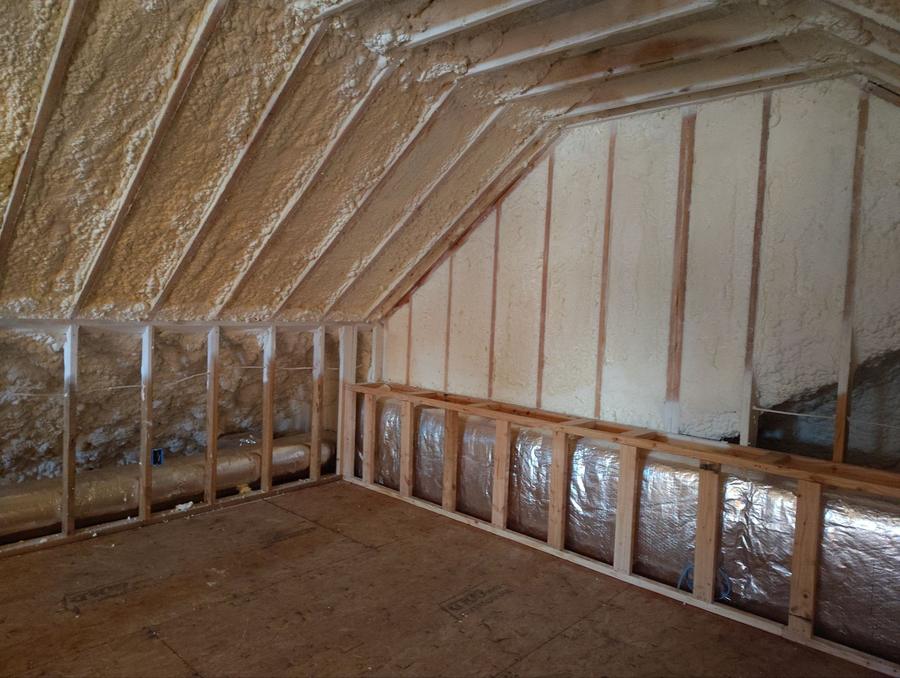
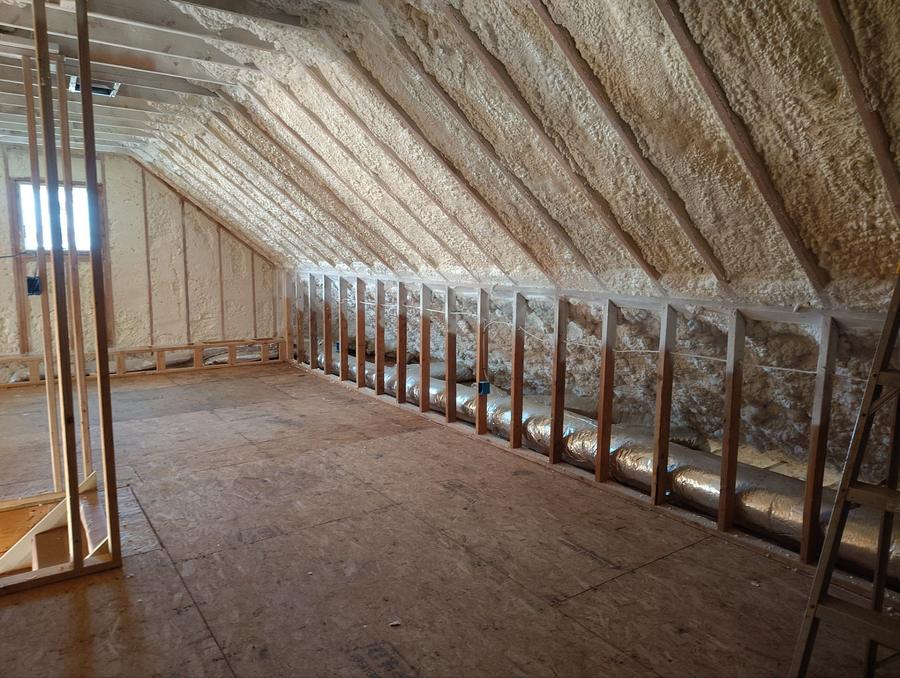
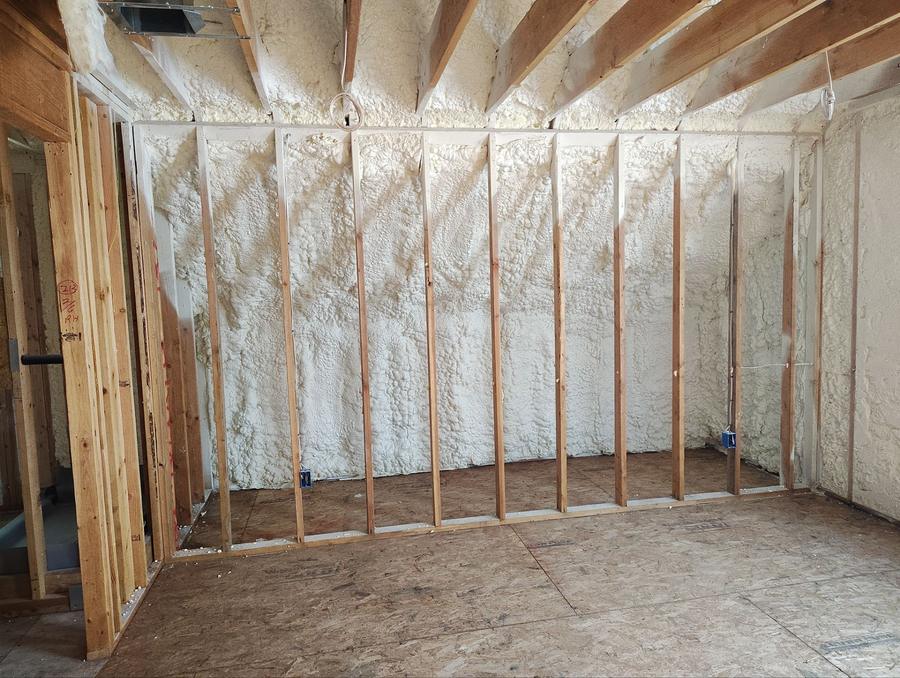
Open cell foam runs R-3.9 to R-4.2 per inch. Closed cell runs R-6.9 to R-7.1
per inch and also acts as a vapor retarder, which is why it costs more and why
it is right in some assemblies and unnecessary in others. All products are
manufactured in the United States and meet applicable building code and safety
standards. ENERGY STAR says sealing air leaks and adding insulation can save up to 10% on annual energy bills.
Insulation rebates in Greenwich
Greenwich is in Eversource territory, so insulation
incentives here run through Energize Connecticut. The order matters and it is
not negotiable: book a Home Energy Solutions assessment first
(the homeowner copay has been $40 since April 2026), have
insulation recommended during that visit, get the project approved before
anyone installs anything, and use a contractor on the Energize CT Insulation
Installers Network. Skip a step and the money is gone.
The rebate is $2.00 per square foot or 75% of the job, whichever is
less, up to $10,000, and $2.50 per square foot up to
$15,000 for income-qualified households and homes in designated
environmental justice communities.
One limit to know before you plan a Greenwich job: the rebate covers the
envelope between conditioned and unconditioned space, so attic floors, floored-over attics, above- and below-grade walls, basement and garage ceilings and rim joists qualify —
attic roof decks and rafters do not. Crawl spaces are not on that list either. A crawl space ceiling may or may not be accepted as a floor over unconditioned space depending on how the job is written up, so if the crawl is the work, confirm it with the program before installation rather than after. Foaming the roof deck to
bring an attic inside the envelope is the right call in some houses, but it is
not the rebated measure, and we will tell you which one you are looking at
before you decide rather than after. See
the full Connecticut rebate
guide for the mechanics.
The federal Section 25C tax credit ended for anything placed in service after
31 December 2025. There is no federal insulation credit on a
2026 job, whatever you may still read online.
Code and climate in Greenwich
Seven in ten Greenwich houses were built before 1980, which is to say before
Connecticut had a meaningful energy code at all. The current one is the
2022 Connecticut State Building Code, in force since 1 October
2022 and based on the 2021 IECC; the next edition was expected in July 2026 and
has been delayed. Fairfield County is climate zone 5A —
you will see 4A quoted in places, but that comes from an ASHRAE addendum
Connecticut never adopted.
For new construction and additions the code sets R-60 in the
ceiling, R-30 in wood-framed walls (or R-20 cavity plus R-5
continuous), R-30 in floors, and R-19 or R-15 continuous in basement and crawl
space walls. None of that applies to a house that is already
standing. The code expressly does not require an existing building to be
altered; it only requires that if you alter an assembly, you do not end up with
less insulation than you started with. Useful as a benchmark, not an obligation
— and ENERGY STAR recommends R-60 for a retrofit
attic in this zone.
Common questions about insulation in Greenwich
Do you install insulation in Greenwich, CT?
Yes. We work across Greenwich, from the pre-1930 frame houses in the
Chickahominy and Byram neighborhoods to the backcountry masonry properties and
the mid-century houses in Riverside, Old Greenwich and Cos Cob. Each needs a
different approach, which is why the audit comes before the quote.
How much does insulation cost in Greenwich?
Most projects run $3,500 to $12,500. In Greenwich the number is driven less
by square footage than by roofline complexity and access — a
simple Riverside ranch attic sits near the bottom of that range, while
a backcountry house with six roof planes, a slate roof and a finished third
floor sits near the top because the air sealing takes days, not hours.
Are there insulation rebates in Greenwich?
Yes, through Energize Connecticut. Greenwich is Eversource territory. The
rebate is $2.00 per square foot or 75% of the job, whichever is less, capped at
$10,000 — but only if a Home Energy Solutions visit came first, insulation
was recommended during it, and the project was approved before installation.
Attic roof decks and rafters are excluded. There is no longer a federal tax
credit.
Can you insulate a stone or brick Greenwich house?
Partly, and we would rather say so up front. Solid and veneered masonry walls
with furring strips behind the plaster have no cavity to fill, so wall
dense-packing is off the table without an interior or exterior retrofit
assembly. What does work, and works well, is the attic floor, the rim joist,
the basement, and sealing the junctions in a complicated roofline. That is
usually where most of the loss is anyway.
Free energy audit in Greenwich
We walk the attic, the basement and the crawl space, find where the house is
losing air and heat, and give you a written scope and a price. No charge, no
obligation. If the answer is that your attic is fine and the real problem is the
rim joist and a bath fan venting into the soffit, we will tell you that —
it is a smaller job and it is the honest one.
Call 914-554-2289 or use the form on this page. Open
8am–8pm, seven days. We have insulated hundreds of homes across New York,
Connecticut and New Jersey with a 100-plus in-house crew.
Get my free estimateor call 914-554-2289, 8am–8pm every day