Newtown is the only one of the 23 towns in Fairfield County whose biggest
building decade is the 1990s: 18.0% of the stock went up between 1990 and
1999. Those houses are large, complicated, and they share one cold room.
It is almost always the bonus room over the garage.
The houses we insulate in Newtown
Newtown has 9,965 housing units, 86.9% detached and 89.9% owner-occupied,
median build year 1976. A third of the town, 33.2%, dates from the 1960s and
70s, 18.0% from the 1990s, and only 10.0% predates 1940. It is a big town with
several centers — Newtown Borough, Sandy Hook, Hawleyville, Botsford
— and mostly wells and septic outside the borough. The borough antique
inventory is real but small. The volume is 1970s through 1990s colonials on
wooded lots of an acre and up.
The 1990s houses are where the money is, because size and complexity did the
damage: multiple roof planes meeting at valleys nobody can reach, cathedral
entries and great rooms, attic-mounted air handlers, and a finished bonus room
over a two- or three-car garage.
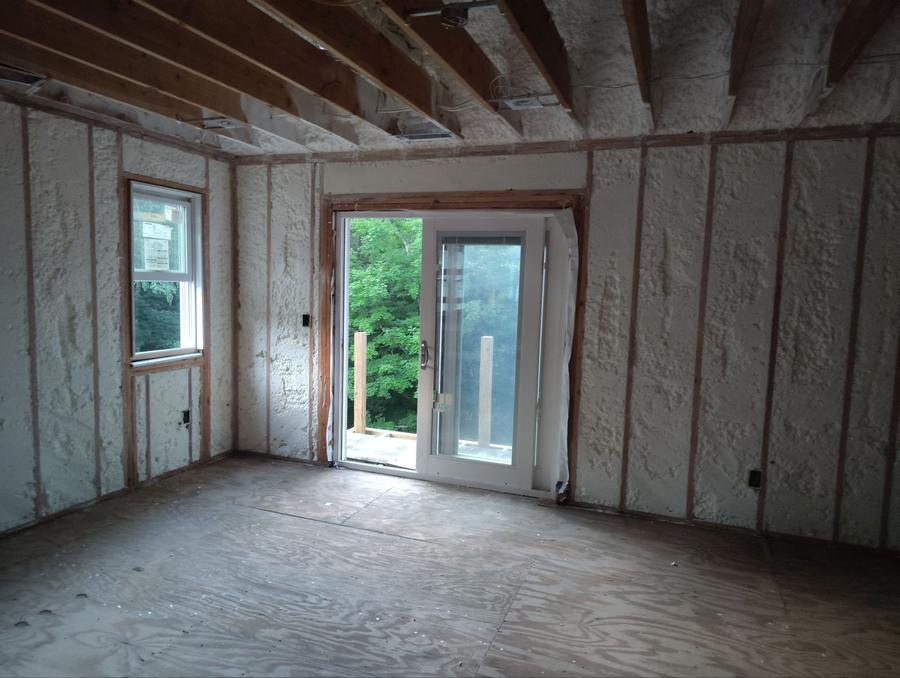
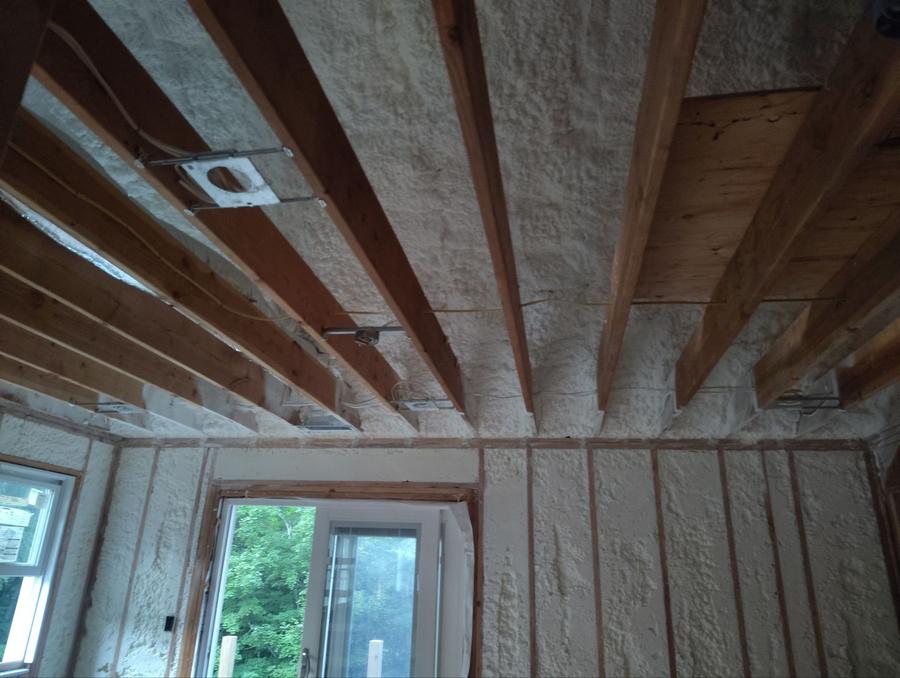
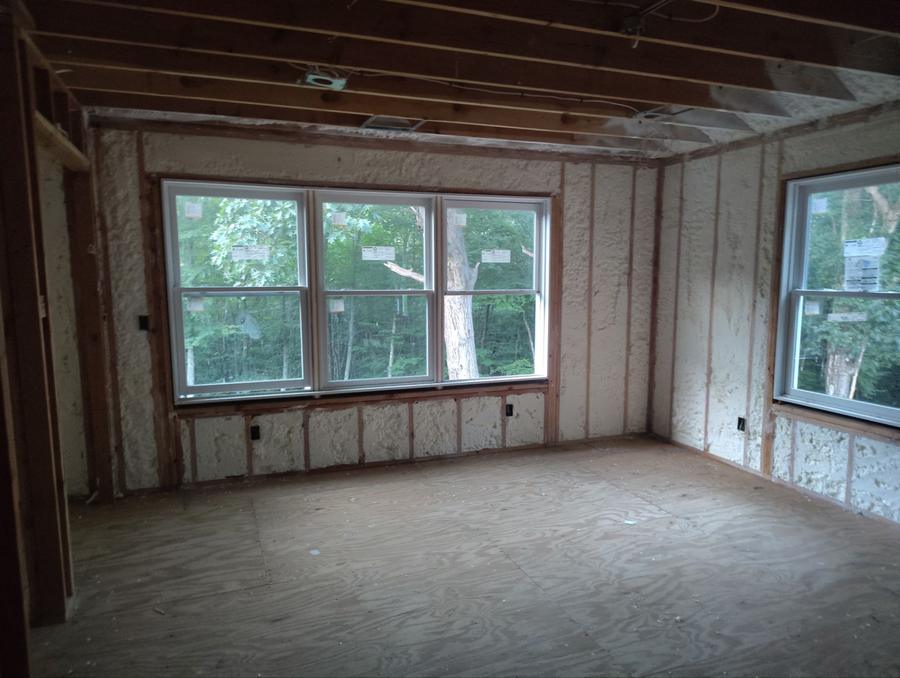
That bonus room is worth describing properly, because it gets diagnosed wrong
constantly. It sits inside the roof above an unheated garage, surrounded by
cold on more sides than any other room in the house. Underneath is the garage
ceiling — often drywall with batts sagging out of it, or nothing at all
— over a space flushed with outdoor air every time the overhead door
goes up. On the sides are short knee walls with vented attic behind them, and
in a bonus room that attic usually wraps three sides, not two. The floor
joists run out under those knee walls as open bays, so attic air travels
directly under the finished floor. Where the room projects past the garage
wall the floor is a cantilever with the joist ends open. And the supply air
often crosses a cold attic first.
Six surfaces, and the usual response is to blame the heating system and add a
zone or a mini-split. Sometimes a mini-split is right, but not until the
garage ceiling is air sealed and insulated to the underside of the floor deck,
the joist bays under the knee walls are blocked, the knee walls have an air
barrier on the attic face, and the cantilever is closed at the joist ends.
Elsewhere in town the 1960s and 70s stock is the familiar version of the same
problem: loose-fill settled to four or five inches, wind-washed thin at the
eaves, and an open chimney chase.
We seal before we insulate
Insulation slows heat moving through a surface. It does nothing about air
moving through a gap. Pack a leaky attic with cellulose and you have a leaky
attic with cellulose in it — the air still moves, it just moves through
something fluffier.
So the first half of a real job is closing the holes: top plates, the chimney
chase, the framing above a dropped soffit, recessed cans, the attic hatch. In
a Newtown house with a bonus room that also means blocking the floor joist
bays where they pass under the knee walls, and sealing the garage ceiling
perimeter. Insulate over an open bay and you have insulated a duct. Then we
insulate.
If a quote specifies a depth of insulation and never mentions air sealing, it
is half a job.
What insulation costs in Newtown
Most of our projects run between $3,500 and $12,500. Newtown
houses tend toward the upper half, not for square footage but for surface
count: a 1990s colonial with a bonus room, a cathedral great room, four or
five roof planes and an air handler in the attic is five separate assemblies,
and the air sealing takes days rather than hours. A 1970s colonial with one
open attic is a bottom-of-range job.
Open cell foam runs R-3.9 to R-4.2 per inch. Closed cell runs R-6.9 to R-7.1
per inch and also acts as a vapor retarder, which is why it costs more and why
it is right in some assemblies and unnecessary in others. All products are
manufactured in the United States and meet applicable building code and safety
standards. ENERGY STAR says sealing air leaks and adding insulation can save up to 10% on annual energy bills.
Insulation rebates in Newtown
Newtown is Eversource territory and incentives run through
Energize Connecticut. The order is not negotiable: book a
Home Energy Solutions visit first (the homeowner copay has been
$40 since April 2026), have insulation recommended during that
visit, get the project approved before anyone installs anything, and use a
contractor on the Energize CT Insulation Installers Network. Skip a step and the
money is gone.
The rebate is $2.00 per square foot or 75% of the job, whichever is
less, up to $10,000, and $2.50 per square foot up to
$15,000 for income-qualified households and homes in designated
environmental justice communities. Households under 60% of state median income
can qualify for HES-Income Eligible, which covers approved insulation up to
100%.
The scope rule lines up well with a bonus room. Attic floors, floored-over attics, above- and below-grade walls, basement and garage ceilings and rim joists qualify, so the knee
walls count as walls and the garage ceiling counts as an unconditioned ceiling
— between them, most of the job. Attic roof decks and rafters do
not qualify. Crawl spaces are not on that list either. A crawl space ceiling may or may not be accepted as a floor over unconditioned space depending on how the job is written up, so if the crawl is the work, confirm it with the program before installation rather than after. Foaming the sloped ceiling of a bonus room or a
cathedral great room is sometimes right, but it is not rebated. See the full Connecticut rebate guide
for the mechanics.
The federal Section 25C tax credit ended for anything placed in service after
31 December 2025. There is no federal insulation credit on a
2026 job.
Code and climate in Newtown
56.7% of Newtown predates 1980, and even the 1990s houses that define the town
were built well below the current standard. That standard is the 2022
Connecticut State Building Code, in force since 1 October 2022 and
based on the 2021 IECC; the next edition was expected in July 2026 and has
been delayed. Fairfield County is climate zone 5A — you
will see 4A quoted in places, but that comes from an ASHRAE addendum
Connecticut never adopted.
For new construction and additions the code sets R-60 in the
ceiling, R-30 in wood-framed walls (or R-20 cavity plus R-5
continuous), R-30 in floors, and R-19 or R-15 continuous in basement and crawl
space walls. None of it applies to a house that is already
standing. The code does not require an existing building to be
altered, only that altering an assembly not leave you with less than you
started with. A benchmark, not an obligation — and the Department of
Energy separately recommends R-60 for a retrofit attic here.
Common questions about insulation in Newtown
Do you install insulation in Newtown, CT?
Yes. Most of our work here is the 1970s through 1990s colonials that make up
the bulk of the town, plus the smaller antique inventory in the borough. These
houses are large with complicated rooflines, so we walk the whole envelope
before quoting rather than pricing by square foot.
How much does insulation cost in Newtown?
Most projects run $3,500 to $12,500. A 1970s colonial with one open attic sits
near the bottom. A 1990s house sits higher because it is not one attic: it is
an attic plus knee walls plus a garage ceiling plus a cathedral ceiling plus
ductwork, each sealed separately before it is insulated.
Are there insulation rebates in Newtown?
Yes, through Energize Connecticut. Newtown is Eversource territory. The rebate
is $2.00 per square foot or 75% of the job, whichever is less, capped at
$10,000, and $2.50 per square foot up to $15,000 for income-qualified
households. The Home Energy Solutions visit comes first and the project must
be approved before installation. Attic roof decks and rafters are excluded. No
federal tax credit any more.
Why is the bonus room over our garage always freezing?
Because it is surrounded by unconditioned space on five or six sides. The
garage below is vented to outdoors every time the door opens, the knee walls
have vented attic behind them on three sides, the floor joists run out into
that attic as open bays, and any overhang past the garage wall is a cantilever
open at the joist ends. Adding heat does not fix that. Sealing those surfaces
does.
Free energy audit in Newtown
We walk the attic, the knee wall spaces, the garage ceiling and the basement,
and give you a written scope and a price. No charge, no obligation. If the
main attic is already fine and the whole problem is the bonus room, we will
scope just that.
Call 914-554-2289 or use the form on this page. Open
8am–8pm, seven days. We work out of New Rochelle, NY with a 100-plus
in-house crew.
Get my free estimateor call 914-554-2289, 8am–8pm every day