92.1% of Madison’s 8,020 housing units are detached houses, and 90.6% of occupied units are owner-occupied. Attached homes make up 2.9%, two-unit buildings 1.2% and three- and four-unit buildings 1.3%, and there is almost nothing larger. On this stretch of the shoreline, between Guilford and Clinton and home to Hammonasset Beach State Park, nearly every insulation job is a single-family house whose owner makes the decisions.
Those houses mostly run on delivered fuel. Fuel oil heats 57.9% of occupied units and bottled gas 10.4%, while utility gas heats 16.7%, electricity 12.9% and wood 1.4%. Southern Connecticut Gas serves the town, but a house burning oil or propane buys its heat by the delivery, and each leak sealed stretches every fill a little further. The median unit dates from 1975, and the 1970s were the busiest decade, building 21.3% of today’s stock.
The houses we insulate in Madison
By era, 11.5% of Madison predates 1940, 11.9% is from the 1940s and 50s, 36.9% from the 1960s and 70s, 27.5% from the 1980s and 90s and 12.3% has been built since 2000. Building held steady for four decades: 15.5% in the 1960s, 21.3% in the 1970s, 14.0% in the 1980s and 13.5% in the 1990s.
Madison was first settled in 1641 and was known as East Guilford through the 18th century, until it incorporated as a town in 1826 and took the name of President James Madison. Madison Center, the main business area, holds the library and the Madison Green Historic District, and the Allis-Bushnell House, the Deacon John Grave House, the Meigs-Bishop House, the Jonathan Murray House and the Shelley House are all on the National Register. A house of that age usually has walls with nothing in them, a cellar with a stone foundation and an open sill, and an attic floor of boards over bare joists. We start those houses at the attic floor and the cellar sill, check the wiring, and decide about the walls last.
The 1960s and 70s, 36.9% of the town, built colonials, raised ranches and contemporaries. A 1970s colonial leaks through its second-floor ceiling: top plates, light boxes, the chimney chase and a pull-down stair with no cover. A raised ranch leaks through its middle, at the garage ceiling under the bedrooms and the rim joist around the lower level. A contemporary leaks through its cathedral slopes, where batts were packed tight against the roof with no vent space and no air seal behind the recessed lights.
The 1980s and 90s added 27.5% and the years since 2000 another 12.3%: larger colonials with bonus rooms over the garage, finished lower levels and, very often, central air run through the attic. Walls and attic floors are insulated in those houses. The losses are the bonus room’s knee walls and the floor over the garage, the attic stair, and the ductwork sitting in an unconditioned attic.
Insulating the attic floor or the roof above it
In a Madison house with an air handler and ducts in the attic, the first decision is where the insulation goes. The two answers are priced, and treated by the rebate, very differently.
The first keeps the attic cold. Seal the attic floor, seal every duct seam and register boot, cover or bury the ducts where the layout allows, and blow insulation over the floor to depth. It costs less, it works well in a simple attic, and attic floors are on the list of areas the Energize CT insulation rebate covers.
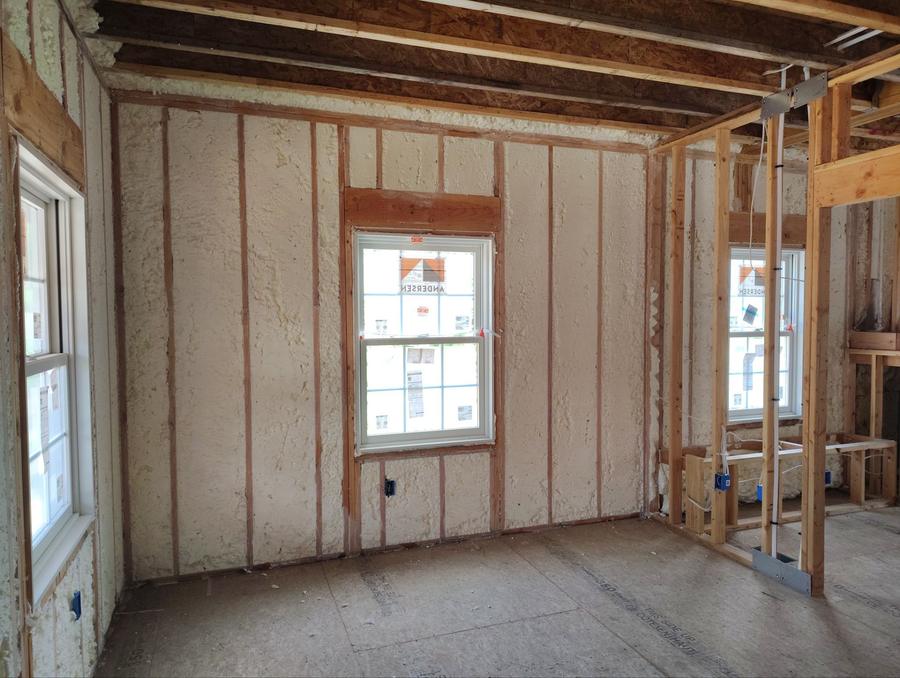
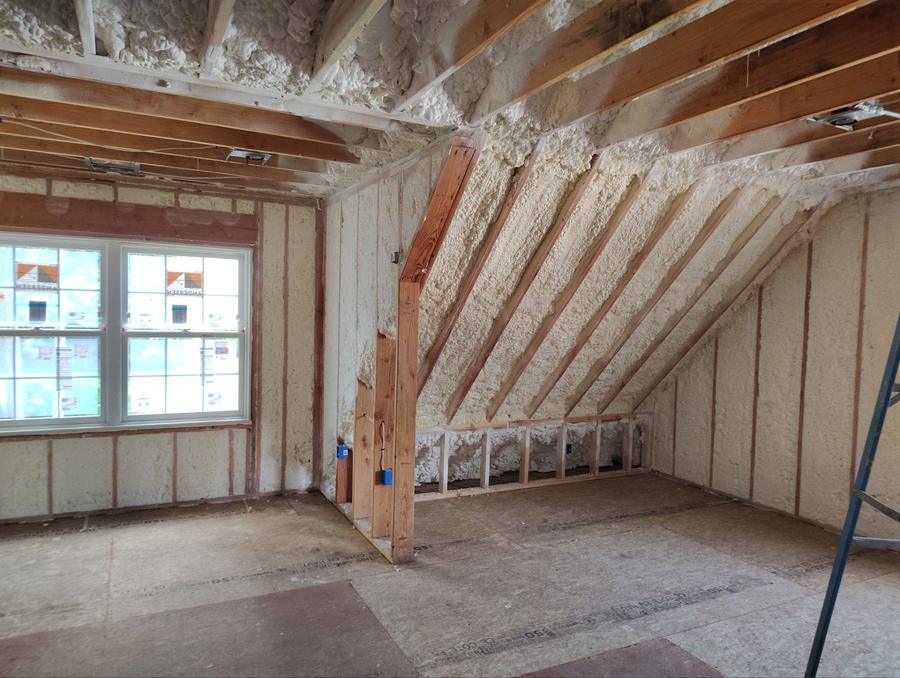
The second brings the attic inside. Spray foam goes on the underside of the roof deck and the gable walls, the vents are closed, and the ducts and air handler end up in conditioned space. In this climate that means closed cell foam, or open cell with a vapor retarder coating over it, so indoor moisture cannot reach cold roof sheathing. It costs more, and it pays best where the attic is crowded with ducts, the ceiling below is broken up by cathedral sections, skylights and recessed lights that cannot all be sealed from above, or the attic floor cannot be reached. The program lists the qualifying areas as attic floors, floored-over attics, walls, basement and garage ceilings and rim joists; foam on the underside of a roof deck is not on that list, so ask the program before counting on a rebate for it.
We will tell you which way fits the house. In many Madison colonials the floor is the right answer; in a contemporary with a complicated roof, it often is not.
We seal before we insulate
Insulation slows heat passing through it. Air takes a different route, through the gaps around it, and every cubic foot of warm air that escapes is replaced by cold air drawn in somewhere lower down.
In a Madison colonial from the 1970s the order is: seal the top plates and every wire and pipe hole in the attic floor; seal the chimney chase with metal and fire-rated sealant; seal the duct boots and seams if there is central air; build an insulated, gasketed box over the pull-down stair; baffle the eaves; then blow the attic floor to depth, and finish in the basement at the rim joist.
If a quote specifies a depth of insulation and never mentions air sealing, it is half a job.
What insulation costs in Madison
Most of our projects run between $3,500 and $12,500. In a colonial the number follows the attic floor area and how much duct sealing it needs; in a contemporary, the cathedral slopes; in a raised ranch, the garage ceiling and rim. Foaming a roof deck costs more than insulating the floor beneath it, and a bonus room adds its knee walls and floor. In an older house near the Green the attic, cellar and wiring set the price. For foam pricing, see what spray foam costs.
Open cell foam runs R-3.9 to R-4.2 per inch. Closed cell runs R-6.9 to R-7.1 per inch and also acts as a vapor retarder, which is why it costs more and why it is right in some assemblies and unnecessary in others. All products are manufactured in the United States and meet applicable building code and safety standards. ENERGY STAR says sealing air leaks and adding insulation can save up to 10% on annual energy bills.
Insulation rebates in Madison
Madison’s electric company is Eversource and its gas company is Southern Connecticut Gas (SCG). Both belong to Energize Connecticut, and Home Energy Solutions is open to customers of Eversource, United Illuminating, Connecticut Natural Gas and Southern Connecticut Gas, whatever fuel heats the house, so a Madison home on oil or propane can apply through Eversource. It serves homes of one to four units that have not had the program’s services within six years.
Since 1 April 2026 the Home Energy Solutions visit has carried a $40 copay. An authorized Home Energy Solutions contractor starts with health and safety tests, runs a blower-door test to pinpoint drafts and air leaks, tests the ducts in a house with forced hot air or central air, and does up to seven hours of air sealing at no cost, with a $10 hourly fee for the extra time a larger home may need. The wrap-up includes a report with the blower-door results and recommended upgrades. There may be a waiting list, and the program is subject to available funding.
The 2026 Energize CT insulation rebate pays up to $2.00 per square foot or 75% of the total cost, whichever is less, up to a maximum of $10,000, with attic floors, floored-over attics, walls, rim joists and basement and garage ceilings all at the same rate. Insulation has to be recommended during the Home Energy Solutions visit, the project approved before installation, and the work performed by an approved contractor from the Energize CT Insulation Installers Network. Spray foam is an accepted material when the area itself qualifies.
There are three income tiers. On Energize CT’s 2026–2027 figures for a household of five, $108,669 or less is Income Eligible, with a no-cost visit and up to 100% of insulation costs covered; $108,670 to $144,893 is Enhanced Incentives, with a no-cost visit and insulation at up to $2.50 per square foot, the real range set by zip code; $144,894 and above is the standard tier. A household close to a limit should confirm its tier before paying the copay.
The Connecticut Green Bank’s Smart-E Loan finances insulation with no money down, up to $50,000, for an owner-occupied Connecticut home of one to four units. Insulation runs at 6.99% APR for 5, 7 or 10 years, 7.49% for 12 and 7.99% for 15 where the lender offers it. Smart-E goes through the Green Bank’s participating contractors; ask whether yours participates.
The program’s own contractors do the Home Energy Solutions visit, and the insulation rebate is paid only on work by a network installer. If the rebate matters most, book the visit first and use a network contractor. If you want foam on a roof deck, which the rebate does not list, or would rather not wait for the program, we will price the job on its own merits. There is no federal tax credit for insulation installed in 2026; Section 25C ended for anything placed in service after 31 December 2025. Our Connecticut rebate guide has the full detail.
Code and climate in Madison
60.2% of Madison’s housing was built before 1980. Shoreline or not, Madison is in climate zone 5A, the zone for every town in Connecticut.
The 2022 Connecticut State Building Code, in effect since 1 October 2022, draws its energy rules from the 2021 International Energy Conservation Code with Connecticut amendments. New homes and additions need R-60 ceilings, or R-49 where it keeps its full uncompressed depth over the top plate at the eaves; wood-frame walls of R-30 cavity, R-20 plus R-5 continuous, R-13 plus R-10 continuous or R-20 continuous; R-30 floors, the figure for a new room over a garage; basement walls of R-15 continuous, R-19 cavity or R-13 plus R-5 continuous; and U-0.30 windows. A new home must pass a blower-door test at 3.0 air changes per hour at 50 pascals on the prescriptive path, and never worse than 5.0. Connecticut’s next code, based on the 2024 IECC, has been adopted in draft, but its effective date has been delayed.
Common questions about insulation in Madison
Do you install insulation in Madison, CT?
Yes. Nearly all of our Madison work is single-family houses: the 1960s and 70s colonials, raised ranches and contemporaries that make up 36.9% of the town, the larger houses of the 1980s, 90s and 2000s with bonus rooms and attic ductwork, and the older houses around Madison Center and the Green. We insulate attic floors and, where it suits the house, roof decks, along with garage ceilings, rim joists and crawl spaces. Attached homes need the association’s approval first.
How much does insulation cost in Madison?
Most projects run $3,500 to $12,500. A colonial is priced on its attic floor and any duct sealing, a contemporary on its cathedral slopes, a raised ranch on its garage ceiling and rim, and a newer house on its bonus room. Spray foam on a roof deck costs more than insulating the floor below it. An older house near the Green depends on its attic, cellar and wiring. The walk-through is free, and the scope and price come in writing.
Are there insulation rebates in Madison?
Yes, through Energize Connecticut. Madison is Eversource for electric and Southern Connecticut Gas for gas, and an oil- or propane-heated home can apply through Eversource. The Home Energy Solutions visit carries a $40 copay, or no cost in the two income-qualified tiers, and the 2026 insulation rebate pays up to $2.00 per square foot or 75% of the cost, whichever is less, to $10,000, on work recommended at the visit, approved first and installed by an Energize CT Insulation Installers Network contractor. No federal tax credit applies in 2026.
Can we use the 1.99% Smart-E rate to insulate our Madison house?
No. The 1.99% Smart-E rate is for eligible heat pump installations only, available through 31 December 2026 and limited to projects of $25,000 and under. Insulation financed with Smart-E runs at the standard rates: 6.99% APR for 5, 7 or 10 years, 7.49% for 12 and 7.99% for 15 where offered, up to $50,000 with no money down, and the lender makes the final decision. If a heat pump is part of the plan, seal and insulate first so the equipment is sized for the tighter house.
Free estimate in Madison
In a colonial we go to the attic first: the floor, the top plates, the chimney, the stair and any ductwork. In a contemporary we look hard at the cathedral slopes and what can be reached from above them. In a raised ranch we start at the garage ceiling and rim. If the choice is attic floor or roof deck, we explain both. Then a written scope and a price, at no charge. That is our free estimate; it is not the Home Energy Solutions visit and does not qualify a house for any rebate.
Call 914-554-2289, 8am–8pm, seven days a week, or use the contact form. The Home Insulators is a family-owned company based in New Rochelle, NY, and every job is done by our own 100-plus in-house crew; we never subcontract.
Get my free estimateor call 914-554-2289, 8am–8pm every day