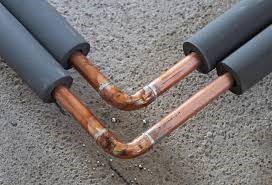
In an unfinished basement, exposed pipes quietly lose heat in winter, drip with condensation in summer, and in a hard freeze can burst and flood the floor above. Insulating those pipes — and the cold space around them — protects your plumbing and trims real energy waste.
Why Basement Pipes Are Worth Insulating
Bare pipes cost you comfort and money in three different ways, so the right fix depends on what each line carries.
- Hot water lines lose heat. A bare copper or PEX pipe running through cold basement air sheds warmth the whole way to your fixtures. Insulating it reduces standby heat loss, so water arrives hotter and sooner — and you waste less running the tap while you wait.
- Cold water lines sweat. In humid months a cold pipe surface pulls moisture out of the air, and that condensation drips onto framing, flooring, and stored belongings. Over time it feeds mold and rot. A sleeve keeps the pipe surface above the dew point so it stays dry.
- Pipes near the foundation can freeze. Lines that run along an uninsulated rim joist, a cold foundation wall, or near a vent or bulkhead are the ones most at risk in a cold snap. Frozen water expands and can split a pipe, and the leak often isn't found until it thaws.
How We Treat the Pipes and the Space Around Them
The most reliable protection is a two-part job: insulate the pipes directly, and warm the basement so they never get close to freezing in the first place.
On the pipes themselves, we fit sleeves sized to the pipe diameter and seal the seams and elbows, since gaps are where condensation and freeze risk sneak back in. But the bigger win is usually the basement envelope. Air sealing and insulating the rim joist (the band of framing where the house meets the foundation) shuts off the cold drafts that pour in right where your pipes run. Closed-cell spray foam is ideal here at roughly R-6 to R-7 per inch because it acts as both an air barrier and a vapor barrier in one pass. Insulating the foundation walls with rigid board or spray foam raises the whole basement's temperature, keeping every pipe farther from the freeze point.
Which material we recommend depends on the assembly, the moisture conditions, and your budget:
- Closed-cell spray foam: ~R-6 to R-7 per inch; air and vapor barrier
- Open-cell spray foam: ~R-3.9 to R-4.2 per inch
- Mineral wool: ~R-3 to R-4.2 per inch
- Fiberglass batt: ~R-3 to R-4 per inch
- Cellulose (blown-in): ~R-3.2 to R-3.8 per inch
A Safety Note for Older Basements
If your home dates to before the 1980s, the existing pipe wrap may contain asbestos — often a chalky, corrugated, or plaster-like covering on old heating pipes — and some attics and walls hold vermiculite. Do not disturb it. Suspect material must be tested first, and if it's positive, removed only by licensed abatement professionals — never as a DIY project. During your audit we'll flag anything questionable and plan the work safely around it rather than tearing into it.
Not sure whether your pipes are sweating, losing heat, or sitting one cold night away from a burst? The Home Insulators has served Westchester and Rockland County, NY and Bergen County, NJ since 2015, and homeowners typically see savings of 20% or more after we tighten up the basement. Call us at 914-825-6824 to schedule your free energy audit, and we'll show you exactly where your pipes — and your energy dollars — are exposed.