39.1% of West Islip’s 8,650 homes were built in the 1950s, and another 26.1% in the 1960s. The median home dates from 1960, 86.9% of the stock predates 1980, and only 6.2% has been built since 2000. 96.2% of the housing is detached houses, two-unit buildings are 0.5%, and there is no building of twenty or more units in the hamlet. 95.8% of occupied homes are lived in by their owners. West Islip is a hamlet in the Town of Islip, on the South Shore between Babylon and Bay Shore, and almost every job here is one house, one owner and one decision.
Heat is close to an even split. 50.8% of occupied homes burn utility gas, 43.1% fuel oil, 4.1% electricity and 1.0% bottled gas. The scope barely changes with the fuel; only the way the savings are counted does, in therms or in gallons. What changes the scope most in West Islip is what sits under the first floor: how the basement is used, and how dry it stays.
The houses we insulate in West Islip
The Secatogue lived along the Great South Bay and the banks of Sampawams Creek, Trues Creek and Willetts Creek. Settlers arrived in 1683 and farmed and fished, and the Long Island Rail Road brought travelers in the mid-19th century. Little housing survives from that long stretch: 4.9% of today’s homes predate 1940 and 5.1% date from the 1940s. In those older houses we assume balloon framing, where a wall cavity can run from the basement to the attic with nothing to stop the air inside it, and we look for knob-and-tube wiring before anything goes into a wall.
The 1950s left 3,382 homes, most of them capes and one-story ranches. A cape of that decade keeps its second floor inside the roof: short knee walls with a batt on the room side and nothing on the back, floor joists running out past the knee wall to the eave, rafter slopes with no baffle and a small flat attic above the collar ties. The cold upstairs floor in January is air moving through those open joist bays. The ranch has one long attic whose loose-fill has settled to a few inches and thins to nothing where the rafters meet the wall plate, with a pull-down stair and a bath fan that both open straight into it.
The 1960s added 2,261 homes and the 1970s another 1,005: larger ranches, high ranches and split-levels. The high ranch sets its garage and family room half in the ground under the bedrooms, so its weak points are the garage ceiling, the rim joist at eye level in the lower room, and the cantilevered overhang across the front. In the 6.9% from the 1980s and 90s, mostly colonials with insulated walls, the job is the attic ductwork and the room over the garage.
Basement walls or basement ceiling: the decision under a West Islip house
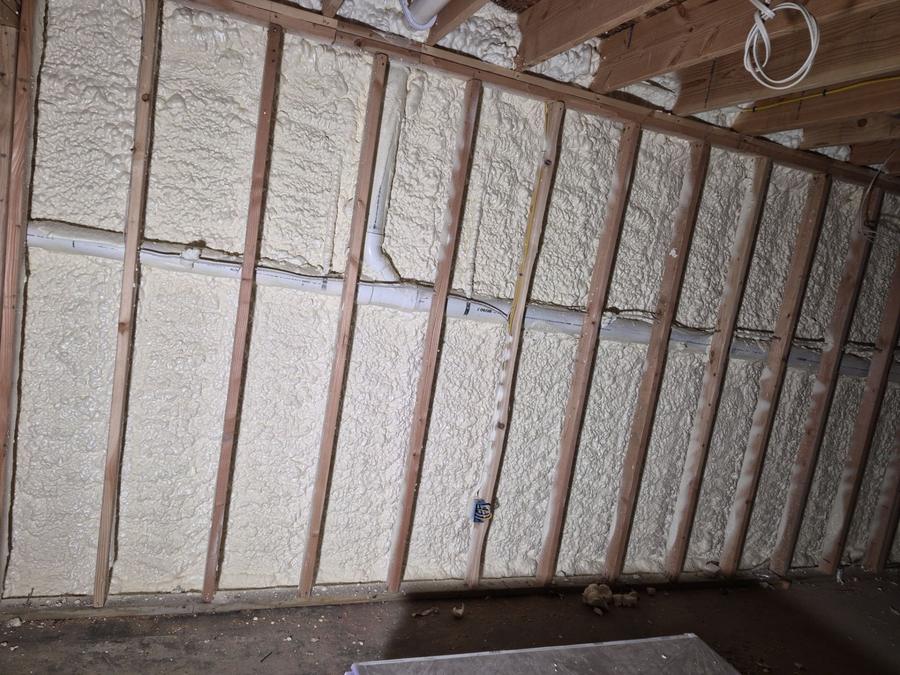
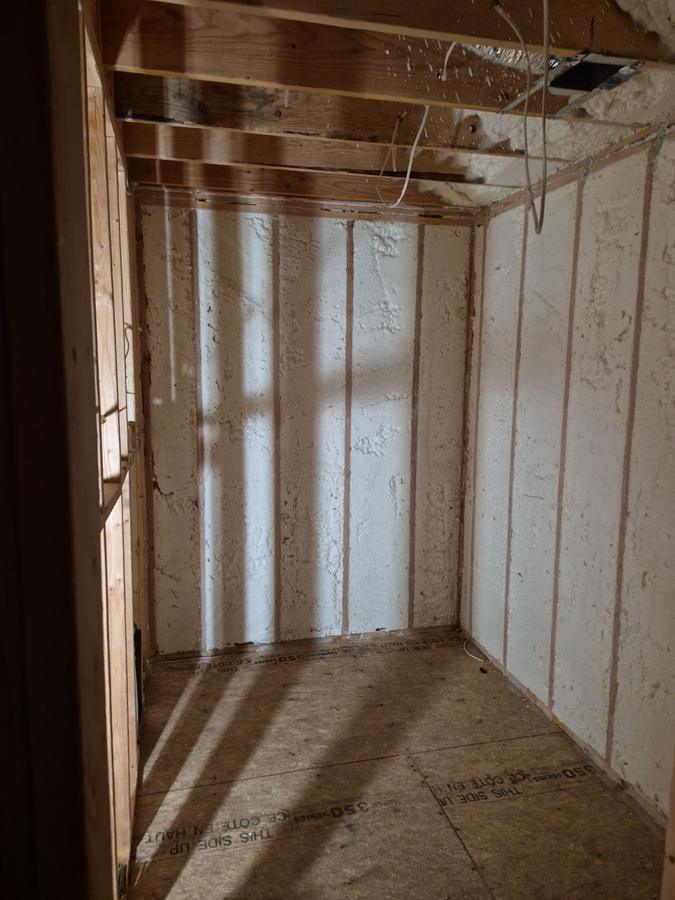
Where a West Islip cape or ranch has a basement, it holds the boiler or furnace, the water heater and, in the 43.1% of homes on oil, the burner and often the tank. Around its top runs the rim joist, the band of framing that sits on the foundation, and in a house of the 1950s or 60s it is usually bare wood with gaps at the sill. Unsealed, that ring is one of the largest holes in the house, and it gets closed cell foam whichever way the rest of the basement goes.
The rest is a choice between two boundaries. If the basement is dry and used, as a family room, a workshop or a laundry, the walls become the boundary: rigid board or closed cell foam against the concrete, framed and finished if the owner wants, and never paper-faced batts pressed against block. If the basement is unfinished and damp, the ceiling can become the boundary instead: insulate between the floor joists above it and the living space is sealed off from the basement below. That choice has costs of its own. The pipes and ducts left below now sit in a colder space and need insulating, and the heat the boiler gives off no longer warms the floor above.
On the low streets toward the Great South Bay, and along the western edge where Sampawams Creek, Hawley’s Lake and the Guggenheim Lakes form the boundary of the hamlet, moisture decides more of that choice. A basement that smells damp in August gets its water sorted first, with gutters, grading or a dehumidifier, and nothing fibrous goes against a foundation wall that gets wet.
We seal before we insulate
Insulation slows heat conducted through a ceiling, a wall or a floor. It does nothing about air moving through a gap, and a cape with open joist bays under its knee walls moves a great deal of air.
In a West Islip cape the work runs from the edges in: block the joist bays under each knee wall at the eave line, put an air barrier on the attic side of the knee walls, seal the top plates, the chimney gap, the plumbing stack and the bath fan in the flat attic, and baffle the slopes so they can be filled without choking the soffit vents. Downstairs, seal the sill and the rim joist, the gaps where pipes and the oil line pass through the foundation, and the chase where the flue leaves the basement. Then insulate.
If a quote specifies a depth of insulation and never mentions air sealing, it is half a job.
What insulation costs in West Islip
Most of our projects run between $3,500 and $12,500. In West Islip the number follows the shape of the house more than its size. A 1950s ranch with a single open attic is the simplest West Islip job and prices toward the bottom of that range. A cape with finished rooms behind knee walls on both sides costs more, because every knee wall, eave bay and slope is a separate piece of work. The basement decides the rest: a rim joist alone is a small addition to the scope, insulated basement walls a larger one, and a basement ceiling depends on how many pipes and ducts run through it. For the foam side of the number, see what spray foam costs.
Open cell foam runs R-3.9 to R-4.2 per inch. Closed cell runs R-6.9 to R-7.1 per inch and also acts as a vapor retarder, which is why it costs more and why it is right in some assemblies and unnecessary in others. All products are manufactured in the United States and meet applicable building code and safety standards. ENERGY STAR says sealing air leaks and adding insulation can save up to 10% on annual energy bills.
Insulation rebates in West Islip
West Islip buys its electricity from PSEG Long Island. Its gas company is National Grid, and National Grid gas is available on many West Islip streets, though not all of them. The electric company decides which rebates a house can use, and because West Islip is PSEG Long Island territory, NYSERDA’s Comfort Home program is not available here.
PSEG Long Island lists a $2,500 insulation rebate and a $1,000 air-sealing rebate for market-rate single-family homes, and $500 for duct sealing, with higher amounts for income-qualified homes and homes in state-designated disadvantaged communities. The rebates are paid through its participating contractors after a free Whole House Energy Assessment that includes a check of insulation and drafts, a thermal scan and a blower door test. A West Islip house on oil qualifies the same as one on gas: single-family homes heated with oil, natural gas, propane or electricity are all eligible. The insulation has to go in with blower-door-assisted air sealing, and PSEG Long Island requires one of its participating contractors, so check its list before you sign.
National Grid’s Long Island insulation rebate program is not taking new applications, and income-eligible households now go through EmPower+. For a Suffolk household under the income limit, NYSERDA’s EmPower+ pays for air sealing and insulation through an EmPower+ contractor: at no cost up to $14,000 at the lower-income tier (at or below $98,925 for a family of four), or half the cost up to $7,000 at the moderate-income tier (below $131,900 for four). Renters can apply too. Long Island households should check eligibility on the MyEnergy portal.
The federal insulation tax credit (Section 25C) ended for work placed in service after 31 December 2025, so there is no federal insulation credit on a 2026 job; be wary of anyone still advertising it. New York has no state tax credit for insulation. The full picture is in our New York and New Jersey rebate guide.
Code and climate in West Islip
86.9% of West Islip’s homes were built before 1980. New York’s first statewide energy code took effect on 1 January 1979, which means the 1950s capes and 1960s ranches that make up most of the hamlet were framed and closed in with no state energy standard at all. Suffolk County is Climate Zone 4.
The standard now is the 2025 Energy Conservation Construction Code of New York State, in force since 31 December 2025. A new house needs R-49 in the ceiling, though R-38 across the entire ceiling satisfies that wherever its full uncompressed height extends over the wall top plate at the eaves. Floors need R-30; basement and crawl space walls R-15 continuous, R-19, or R-13 plus R-5 continuous; windows U-0.27; and the finished house may leak no more than 3.0 air changes per hour at 50 pascals.
A house already standing is treated differently. The parts of it that are not being altered do not have to comply, so sealing a cape’s knee walls does not drag its windows or foundation into the new-home table, and New York’s code does not require a blower door test when you insulate an existing home. Where the work exposes roof or wall cavities, as it does when a knee wall is opened, those cavities must be insulated to full depth. ENERGY STAR recommends R-60 for an uninsulated attic in this zone and R-49 where 3 to 4 inches are already down.
Common questions about insulation in West Islip
Do you install insulation in West Islip, NY?
Yes. Most of our West Islip work is the 1950s cape and ranch, 39.1% of the hamlet’s homes, and the 1960s ranches, high ranches and splits that followed: knee walls with nothing behind them, joist bays open at the eave, settled attic floors, basement rims and garage ceilings. We also insulate basements, walls or ceilings depending on how dry they are, and the older houses from before 1940.
How much does insulation cost in West Islip?
Most projects run $3,500 to $12,500. A 1950s ranch with a single open attic is usually at the lower end. A cape with finished upstairs rooms costs more because each knee wall, slope and eave bay is separate work, and basement walls or a basement ceiling add their own line. A high ranch adds the garage ceiling and the rim in the lower family room. We give a written scope and price after a free walk-through.
Are there insulation rebates in West Islip?
Yes, through PSEG Long Island, which supplies West Islip’s electricity. It lists a $2,500 insulation rebate and a $1,000 air-sealing rebate for market-rate single-family homes, with more for income-qualified homes, paid through its participating contractors after a free Whole House Energy Assessment. Oil-heated and gas-heated houses are both eligible. Comfort Home is not open to PSEG Long Island homes. Income-eligible households can apply to EmPower+. There is no federal 25C credit on a 2026 job and no New York State insulation credit.
Should we insulate our West Islip basement walls or the ceiling above the basement?
It depends on how the basement is used and how dry it is. A dry basement that is lived in or holds a laundry is better inside the house: seal the rim joist with closed cell foam and insulate the walls with rigid board or foam, not batts against the block. A damp, unused basement can be left outside the house by insulating the ceiling, but then the pipes and ducts below need insulating too. Either way the rim joist gets sealed, and near the bay or the creeks we deal with any moisture first.
Free energy audit in West Islip
In a West Islip cape we start upstairs: behind each knee wall, into the joist bays at the eave, up into the flat attic. Then the basement: the rim joist and sill, the walls and whether they stay dry, the pipes and ducts overhead, and in a high ranch the garage ceiling and the cantilever. If the attic is fine and the real loss is the rim, we say so. Then a written scope and a price. No charge, no obligation.
Call 914-825-6824 or use our contact form. Open 8am–8pm, seven days. Family-owned since 2015, we work out of New Rochelle, NY with a 100-plus in-house crew that never subcontracts.
Learn more
- Insulation contractors across Suffolk County
- Insulation in Bay Shore
- Insulation in North Babylon
- Insulation in Babylon
- Basement insulation
- Insulating the ceiling of an unfinished basement
- Air sealing