Fuel oil heats 58.9% of occupied homes in East Hampton, Connecticut, bottled gas 11.5%, electricity 14.0% and wood 9.2%, while utility gas reaches just 4.3%. This is the Middlesex County town of Lake Pocotopaug, Cobalt and Middle Haddam, once named Chatham and known as Belltown, not the East Hampton on Long Island. It is not East Haddam either, the town next door and a common mix-up.
East Hampton has 5,385 housing units. 80.7% are detached houses, 6.4% are in two-unit buildings, and 85.4% of occupied homes are owner-occupied. The median unit dates from 1976, and the town has kept building: 15.5% of units went up in the 2000s alone, and 22.2% of the stock is from 2000 or later. For the oil-heated majority, sealing and insulation pay back as fewer deliveries each winter. For a house that leans on a wood stove, they pay back in fewer cords split and carried, and in far rooms that finally hold the stove’s heat.
The houses we insulate in East Hampton
Settlers from Eastham, Massachusetts, came up the Connecticut River in 1739 to Middle Haddam, and some went on to the hills near Lake Pocotopaug, naming their parish Easthampton in 1746. The town was incorporated as Chatham in 1767 and renamed East Hampton in 1915. An early iron forge stood at the lake’s outlet, and from 1808, when William Barton built the first bell factory on what became Barton Hill, thirty firms were said to have made bells, using the water power of the Pocotopaug Stream. Middle Haddam, where Captain Jesse Hurd built ships after the Revolution, is now a National Register historic district along Moodus and Long Hill Roads.
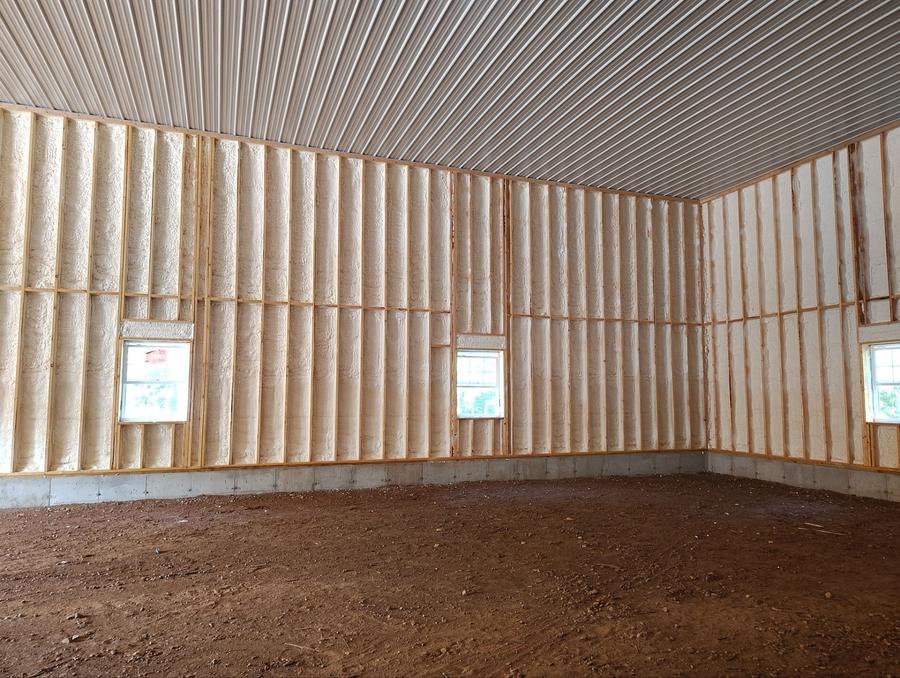
17.5% of East Hampton’s homes, 941 of them, predate 1940. In a Middle Haddam house or a village house from the bell-shop years we expect walls with little or nothing in them, balloon framing in the later ones, a fieldstone or rubble foundation with a damp cellar, and knob-and-tube wiring until an electrician says it is gone. Balloon-framed bays get blocked top and bottom before they are filled, and in a damp stone cellar closed cell foam goes on the rim joist, never fiberglass.
The 1950s built 10.4% of today’s units, the 1960s 8.1% and the 1970s 17.9%, the busiest decade of all. Capes from the first of those decades leak at the knee walls and the open joist bays below their upstairs rooms. Ranches leak through ceilings into attics of thin, settled insulation. The 1970s raised ranch adds a cold bedroom over the garage and an exposed rim around its lower level, often the same level that holds the oil boiler.
The houses of the 1980s, 14.7% of units, and of the 2000s were insulated when built, so their problems are air: bonus rooms over garages with open floor cavities, knee walls behind complicated roofs, cantilevered overhangs, cathedral ceilings and recessed lights open to the attic above.
Lake Pocotopaug accounts for most of the town’s water area. A house set into a slope above the water often has a walkout lower level, its back wall below grade and its lake side fully exposed, with a rim joist that meets outdoor air along the open side. That wall and rim, and the floor over any unheated section, are where a lake house loses heat that its owners blame on the windows.
Oil tanks, wood stoves and a tighter house
Most East Hampton homes burn their heating fuel inside the house, and that changes how we tighten one. An older oil boiler with a chimney, or a wood stove, depends on the house supplying air and on the chimney drawing smoke and exhaust up and out. Seal a house hard and then run a bath fan, a clothes dryer and a range hood at once, and they can pull air down that chimney instead. So combustion appliances get checked before the air sealing starts and again when it is done, and a stove that struggles for air may need an outside air supply.
A wood stove adds a fire question to every attic job. Where a chimney or stovepipe passes through a ceiling, the gap around it is sealed with sheet metal and high-temperature sealant, kept at the chimney maker’s required clearance, and no foam or loose insulation touches the chimney itself. The rest of the attic floor is sealed and insulated normally, and a working carbon monoxide alarm belongs on every floor.
The oil tank and boiler usually sit in the basement, and the boiler’s own heat helps keep that space from freezing. Insulate the basement ceiling and the basement gets colder, along with its pipes. Insulate the rim joist and the upper foundation walls instead, and the basement stays inside the warm part of the house. With the boiler down there, the second choice is usually the right one.
We seal before we insulate
Insulation slows heat moving through a surface. Air leaks carry it straight out, which is why a leaky house with a wood stove has one warm room and several cold ones.
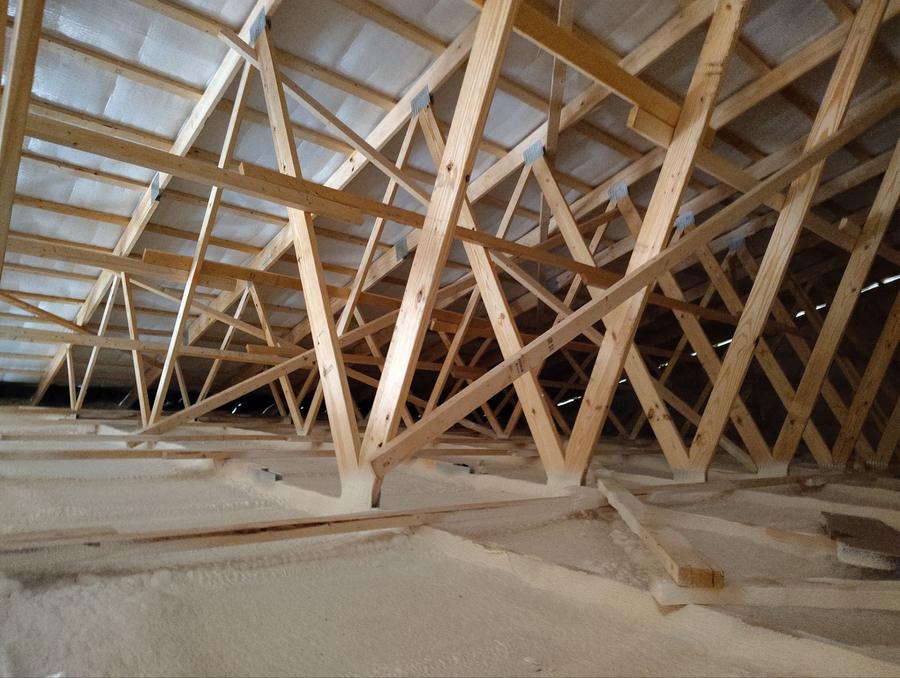
In a 1970s East Hampton raised ranch the sequence runs: test the boiler and any stove first; seal the attic hatch, the top plates, the plumbing stack, the wire holes and the light boxes; close the chimney chase with sheet metal at the required clearance; baffle the eaves; seal the garage ceiling below the bedrooms; foam the rim joist around the lower level; then blow the attic to depth and test the appliances again.
If a quote specifies a depth of insulation and never mentions air sealing, it is half a job.
What insulation costs in East Hampton
Most of our projects run between $3,500 and $12,500. A raised ranch is priced on its attic, garage ceiling and rim; a lake house with a walkout level, on the exposed wall and rim along the open side; a 2000s colonial, on its bonus room and knee walls. A pre-1940 house in Middle Haddam or the village is priced on its walls, its stone cellar and any wiring that must be retired first. Our spray foam cost guide covers the foam side.
Open cell foam runs R-3.9 to R-4.2 per inch. Closed cell runs R-6.9 to R-7.1 per inch and also acts as a vapor retarder, which is why it costs more and why it is right in some assemblies and unnecessary in others. All products are manufactured in the United States and meet applicable building code and safety standards. ENERGY STAR says sealing air leaks and adding insulation can save up to 10% on annual energy bills.
Insulation rebates in East Hampton
East Hampton’s electricity comes from Eversource and its gas from Connecticut Natural Gas (CNG). Home Energy Solutions is open to customers of Eversource, United Illuminating, Connecticut Natural Gas and Southern Connecticut Gas, whatever fuel heats the house. With utility gas in 4.3% of homes, most households will apply through their Eversource electric account. The program fits homes of one to four units, a renter needs the landlord’s approval, and a home that had these services in the last six years must wait.
A standard Home Energy Solutions visit carries a $40 copay, effective 1 April 2026. An authorized contractor does the health and safety tests first, then a blower-door test to pinpoint drafts and air leaks and a duct test where there is forced hot air or central air conditioning, and seals air leaks at no cost for up to seven hours, with a $10 hourly fee after that. The visit closes with a report of recommended upgrades, rebates and financing. There may be a waiting list, and the program is subject to available funding.
The 2026 Energize CT insulation rebate pays up to $2.00 per square foot or 75 percent of the total cost, whichever is less, to a maximum of $10,000. Qualifying areas are attic floors, floored-over attics, walls, basement and garage ceilings and rim joists. An attic floor holding R-19 or less has to finish at R-49 or more. Foam on the underside of a roof deck is not on the list, so ask the program before counting on a rebate for it. The insulation has to be recommended during a Home Energy Solutions visit, approved before installation and performed by an approved contractor from the Energize CT Insulation Installers Network.
Three income tiers apply. On Energize CT’s 2026–2027 figures for a five-person household, $108,669 or less is Income Eligible, with a no-cost visit and up to 100 percent coverage of insulation costs; $108,670 to $144,893 is Enhanced Incentives, with a no-cost visit and up to $2.50 per square foot, a range that moves with the zip code; $144,894 and above is the standard tier. If you are near a limit, ask which tier applies before you pay a copay. Parts of East Hampton are designated environmental justice communities; the state’s map shows whether a specific address qualifies for up to $2.50 per square foot, up to $15,000.
The rebate is paid only on work by the program’s network installers. Ask any installer who quotes, including us, whether they are in that network, and compare prices after any rebate before you decide. The Connecticut Green Bank’s Smart-E Loan lends up to $50,000 with no money down on an owner-occupied home of one to four units, at 6.99% APR over 5, 7 or 10 years, 7.49% over 12 and 7.99% over 15 where the lender offers it; it runs through the Green Bank’s participating contractors, so ask whether yours participates. There is no federal tax credit for insulation installed in 2026, because Section 25C ended for anything placed in service after 31 December 2025. Our Connecticut rebate guide covers the rest.
Code and climate in East Hampton
56.7% of East Hampton’s housing was built before 1980. The town sits in climate zone 5A, as every Connecticut town does, and the 2022 Connecticut State Building Code, which adopts the 2021 IECC with state amendments, has governed applications filed since 1 October 2022.
For a new house or addition it sets ceilings at R-60, with R-49 enough where its full uncompressed depth carries over the wall top plate at the eaves; wood-frame walls at R-30 cavity, R-20 plus R-5 continuous, R-13 plus R-10 continuous or R-20 continuous; floors at R-30; basement walls at R-15 continuous, R-19 cavity or R-13 plus R-5 continuous; and windows at U-0.30. A new home must also pass a blower-door test, 3.0 air changes per hour at 50 pascals on the prescriptive path and never worse than 5.0. Connecticut’s next code, based on the 2024 IECC, has been adopted in draft, but its effective date has been delayed.
Common questions about insulation in East Hampton
Do you install insulation in East Hampton, CT?
Yes, in East Hampton, Connecticut, the Middlesex County town around Lake Pocotopaug. We insulate the older houses of Middle Haddam and the village, the capes, ranches and raised ranches of the 1950s to 70s, the colonials of the 1980s and 2000s, lake houses with walkout levels, and two-family buildings, which we scope as one building. Whether your house heats with oil, propane, wood or electricity, the work is the same, with combustion appliances checked before and after air sealing.
How much does insulation cost in East Hampton?
Most projects run $3,500 to $12,500. A raised ranch is priced on its attic, the garage ceiling under the bedrooms and the rim around the lower level. A lake house turns on its walkout wall and exposed rim, a newer colonial on its bonus room and knee walls, and a pre-1940 house on its walls, stone cellar and any old wiring. Our walk-through is free, and you get the scope and price in writing.
Are there insulation rebates in East Hampton?
Yes, through Energize Connecticut. East Hampton is Eversource for electricity and Connecticut Natural Gas for gas, and since few homes have gas, most households apply through Eversource. The Home Energy Solutions visit carries a $40 copay on the standard tier. The 2026 rebate pays up to $2.00 per square foot or 75 percent of cost, whichever is less, to $10,000, for work recommended at the visit, approved first and installed by a network contractor. Parts of town qualify for a higher environmental justice rate.
Our house above Lake Pocotopaug has a walkout basement. What gets insulated down there?
The walls and rim that face the open side, first. A walkout wall is above grade on the lake side, so it loses heat like any exterior wall, and its rim joist meets outdoor air. We seal and foam that rim, insulate the exposed wall, and treat the buried back wall for moisture before adding anything to it. If the lower level is finished, the work can come from outside or through the ceiling. If it holds the boiler, we keep it inside the insulated part of the house.
Free estimate in East Hampton
An East Hampton walk-through starts with what burns: the boiler, the chimney, any wood stove and its pipe. Then the attic, the top plates and the chimney chase, the garage ceiling in a raised ranch, the walkout wall in a lake house, and the rim joist and cellar walls all the way around. Then a written scope and price, at no charge. This is our free estimate, separate from the Home Energy Solutions visit, and it qualifies a house for no rebate.
Call 914-825-6824 between 8am and 8pm, seven days, or use the contact form. We work from New Rochelle, NY, with a 100-plus in-house crew that never subcontracts.
Learn more
- Insulation contractors across Middlesex County
- Insulation contractors in Portland
- Insulation contractors in East Haddam
- Insulation contractors in Middletown
- Air sealing
- Basement insulation
- Attic insulation