Clifton has 7,167 two-family houses. That is 21.0% of the city’s 34,064 housing units in two-unit buildings, and with the 3,072 units in three- and four-family buildings, 30.0% of Clifton is two- to four-family. Another 45.3% is detached houses and 6.9% attached. Only 8.1% of units sit in buildings of twenty or more. It is a city of houses, and an old one: the median unit dates from 1952 and 85.1% of the stock went up before 1980.
Two eras built it. 29.8% predates 1940, the frame houses and two-families of the old Acquackanonk Township that became a city in 1917. 40.3% is 1940s and 50s, 16.5% from the 1940s and 23.8% from the 1950s, the capes and ranches that covered the last farm fields. After that the city was full: 14.9% is 1960s and 70s, 6.6% is 1980s and 90s, and 8.3% has been built since 2000. 58.7% of occupied units are owner-occupied, which in a city with this many two-families means a lot of owners living downstairs from a tenant.
Gas heats 84.6% of Clifton, electricity 7.7%, oil 3.9% and propane 2.3%. So there are two Clifton jobs: the pre-war two-family, scoped as one building, and the post-war cape, scoped at its knee walls. Both are gas bills.
The houses we insulate in Clifton
Clifton took its name from the cliffs of Garret Mountain, which border Albion Place in the northwestern corner, and it was farmland and a federal animal quarantine station before it was a suburb. Three small farms still work inside the city, Ploch’s since 1867 and Richfield Farms since 1917 among them, and the Newark Branch of the Erie–Lackawanna gave the older neighborhoods their shape. Botany Village at the northern end, Dutch Hill near downtown, Athenia and Delawanna around the two train stations, and Lakeview on the western edge hold most of the 29.8% that predates 1940.
The pre-war house here is the up-and-down two-family: a shared stair chase, one heating plant in the cellar, a floor cavity between the two apartments, a low-slope or shallow-gable roof over the top unit, and balloon-framed side walls with stud bays open from sill to attic. Some carry a third apartment in the attic under a roof with no room for insulation. Knob-and-tube wiring is common here, and it comes out before anything goes in. The pre-war detached houses on the same streets, foursquares and gable-front colonials, share the balloon framing and add a walk-up attic with a floor laid over nothing.
The 1950s cape is the other Clifton house, 40.3% of the city with the 1940s, on the streets that filled in around Allwood and Route 3, Richfield, Rosemawr, Montclair Heights in the southwestern corner and Yanticaw Pond. The cape fails at the knee wall: a short stud wall with a batt on the room side and nothing behind it, facing a triangular attic open to the eave, with the bedroom floor joists running under it to the outside. The slopes are 2×6 rafters with no baffle and the flat attic above is shallow. The ranch of the same decade has one long attic of settled loose-fill and a rim joist nobody has touched since 1955. Many of these houses wear asbestos-cement shingle or aluminum siding, and that decides how the walls get filled: from inside or by lifting shingles, never by drilling through.
The 1960s and 70s stock, 14.9%, is split-levels with a bedroom over the garage, plus the small apartment buildings of five to nineteen units, 9.5% of the city, whose owners call about a top-floor ceiling and a rim. The 8.3% built since 2000 is largely the rebuild: a duplex or a large house on an old lot, walls already full under the codes of its decade, with a party wall or an attic air handler as the real job. The 2,335 attached units, 6.9% of the city, are those duplex halves and the townhouses.
The Passaic River forms the northeastern edge of the city and Weasel Brook runs through Weasel Brook Park to meet it near Route 21. A cellar near either that has been wet gets the flood treatment: insulate the underside of the first floor, and no closed-cell foam on a wall that floods.
Two-family Clifton: one building, one scope
A two-family cannot be insulated one apartment at a time. The stair chase runs from cellar to attic through both units; the floor cavity between the apartments is open at the rim on all four sides; the boiler in the cellar serves both; and the roof over the top unit is the only attic there is. Seal the downstairs unit alone and the building still leaks through the other apartment. So we scope it as one building, at one price.
That matters for the rebate too. PSE&G’s whole-home program is written for one- to four-unit homes the owner lives in, so the Clifton owner living downstairs from a tenant qualifies, and the building is treated as one project. An absentee-owned two-family goes through its owner. The work itself is mostly done from the cellar, the attic and outside: rim and cellar ceiling from below, the roof cavity from above, the walls from outside behind the siding. The tenant sees a crew in the hallway for a day and a lower bill after.
We seal before we insulate
Insulation slows heat moving through a surface. It does nothing about air moving through a gap. Blow a two-family’s roof cavity full and leave the stair chase open at the top, and the chase keeps pulling cellar air through both apartments and out the roof.
In a Clifton two-family the sequence is: seal the stair chase where it meets the attic and the cellar; seal the floor cavity between units at the rim on every side; close the plumbing and flue chases at the attic plane; seal the cellar rim and the top of the foundation wall; then dense-pack the balloon-framed walls after the wiring is checked and insulate the roof cavity to the depth it will take. In a cape it is the knee walls first: block the joist bays at the eave, air barrier on the back of the knee wall, baffles in the slopes, seal the flat attic, then insulate.
If a quote specifies a depth of insulation and never mentions air sealing, it is half a job.
What insulation costs in Clifton
Most of our projects run between $3,500 and $12,500. A two-family is priced as one building, and the number moves with the roof area over the top unit, the count of balloon-framed wall bays to block and dense-pack, whether there is an attic apartment, and cellar access. A cape is priced on its feet of knee wall and eave and on whether the slopes are filled, and the siding decides whether the walls are in the scope at all. For how dense-pack cellulose and foam compare in an old wall, see spray foam vs fiberglass vs cellulose.
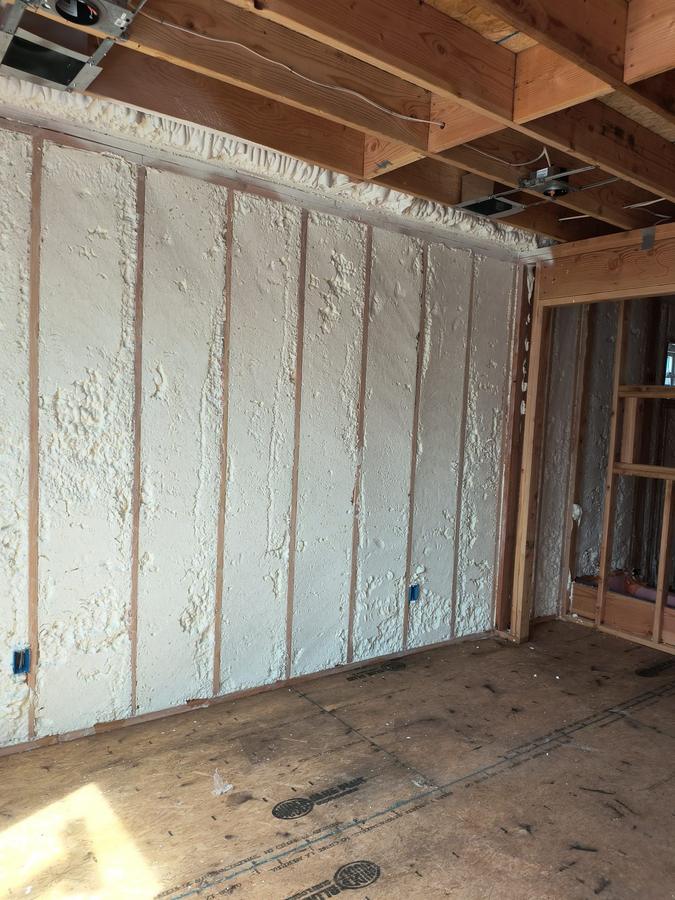
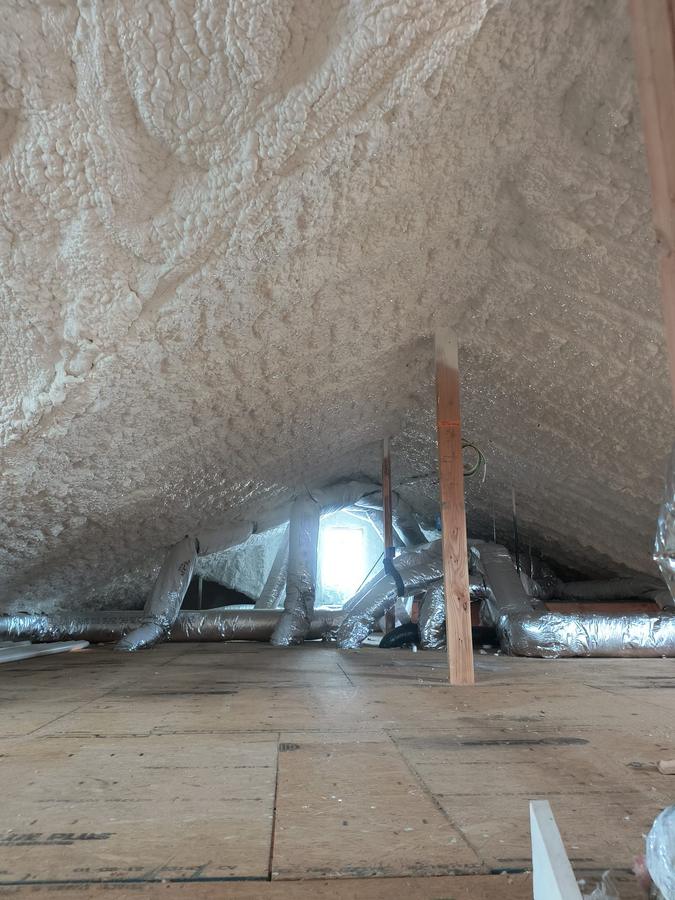
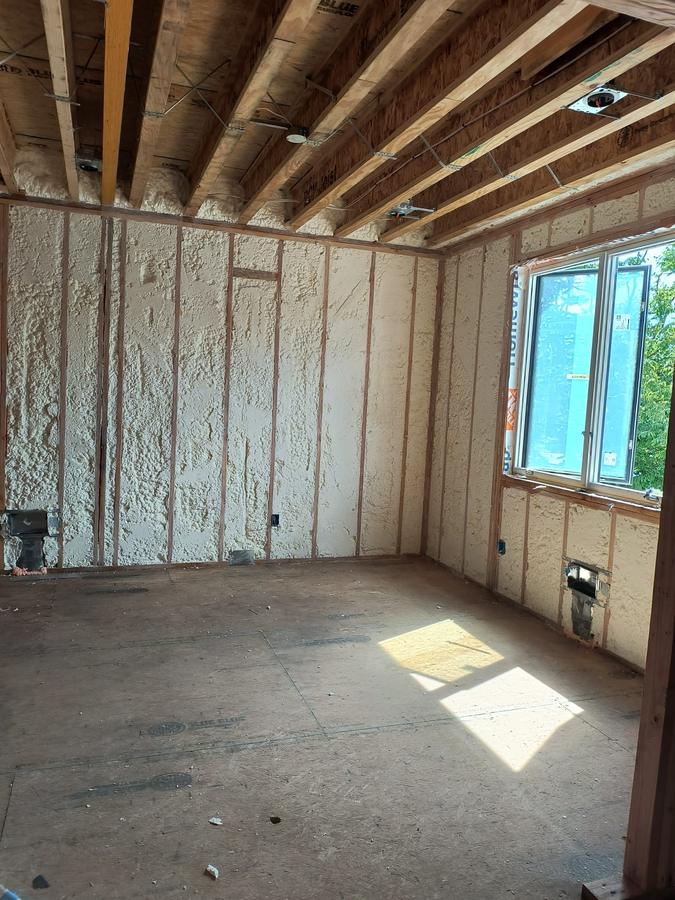
Open cell foam runs R-3.9 to R-4.2 per inch. Closed cell runs R-6.9 to R-7.1 per inch and also acts as a vapor retarder, which is why it costs more and why it is right in some assemblies and unnecessary in others. All products are manufactured in the United States and meet applicable building code and safety standards. ENERGY STAR says sealing air leaks and adding insulation can save up to 10% on annual energy bills.
Insulation rebates in Clifton
Clifton is PSE&G territory for both electric and gas, two-families and capes alike, and 84.6% of the city heats with gas, so the rebates are PSE&G’s.
PSE&G Whole Home Energy Solutions offers up to $7,500 in rebates toward air sealing, insulation and related work, plus 0% on-bill repayment of up to $25,000, over 7 years for projects of $10,000 or less and 10 years above that or for income-qualified customers. It is for one- to four-unit homes the owner lives in, which covers most of Clifton’s two-families. It starts with a home energy assessment by a BPI-certified contractor participating in PSE&G’s program, and the contractor sets that fee. PSE&G does not publish per-measure amounts, so “up to $7,500” is as precise as anyone gets.
Separate from that, PSE&G’s Whole Home Energy Assessment is free for any PSE&G residential gas or electric customer in a home of fewer than five units, a walk-through with LEDs, a smart thermostat and attic-hatch insulation put in on the spot. PSE&G Home Weatherization installs insulation, air sealing and duct sealing at no cost for households between 250% and 400% of the federal poverty level. New Jersey Comfort Partners does the same for households at or below 250% of the federal poverty guidelines, $82,500 a year for a family of four, in buildings of 1 to 14 individually metered units, which takes in the two-families. The 3.9% of Clifton heated with oil is referred to the state’s Office of Weatherization instead.
The New Jersey IRA Home Energy Rebates have not launched. The state says they are still in development, so they are not available. The federal Section 25C tax credit ended for anything placed in service after 31 December 2025; there is no federal insulation credit on a 2026 job, and a contractor still advertising one is behind. The full picture is in our New York and New Jersey rebate guide.
Code and climate in Clifton
85.1% of Clifton went up before 1980, and both of its big cohorts, the pre-war two-family and the 1950s cape, went up before New Jersey’s first statewide energy subcode of 1 January 1978, with no insulation requirement at all. Passaic County is climate zone 5A, with Bergen, Morris and Sussex; Essex, which Clifton borders at Bloomfield, Montclair and Nutley, is 4A.
New Jersey adopted the 2024 IECC on 17 August 2026. For new construction it sets R-49 ceilings — the 2021 edition it replaced called for R-60, and a complete permit application filed under the old code is still accepted until about 16 February 2027 — with walls at R-30 in the cavity or R-20 plus R-5 continuous, windows at U-0.28, and air leakage of 3.0 air changes per hour at 50 pascals. R-49 is the number the state considers right for this climate, and it is what we design to.
A house already standing falls under New Jersey’s Rehabilitation Subcode: insulating the attic or the roof cavity does not require bringing the rest of the building to code and does not require a blower-door test. Blown-in or batt insulation installed against the interior finish is ordinary maintenance with no permit; spray foam and other foam plastic insulation need a permit, which we pull as part of the job.
Common questions about insulation in Clifton
Do you install insulation in Clifton, NJ?
Yes. Most of what we do here is the pre-war two-family of Botany Village, Dutch Hill, Athenia, Delawanna and Lakeview, scoped as one building from cellar to roof, and the 1950s cape of the post-war streets, scoped at its knee walls, slopes and flat attic. We also do the pre-war foursquares and colonials, the 1960s splits, the duplexes built since 2000, and the top-floor ceilings and rims of the small apartment buildings.
How much does insulation cost in Clifton?
Most projects run $3,500 to $12,500. A two-family is one building and one price; the drivers are the roof area over the top unit, the number of balloon-framed wall bays to block and dense-pack, an attic apartment if there is one, and cellar access. A cape is priced on knee wall and eave footage, and the siding decides whether the walls are in the scope. We give a written scope and a price after a free walk-through.
Are there insulation rebates in Clifton?
Yes. Clifton is PSE&G territory for gas and electric. PSE&G Whole Home Energy Solutions offers up to $7,500 in rebates plus 0% on-bill repayment of up to $25,000 for one- to four-unit owner-occupied homes, and PSE&G’s lighter Whole Home Energy Assessment is free. Comfort Partners and PSE&G Home Weatherization do the work at no cost for income-qualified households. New Jersey’s IRA rebates have not launched, and the federal 25C credit ended for anything placed in service after 31 December 2025.
We own a two-family in Clifton and rent the upstairs. Can it be insulated without disturbing the tenant?
Mostly, yes. The work happens in the cellar, in the roof cavity over the top unit, and on the outside walls behind the siding, so the tenant’s apartment is entered only to reach the attic hatch and to check the wiring before the walls are filled. The building is scoped and priced as one, because the stair chase, the floor cavity between units and the heating plant are shared. As the owner living in the building, you are the one PSE&G’s program is written for.
Free energy audit in Clifton
In a two-family we walk the cellar and the rim, follow the stair chase to the attic, and look at the roof cavity over the top unit and at the siding before we talk about walls. In a cape we go into the eave spaces behind the bedroom knee walls, check the slopes and the flat, then the basement. If the walls are fine and the job is the chase and the roof, we say so. Then a written scope and a price. No charge, no obligation.
Call 914-554-2289 or use the contact form. Open 8am–8pm, seven days. We work out of New Rochelle, NY with a 100-plus in-house crew.
Get my free estimateor call 914-554-2289, 8am–8pm every day