Englewood is four wards and four kinds of house. The picture most people carry is East Hill, the Victorian houses and the estates, and it describes a minority: 39.5% of the city’s 12,047 housing units are detached houses, 52.7% are owner-occupied, and 27.3% sit in buildings of twenty or more units.
So this page is for all four: the stucco or Tudor house on East Hill whose walls we will not drill, the balloon-framed Victorian on the flat, the post-war cape and split, and the Fourth Ward two-family or garden apartment where the owner is not the person paying the heat. It is about Englewood, not Englewood Cliffs, a separate borough with 2,029 units, 93.7% of them detached.
The houses we insulate in Englewood
The median Englewood home was built in 1959. 26.4% of the stock predates 1940, 25.2% went up in the 1940s and 50s, 13.3% in the 1960s and 70s, 14.5% in the 1980s and 90s, and 20.6% since 2000; 64.9% predates 1980. By structure the city is 39.5% detached, 8.7% attached, 11.2% in two- to four-family buildings, 13.4% in buildings of five to nineteen units and 27.3% in buildings of twenty or more. Gas heats 69.8% of homes and electricity 20.2%.
The pre-1940 quarter grew on the Northern Railroad after 1859 and tripled in population between 1900 and 1930: frame Victorians and 1920s colonials with balloon-framed walls, stud bays open from the sill to the attic, plank sheathing, no wall insulation, and a rubble or brick foundation with a rim that leaks all winter. We assume knob-and-tube until the electrician says otherwise, because it has to come out before anything goes into a wall.
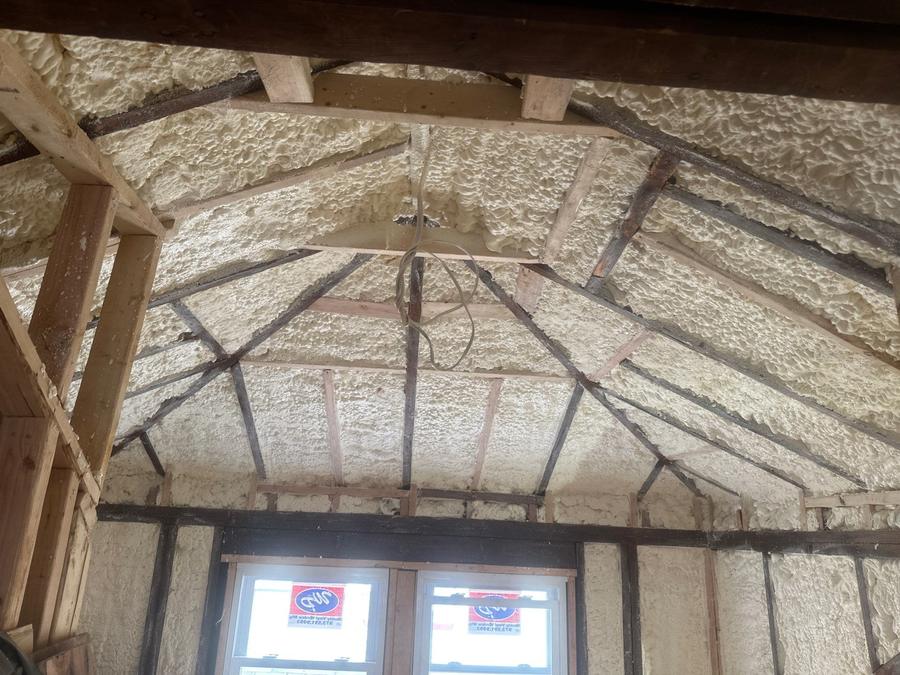
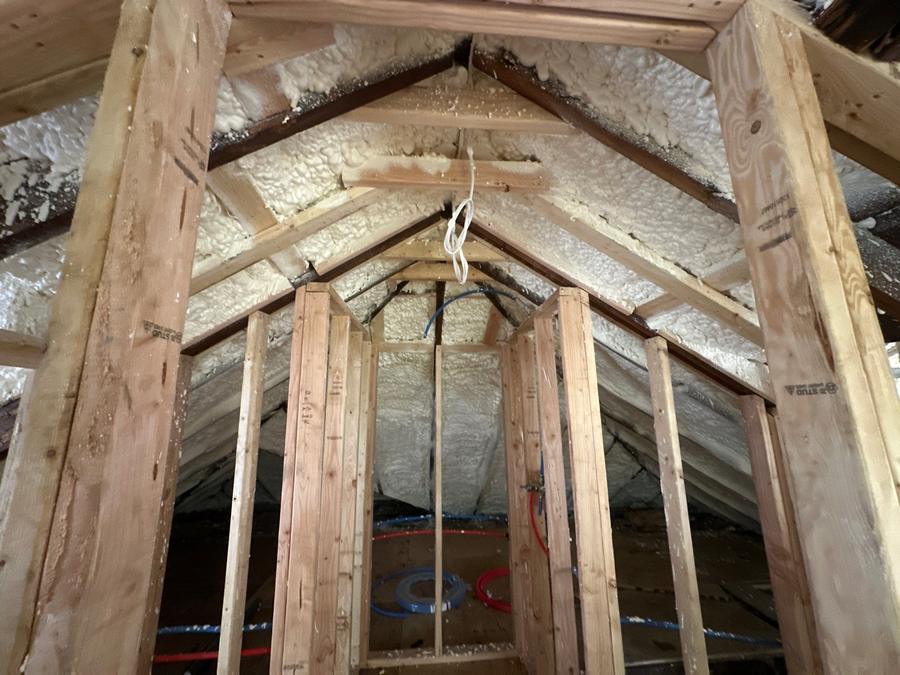
East Hill is the exception that matters. Its houses — Gloria Crest, the 1926 Mediterranean villa on five acres, is the extreme case at 24,000 square feet — are stucco on lath, half-timbered Tudor, brick veneer over furring or solid masonry. There is no fillable cavity, and we will not drill a stucco wall to find that out. The work in those houses is the attic plane, the third-floor knee walls and dormer cheeks, the service-wing shafts and chimney chases, and the rim and band joist. Under a big stepped slate roof that is a full job by itself.
The post-war half is capes and story-and-a-half houses from the 1940s and 50s, then ranches and splits into the 70s. The cape fails at the knee wall with no air barrier on its back side, joist bays open to the eave and unbaffled slopes; the ranch fails across a long low attic of settled loose-fill and unsealed bypasses, with wind-washed eaves and a cold bedroom over the garage. Many of the capes still carry their original cement shingle siding, so we fill those walls from inside or by lifting shingles, never by drilling through.
Grand Avenue and Tenafly Road carry four Register-listed Dutch stone houses: Benson, Garret Lydecker, Demott–Westervelt and Van Horn–Newcomb. Mortared sandstone with plaster on the stone or on shallow furring, nothing to fill, and landmarked, so exterior drilling is off the table. The garret from inside, the attic floor, the cellar and rim, and the later frame wing are the scope.
On the west the ground falls toward Overpeck Creek. Ida dropped nearly 8 inches of rain on Englewood in two hours on 1 September 2021; Palisade Avenue “became a raging river” and the Overpeck side was inundated. A finished basement that flooded once will flood again, so we put no closed cell foam on that wall; we seal and insulate the first-floor deck above it and replace the batts that fell out of the joist bays. The same lowland runs on into Leonia.
Garden apartments, towers and the newest fifth of Englewood
27.3% of Englewood’s units are in buildings of twenty or more, 2,491 of them in buildings of fifty-plus. The Fourth Ward is the center of that: its housing was called the worst in Bergen County until late-1960s urban renewal cleared it and put up the Rock Creek Terrace and Park View Terrace garden apartments by the early 1970s. A garden apartment is a retrofit we can do — a low-slope roof over the top floor, party walls, a boiler room, a rim — but the owner or the association signs, not the tenant, and we scope it as one building. Englewood’s Tudor-revival apartment houses are the same masonry story as East Hill: attic plane, shafts and rim, not walls. A high-rise is not what we do; that is a capital decision for a board, and we say so on the phone.
The 20.6% built since 2000 is the other stock. Those houses went up under the 2000–2015 energy codes, so the walls are already insulated and blowing more in is not the job. What leaks is the party wall of a side-by-side rebuild, the garage-under floor, a cantilevered bay, a bath fan dumping into the attic, and an air handler sitting in a vented attic on leaky ducts. That is an air-sealing and duct job, and usually a shorter one.
We seal before we insulate
Insulation slows heat moving through a surface. It does nothing about air moving through a gap. Pack a leaky attic with cellulose and you have a leaky attic with cellulose in it.
In an Englewood house from the pre-1940 quarter, the sequence is the job. Block the stud bays at the top and bottom plates so the walls stop working as flues, then close the attic plane: the chimney chase, the stair opening, the plumbing stack, the top plates, the knee walls behind any third-floor room. Then dense-pack the walls, then the attic floor, then the rim in the cellar. On East Hill the order is the same with the walls left out: the attic plane, the shafts and the rim carry the whole job, from inside.
If a quote specifies a depth of insulation and never mentions air sealing, it is half a job.
What insulation costs in Englewood
Most of our projects run between $3,500 and $12,500. In Englewood what moves the number is which of the four stocks you are in: a balloon-framed Victorian with walls to block and dense-pack sits toward the upper end, a big East Hill attic with knee walls and shafts can be a full job by itself, and a post-2000 house is usually a shorter air-sealing and duct scope.
Open cell foam runs R-3.9 to R-4.2 per inch. Closed cell runs R-6.9 to R-7.1 per inch and also acts as a vapor retarder, which is why it costs more and why it is right in some assemblies and unnecessary in others. All products are manufactured in the United States and meet applicable building code and safety standards. ENERGY STAR says sealing air leaks and adding insulation can save up to 10% on annual energy bills.
Insulation rebates in Englewood
Englewood is PSE&G territory for both electric and gas: one utility, one set of programs.
The live money is PSE&G Whole Home Energy Solutions: up to $7,500 in rebates toward air sealing, insulation and related work, plus 0% on-bill repayment of up to $25,000 over 7 or 10 years. It starts with PSE&G’s home energy assessment, and the work must be done by a BPI-certified contractor participating in PSE&G’s program. PSE&G does not publish what each measure pays, so “up to $7,500” is as precise as anyone can be.
PSE&G’s Whole Home Energy Assessment is free for any PSE&G gas or electric customer, once a year. PSE&G Home Weatherization installs insulation, air sealing and duct sealing at no cost for households above 250% and below 400% of the federal poverty level. New Jersey Comfort Partners does the same at no cost for households at or below 250% of the federal poverty guidelines, $82,500 for a family of four, and refers homes heated with oil or propane to the state weatherization office. In a city where only 52.7% of units are owner-occupied, those two no-cost programs are often the ones that matter.
The New Jersey IRA Home Energy Rebates have not launched. The state’s page says “under development,” so they are not available yet.
The federal Section 25C tax credit ended for anything placed in service after 31 December 2025. There is no federal insulation credit on a 2026 job. The full picture is in our New York and New Jersey rebate guide.
Code and climate in Englewood
64.9% of Englewood’s units went up before 1980; New Jersey’s first statewide energy subcode took effect on 1 January 1978, so two-thirds of the city predates any energy code. Bergen County is climate zone 5A; Essex, Hudson and Union next door are 4A.
New Jersey adopted the 2024 IECC on 17 August 2026. For new construction it sets R-49 ceilings — the 2021 edition it replaced called for R-60, and a permit application filed under the old code is still accepted for six months, until about mid-February 2027 — with walls at R-20 plus R-5 continuous, windows at U-0.28, and air leakage of 3.0 air changes per hour at 50 pascals. Existing homes fall under New Jersey’s Rehabilitation Subcode: insulating an attic does not require bringing the rest of the house to code and does not require a blower-door test. Blown-in or batt insulation installed against the interior finish is ordinary maintenance with no permit; spray foam and other foam plastic insulation need a permit, which we pull as part of the job. R-49 is the number the state considers right for this climate, and it is what we design to.
Common questions about insulation in Englewood
Do you install insulation in Englewood, NJ?
Yes, in all four wards, and the job depends on which one. A pre-1940 frame house gets its stud bays blocked and dense-packed after the knob-and-tube check. An East Hill stucco or Tudor house gets its attic plane, knee walls, shafts and rim sealed and insulated, with the walls left alone. A post-war cape gets its knee walls and slopes. A garden apartment or two-family is scoped as one building with the owner.
How much does insulation cost in Englewood?
Most projects run $3,500 to $12,500. A balloon-framed Victorian with walls to block and dense-pack sits toward the upper end; a large East Hill attic with knee walls and shafts can be a full job by itself; a post-2000 house is usually a shorter air-sealing and duct scope. Knob-and-tube removal, where it is needed, is an electrician’s cost ahead of ours.
Are there insulation rebates in Englewood?
Englewood is PSE&G territory for gas and electric. PSE&G Whole Home Energy Solutions offers up to $7,500 in rebates plus 0% on-bill repayment of up to $25,000, and it starts with a PSE&G home energy assessment. Comfort Partners and PSE&G Home Weatherization do the work at no cost for income-qualified households. New Jersey’s IRA rebates have not launched, and the federal 25C credit ended for anything placed in service after 31 December 2025.
Our East Hill house is stucco. Can you insulate the walls?
Not by drilling them, and we will say so at the door. Stucco on lath, half-timbered Tudor and solid masonry walls have no cavity to fill, and drilling a stucco wall to find that out is damage, not a job. What we do in those houses is the attic plane, the third-floor knee walls and dormer cheeks, the chimney and service shafts, and the rim joist, all from inside and without touching the exterior.
Free energy audit in Englewood
We walk the attic, the knee walls and any third-floor rooms, the cellar and rim, and on East Hill the shafts and chases that carry the heat out of a masonry house, then give you a written scope and a price. No charge, no obligation. If your walls cannot be filled, we say so and price what can be done instead.
Call 914-554-2289 or use the form on this page. Open 8am–8pm, seven days. We work out of New Rochelle, NY with a 100-plus in-house crew.
Get my free estimateor call 914-554-2289, 8am–8pm every day