36.8% of Piscataway was built in the 1960s and 70s, the largest two-decade share of any town we cover in Middlesex County. 22.7% of the township’s 18,147 units went up in the 1960s alone and 14.1% in the 1970s. The median unit dates from 1974. Behind that, 15.9% came in the 1940s and 50s, 26.8% in the 1980s and 90s, 15.0% since 2000, and 5.5% predates 1940 in a township formed in 1666, the fifth-oldest municipality in New Jersey. 58.2% of it was standing before 1980.
57.3% of the stock is detached houses and 8.3% attached, 1,514 townhouse and duplex units. 17.4% sits in buildings of five to nineteen units, the garden apartments. 64.6% of occupied units are owner-occupied, barely above the county’s 63.5%, and the rented third matters here because Rutgers sits inside the township. Gas heats 82.2% of homes, electricity 12.0% and oil 3.0%.
So the work in Piscataway is mostly one thing: the 1960s and 70s split-level, bi-level and ranch, insulated once at the time and never air sealed.
The houses we insulate in Piscataway
Piscataway spreads across nine borders and a dozen named sections — Arbor, Bound Brook Heights, Fellowship Farm, Fieldville, Johnson Park, Lake Nelson, New Market, Newtown, North Stelton, Possumtown, Randolphville, Raritan Landing, Riverview Manor and Society Hill. The 992 units that predate 1940, 5.5% of the stock, sit mostly in the older crossroads settlements such as New Market, the Quaker village that was called Quibbletown when settlers there argued over which day was the Sabbath. Those houses are balloon-framed as a rule: stud bays open from the sill to the attic, which is why the tops get blocked before anything is blown, and knob-and-tube wiring comes out before a wall is filled.
15.9% arrived in the 1940s and 50s, the Camp Kilmer years, when the Army took 1,500 acres of Piscataway and Edison and the township started filling in around it. Capes and small ranches. The cape fails at the knee wall: batts stapled to the room side with nothing behind them, joist bays running under the bedroom floor out to the open eave, unbaffled slopes, a shallow flat attic. The ranch fails at the top plates and the settled loose-fill in one long attic.
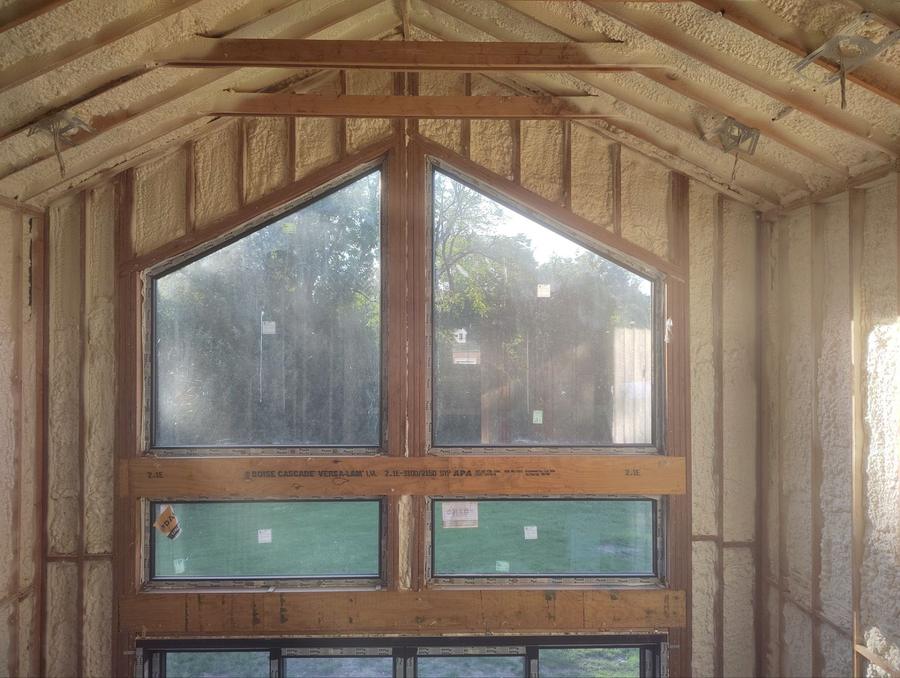
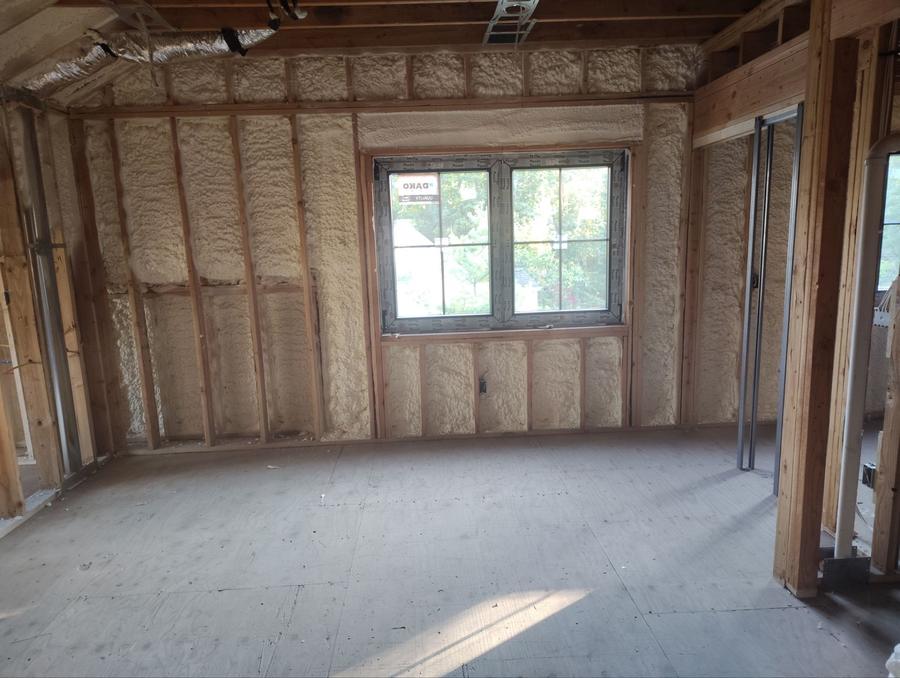
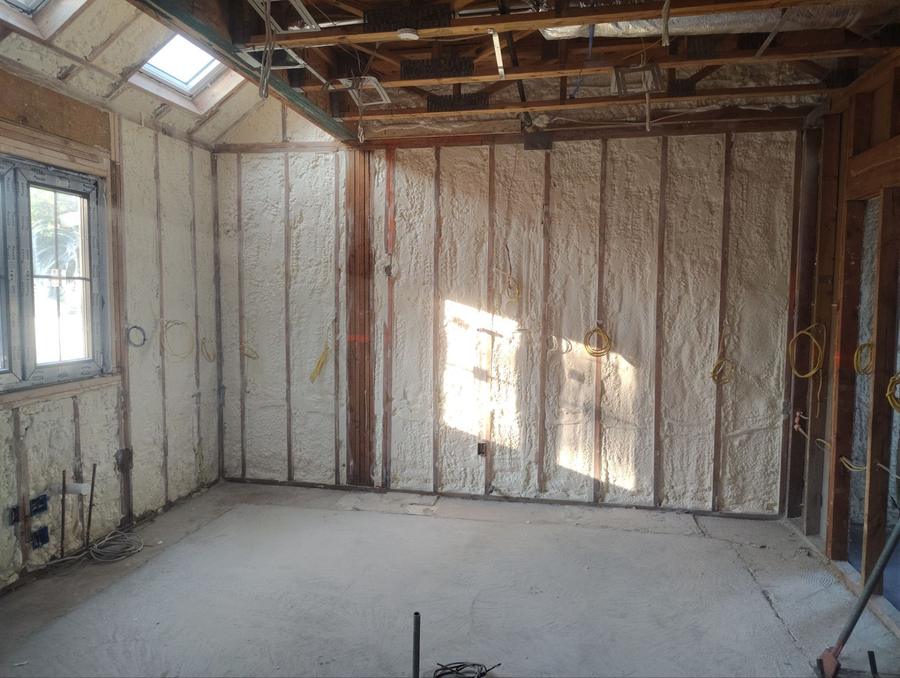
Then the main event. 22.7% in the 1960s and 14.1% in the 1970s built the split-levels, bi-levels and long ranches that define the township, and they fail in the same two places every time. First, the room over the garage: the joist bays under that floor are open at the header, so outside air runs under the bedroom all winter and the carpet is cold in February. Second, the lower level, which sits half below grade against a foundation wall nobody insulated, with the rim joist above it open into the garage. Then the cantilevered bay, the settled attic that was blown once around 1972, and the recessed lights that a later kitchen remodel punched through the ceiling.
26.8% came in the 1980s and 90s and 15.0% since 2000, including 6.1% in the 2010s and 1.5% since 2020 — some of the newest housing in the county. Those houses have R-11 to R-13 in the walls, so the walls are not the job. The air handler and the ductwork sit in the vented attic, above the insulation instead of below it, and the duct leakage warms the attic rather than the bedrooms. In the townhouse rows the party wall runs up into the attic open at the top, built to stop fire rather than air, and we close it at the attic plate on your side.
Rutgers, rentals, and who the rebate is written for
The Livingston and Busch campuses of Rutgers sit inside Piscataway, along with SHI Stadium and part of the medical school, and that shapes the housing market. 64.6% of occupied units are owner-occupied, so roughly a third are rented, and a good share of the ranches and splits near the campuses are landlord-owned houses with four or five bedrooms and a converted basement.
Two honest points about that. The utility rebate programs are for one- to four-unit homes that the owner lives in. A landlord can pay for insulation, and it is often the best money spent on a rental — a cold room over the garage generates a complaint every winter — but the Whole Home rebates and the free assessment are written for the owner-occupant. If you rent in Piscataway, the person who has to make the call is the owner.
The second point is about the converted basement. Finished lower levels in these houses often have a dropped ceiling that hides the rim joist, ductwork stuffed into a soffit and a bathroom fan venting into the joist space. If you are going to spend money down there, the rim joist and the band around the perimeter come first, then the garage wall, then the ceiling. And 17.4% of the township that sits in garden-apartment buildings of five to nineteen units is a landlord’s decision on a shared roof, not a job we can sell one tenant.
We seal before we insulate
Insulation slows heat moving through a surface. It does nothing about air moving through a gap. Add six inches of loose-fill over an attic floor with open top plates, an open chimney chase and a bath fan blowing into it, and the house leaks exactly as much as it did that morning.
In a Piscataway split-level the sequence is: seal the top plates, the plumbing and flue chases and the recessed lights in the upper attic, vent the bath fan to the outside, block and seal the joist bays under the room over the garage, seal the garage ceiling and the door between garage and house, then the rim joist and the cantilever below. Then insulate — the attic to R-49, the garage ceiling, the rim. In a 1990s colonial the same list starts at the air handler platform and the duct seams.
If a quote specifies a depth of insulation and never mentions air sealing, it is half a job.
What insulation costs in Piscataway
Most of our projects run between $3,500 and $12,500. In a split or bi-level the number moves with the garage ceiling, the cantilever and whether the lower-level foundation wall is in the scope. In a house with a finished basement it moves with how much of the rim we can reach without opening the ceiling. In a newer colonial it moves with duct footage and sloped-ceiling area rather than walls. Our spray foam cost page breaks the foam side down.
Open cell foam runs R-3.9 to R-4.2 per inch. Closed cell runs R-6.9 to R-7.1 per inch and also acts as a vapor retarder, which is why it costs more and why it is right in some assemblies and unnecessary in others. All products are manufactured in the United States and meet applicable building code and safety standards. ENERGY STAR says sealing air leaks and adding insulation can save up to 10% on annual energy bills.
Insulation rebates in Piscataway
Piscataway is PSE&G territory for both electric and gas, which makes this simpler than in most of the county: one utility, one program, one account number.
PSE&G Whole Home Energy Solutions offers up to $7,500 in rebates toward air sealing, insulation and the envelope work an assessment calls for, plus interest-free on-bill repayment of up to $25,000 — seven years on projects of $10,000 or less, ten years above that or for income-qualified customers. It starts with a home energy assessment by a BPI-certified contractor participating in PSE&G’s program, and the contractor sets that fee. PSE&G does not publish what individual measures pay, so treat any contractor quoting you a per-inch rebate figure with suspicion.
Separate from that, PSE&G’s Whole Home Energy Assessment is a really free walk-through for any PSE&G residential gas or electric customer in a home of fewer than five units. A technician installs small items on the spot — LEDs, a smart thermostat, aerators, door sweeps, attic-hatch insulation — and points you at the rebate program. The 12.0% of Piscataway that heats with electricity qualifies for it on the electric account alone.
PSE&G Home Weatherization installs insulation, air sealing and duct sealing at no cost for households between 250% and 400% of the federal poverty level, or in a low- or moderate-income census tract, or on NJ SHARES. New Jersey Comfort Partners does the same at or below 250%, $82,500 a year for a family of four in 2026, in buildings of one to fourteen individually metered units; the 3.0% here that heats with oil is referred to the state’s Office of Weatherization instead. New Jersey’s IRA Home Energy Rebates have not launched — the state says they are in development and not open for applications.
The federal Section 25C tax credit ended for anything placed in service after 31 December 2025. There is no federal insulation credit on a 2026 job. The rest is in our rebate guide.
Code and climate in Piscataway
58.2% of Piscataway was built before 1980, and nearly all of the 1960s cohort predates New Jersey’s first statewide energy subcode of 1 January 1978. The largest group of houses in the township was built with no insulation requirement at all. Middlesex County is climate zone 4A; Somerset, just over the Raritan, is 5A.
New Jersey adopted the 2024 IECC on 17 August 2026. For new construction it sets R-49 ceilings — the 2021 edition it replaced called for R-60, and a complete permit application filed under the old code is still accepted until about 16 February 2027 — walls at R-30 in the cavity or R-20 plus R-5 continuous, windows at U-0.30 in the 4A counties, and air leakage of 3.0 air changes per hour at 50 pascals. R-49 is what the state considers right for this climate, and it is what we design to.
An existing house falls under New Jersey’s Rehabilitation Subcode. Insulating an attic does not require bringing the rest of the house to code and does not require a blower-door test. Blown-in or batt insulation against the interior finish is ordinary maintenance with no permit; spray foam and other foam plastic insulation need a permit, which we pull as part of the job.
Common questions about insulation in Piscataway
Do you install insulation in Piscataway, NJ?
Yes, and most of it is the 1960s and 70s split-level, bi-level and ranch that makes up 36.8% of the township — the room over the garage, the half-below-grade lower level, the settled attic. We also do the 1950s capes, the newer colonials with ducts in the attic, and the 1,514 attached townhouse units. We do not take on the garden-apartment buildings, where the roof and the mechanicals belong to an owner other than the person living there.
How much does insulation cost in Piscataway?
Most projects run $3,500 to $12,500. In a split the drivers are the garage ceiling, the cantilever and whether the lower-level wall is in the scope. A finished basement raises the price of reaching the rim joist and sometimes takes it out of the job. In a newer colonial it is duct footage and sloped-ceiling area, since the walls are already full. A townhouse is usually the smallest job on the list: the party wall, the attic plane and the rim.
Are there insulation rebates in Piscataway?
Yes. Both bills come from PSE&G, so there is one program. PSE&G Whole Home Energy Solutions pays up to $7,500 in rebates plus interest-free on-bill repayment of up to $25,000, starting with an assessment by a BPI-certified contractor in its program. PSE&G’s separate Whole Home Energy Assessment walk-through is free. Comfort Partners does the work at no cost at or below 250% of the federal poverty guidelines. New Jersey’s IRA rebates have not launched, and the federal 25C credit ended after 31 December 2025.
We rent a house near the Rutgers campuses. Can we get the insulation done?
You can pay for it, but the utility rebates cannot: Whole Home Energy Solutions is written for one- to four-unit homes the owner lives in, and the free assessment goes to the customer of record. The practical move is to get the owner on the phone with us. A cold room over the garage and a lower level that never warms up are the two complaints landlords hear every winter in these houses, and the work that fixes them is a day of air sealing rather than a renovation.
Free energy audit in Piscataway
We measure what is in the attic and find the bypasses — top plates, chases, bath fans, recessed cans, and the air handler if it lives up there. Then the room over the garage, the cantilever, the lower level and the rim joist, and in a finished basement we work out what can be reached without opening the ceiling. Then a written scope and a price. No charge, no obligation.
Call 914-554-2289 or use the contact form. Open 8am–8pm, seven days. We work out of New Rochelle, NY with a 100-plus in-house crew.
Get my free estimateor call 914-554-2289, 8am–8pm every day