32.1% of Southbury’s 8,826 housing units were built in the 1970s, far more than in any other decade, and 20.2% are attached homes. Those two numbers describe the town that grew up after Interstate 84 reached Southbury by 1963 and Heritage Village opened in 1967. Detached houses make up 58.9% of units, two-unit buildings 6.2% and three- and four-unit buildings 6.8%, and 87.3% of occupied units are owner-occupied. The median unit dates from 1977.
Heating is split almost evenly between two fuels. Fuel oil heats 41.4% of occupied units and electricity 38.3%, with bottled gas at 9.6%, utility gas at just 7.5% and wood at 1.9%. Both of the big fuels make air leaks expensive. An oil house buys every lost degree by the gallon; an electrically heated home pays for it on the Eversource bill, and sealing the house cuts that use directly. Southbury is still a mix of sprawling rural country, suburban neighborhoods and historic districts, and we work in all three.
The houses we insulate in Southbury
By era, 8.5% of Southbury predates 1940, 5.2% is from the 1940s and 50s, 46.5% from the 1960s and 70s, 25.5% from the 1980s and 90s and 14.4% has been built since 2000.
The oldest houses belong to a farming town. Southbury was part of Woodbury until it incorporated in 1787, and through the 1800s the Pomperaug and Housatonic rivers powered its mills, tanneries and distilleries. The South Britain Historic District, Southbury Historic District No. 1 along Main Street, and the Hurley Road and Sanford Road historic districts are all on the National Register; the writer Gladys Taber lived full-time from 1935 in a 1690 farmhouse off Jeremy Swamp Road. A farmhouse of that age has usually grown by additions, and each seam between the original frame and a later ell or kitchen wing is an air path. Under the additions there is often a shallow crawl space instead of a cellar, open to cold air, with the floor above it uninsulated.
The 1960s and 70s built raised ranches, split-levels and colonials across the town’s suburban neighborhoods. A raised ranch from those years has bedrooms over a garage whose ceiling was never sealed, a rim joist exposed at the mid-level, and an attic with a few inches of settled fill. A 1970s colonial adds a pull-down attic stair with no cover and, often, a family room over a crawl space.
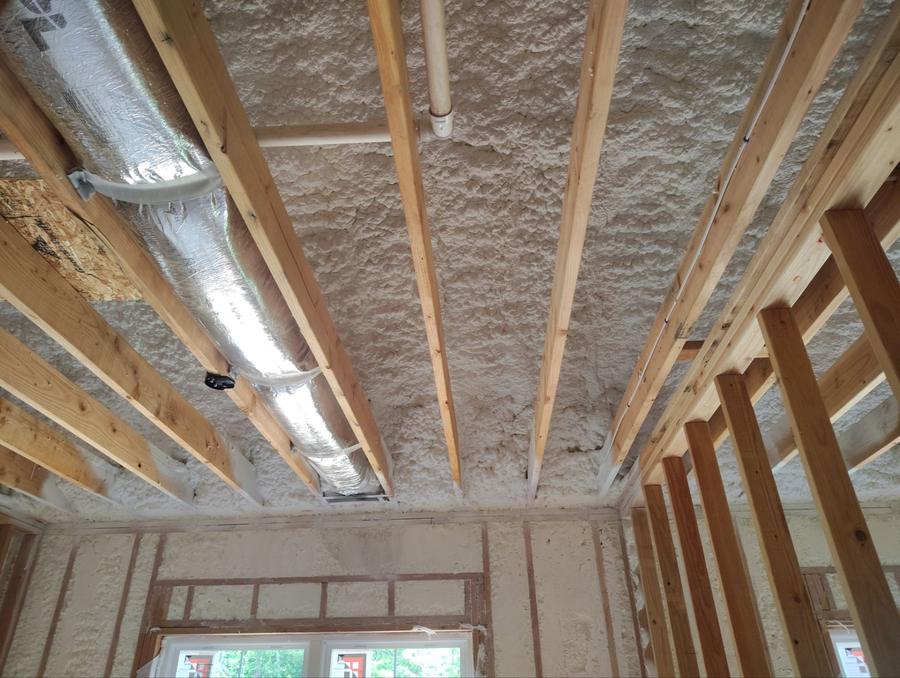
The 1980s and 90s, 25.5% of the town, and the 11.6% built from 2000 to 2009 brought larger colonials with bonus rooms, cathedral ceilings and ductwork in the attic. Those houses were insulated when they were built. What they need is sealing at the recessed lights, the attic hatch and the ducts, and a floor that actually stops the cold under the bonus room.
Heritage Village and the attached home
Heritage Village opened in 1967 on a 1,000-acre site, and Victor Borge’s former estate and Cornish hen game farm is now part of it. It is one of New England’s largest retirement communities, with approximately 2,580 homes and about 4,000 people, and residents must be 55 or older. Across Southbury, 20.2% of units are attached homes, 6.2% are in two-unit buildings and 6.8% in three- and four-unit buildings.
An attached home loses heat in different places from a detached one. The end units have three outside walls and the middle units one or two, but every unit has a ceiling under an attic, and in some older buildings that attic runs across several units above a party wall that stops at the ceiling line. Warm air from one unit can drift across the top of the wall and out through the roof vents. The ceiling hatch, recessed lights and bath fans in each unit open into that shared space, and a unit over a crawl space or a garage has a cold floor as well.
The practical question is who owns what. In most associations the roof, the attic and the exterior walls are common property, so work there needs the association’s written approval, and sealing a shared attic properly is really a job for the whole building. Inside the unit, a hatch, a light fixture or a floor over a garage may be the owner’s to decide. Read the association documents before anyone quotes. For many owners, steadier room temperatures matter as much as a lower bill.
We seal before we insulate
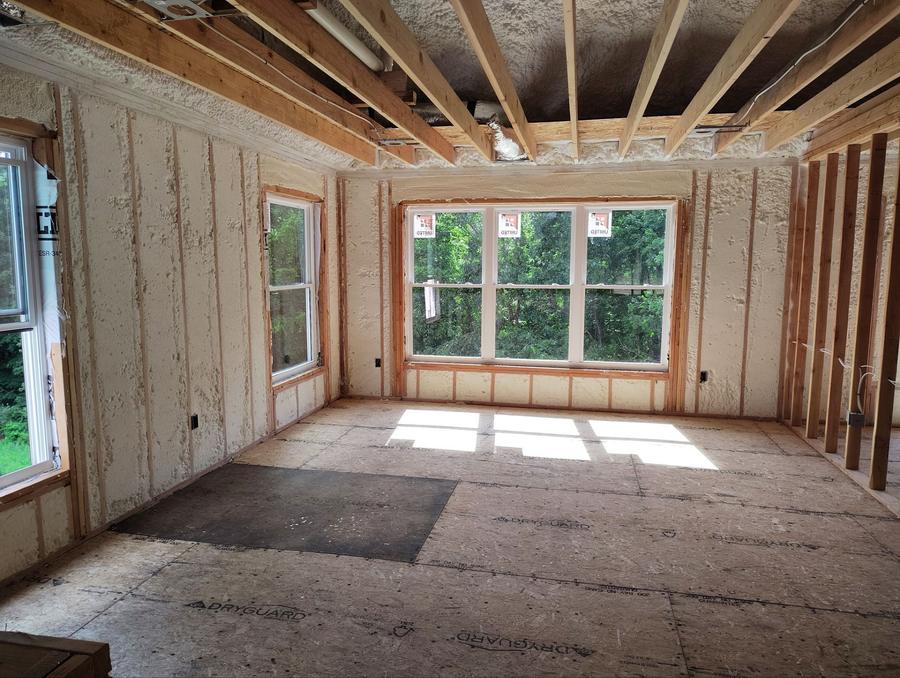
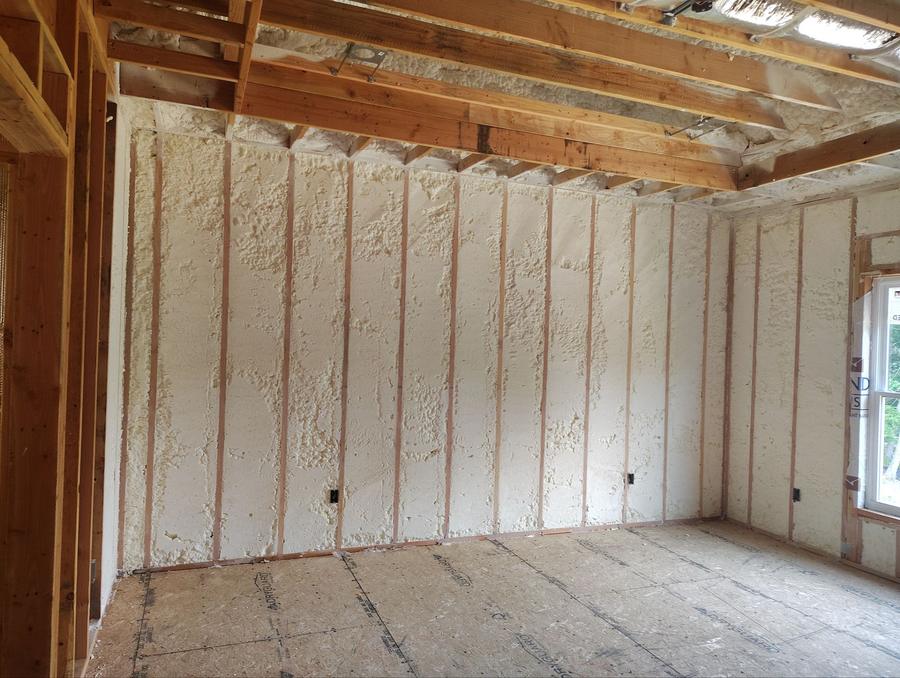
Insulation holds back heat moving through a surface; it does not stop air moving through a hole. Leave the holes open, and warm air carries the heat out around the insulation, whatever its depth.
In a Southbury raised ranch from the 1970s the order is: seal the joist bays and wiring holes in the garage ceiling under the bedrooms; seal and insulate the rim joist at the mid-level; in the attic, rake back the old fill and seal the top plates, the plumbing vent, the light boxes and the bath fan housings; weatherstrip the hatch; then blow in new insulation to full depth. In an attached unit the same logic starts at the ceiling hatch and every fixture that pierces the ceiling.
If a quote specifies a depth of insulation and never mentions air sealing, it is half a job.
What insulation costs in Southbury
Most of our projects run between $3,500 and $12,500. In a raised ranch the number moves with the garage ceiling, the rim joist and the attic area; in a colonial, with the attic and any crawl space under a family room; in a newer house, with the bonus room and duct sealing. An attached unit is usually a smaller job, bounded by what the association allows. A farmhouse is priced on its additions, crawl spaces and attic. For the foam side of the price, see what spray foam costs.
Open cell foam runs R-3.9 to R-4.2 per inch. Closed cell runs R-6.9 to R-7.1 per inch and also acts as a vapor retarder, which is why it costs more and why it is right in some assemblies and unnecessary in others. All products are manufactured in the United States and meet applicable building code and safety standards. ENERGY STAR says sealing air leaks and adding insulation can save up to 10% on annual energy bills.
Insulation rebates in Southbury
Eversource is Southbury’s electric company and also its gas company, and it runs the Energize Connecticut programs. Home Energy Solutions is open to customers of Eversource, United Illuminating, Connecticut Natural Gas and Southern Connecticut Gas, whatever fuel heats the house, so an oil-, propane- or electrically heated home can apply through its Eversource electric account if it has not had the program’s services within six years. The program is ideally suited to homes of one to four units; for a building of five or more units, the owner is pointed to the Multifamily Initiative instead.
A Home Energy Solutions visit costs a $40 copay, effective 1 April 2026. An authorized Home Energy Solutions contractor runs health and safety tests, a blower-door test to pinpoint drafts and air leaks and, where there is forced hot air or central air, a duct test. Air sealing is provided at no cost for up to seven hours, with a $10 hourly fee for extra time a larger or older home may need. A waiting list is possible, and the program is subject to available funding.
The 2026 Energize CT insulation rebate pays up to $2.00 per square foot or 75% of the total cost, whichever is less, up to a maximum of $10,000, on attic floors, floored-over attics, walls, rim joists and basement and garage ceilings. Parts of Southbury are designated environmental justice communities; the state’s map shows whether a specific address qualifies, and a home in one may be eligible for $2.50 per square foot, up to $15,000. The insulation must be recommended during the Home Energy Solutions visit, approved before installation, and performed by an approved contractor from the Energize CT Insulation Installers Network. Foam on the underside of a roof deck is not on the qualifying list; ask the program before counting on a rebate for it.
Income sets the tier. On Energize CT’s 2026–2027 figures, a one-person household at $48,714 or less is Income Eligible, with a no-cost visit and up to 100% of insulation costs covered; $48,715 to $64,953 is Enhanced Incentives, with a no-cost visit and insulation at up to $2.50 per square foot, the true range set by zip code; $64,954 and above is the standard tier. For the Income Eligible tier, assets like your home and car are not counted. Near a line, ask which tier applies before paying a copay.
The Connecticut Green Bank’s Smart-E Loan lends up to $50,000 with no money down for an owner-occupied Connecticut home of one to four units, and a condominium qualifies only if it is individually metered. Rates are 6.99% APR for 5, 7 or 10 years, 7.49% for 12 and 7.99% for 15 where the lender offers it. Participating contractors arrange it, so ask whether yours participates.
The program’s own contractors do the Home Energy Solutions visit, and the rebate is paid only when a network installer does the work. Ask any installer who quotes, including us, whether they are in that network, and compare prices after any rebate before you decide. There is no federal tax credit for insulation installed in 2026: Section 25C ended for anything placed in service after 31 December 2025. Our Connecticut rebate guide sets out every program.
Code and climate in Southbury
60.1% of Southbury’s housing was built before 1980. Up in the Pomperaug and Housatonic valleys or down in the shoreline towns, Connecticut is one climate zone, and Southbury is in climate zone 5A.
The 2022 Connecticut State Building Code has been in force since 1 October 2022, using the 2021 International Energy Conservation Code with Connecticut’s amendments. It asks a new home or addition for R-60 ceilings, satisfied by R-49 where the full uncompressed depth extends over the top plate at the eaves; wood-frame walls of R-30 cavity, R-20 cavity plus R-5 continuous, R-13 plus R-10 continuous or R-20 continuous; R-30 floors; basement walls of R-15 continuous, R-19 cavity or R-13 plus R-5 continuous; and U-0.30 windows. A new home must pass a blower-door test at 3.0 air changes per hour at 50 pascals on the prescriptive path, and never worse than 5.0. Connecticut’s next code, based on the 2024 IECC, has been adopted in draft, but its effective date has been delayed.
Common questions about insulation in Southbury
Do you install insulation in Southbury, CT?
Yes. Most of our Southbury work is the raised ranches, splits and colonials of the 1960s and 70s, 46.5% of the town, and the larger colonials of the 1980s, 90s and 2000s. We also work in older houses in South Britain and the town’s other historic districts, and in attached homes where the association approves.
How much does insulation cost in Southbury?
Most projects run $3,500 to $12,500. A raised ranch is priced on its garage ceiling, rim joist and attic, a colonial on its attic and any crawl space, and a newer house on its bonus room and duct sealing. An attached unit is often smaller, limited to what the association allows. A farmhouse depends on its additions and crawl spaces. We walk the house at no charge and give you the scope and price in writing.
Are there insulation rebates in Southbury?
Yes, through Energize Connecticut. Eversource is Southbury’s electric and gas company. The Home Energy Solutions visit costs $40, or nothing in the two income-qualified tiers, and the 2026 insulation rebate pays up to $2.00 per square foot or 75% of the cost, whichever is less, to $10,000, on work recommended at the visit, approved in advance and installed by an Energize CT Insulation Installers Network contractor. Parts of Southbury are environmental justice communities, where the rate can be higher. No federal tax credit applies in 2026.
I live in Heritage Village. Can my home be insulated?
Often, but start with the association. In most communities of attached homes the roof, attic and outside walls are common property, so work there needs written approval, and a shared attic is best sealed for the whole building at once. Inside your own home, a ceiling hatch, recessed lights or a floor over a garage may be yours to decide. Check your documents first. Energize CT directs buildings of five or more units to its Multifamily Initiative, and Smart-E accepts a condominium only if it is individually metered.
Free estimate in Southbury
In a raised ranch we start at the garage ceiling and the rim joist, then go up to the attic. In a colonial we check the attic stair, the attic and any crawl space. In an attached home we look at the ceiling hatch and fixtures and, with the association’s approval, the attic above. In a farmhouse we trace the seams between additions and look underneath them. Then a written scope and a price, at no charge. That is our free estimate; it is separate from the Home Energy Solutions visit and does not qualify a home for any rebate.
Call 914-554-2289 from 8am to 8pm, seven days a week, or use the contact form. The Home Insulators is family-owned and based in New Rochelle, NY, and our own 100-plus in-house crew does every job; we never subcontract.
Get my free estimateor call 914-554-2289, 8am–8pm every day