34.8% of Carmel’s 12,783 housing units were built in the 1960s and 70s, and the median unit dates from 1971. 18.6% is 1940s and 50s, 21.6% is 1980s and 90s, 13.3% has gone up since 2000, and only 11.6% predates 1940. No town in Putnam County holds more housing, and the house that defines this one is the raised ranch, the split-level and the long ranch of those two decades.
77.6% of units are detached houses, 84.3% of occupied homes are owner-occupied, and 7.9%, 1,008 units, are townhouses and attached condos. The fuel matters as much as the age: 61.0% of occupied homes heat with fuel oil or kerosene, 21.0% with electricity, 5.7% with bottled propane and just 9.5% with utility gas.
Carmel is the county seat, 40.7 square miles on the Westchester line, and it has no incorporated villages. Mahopac, in the southern half of the town, and the hamlet of Carmel, in the northeast corner, are each big enough to be one, and around them sit Baldwin Place, Carmel Hills, Mahopac Falls, Stillwater and Tilly Foster.
The houses we insulate in Carmel
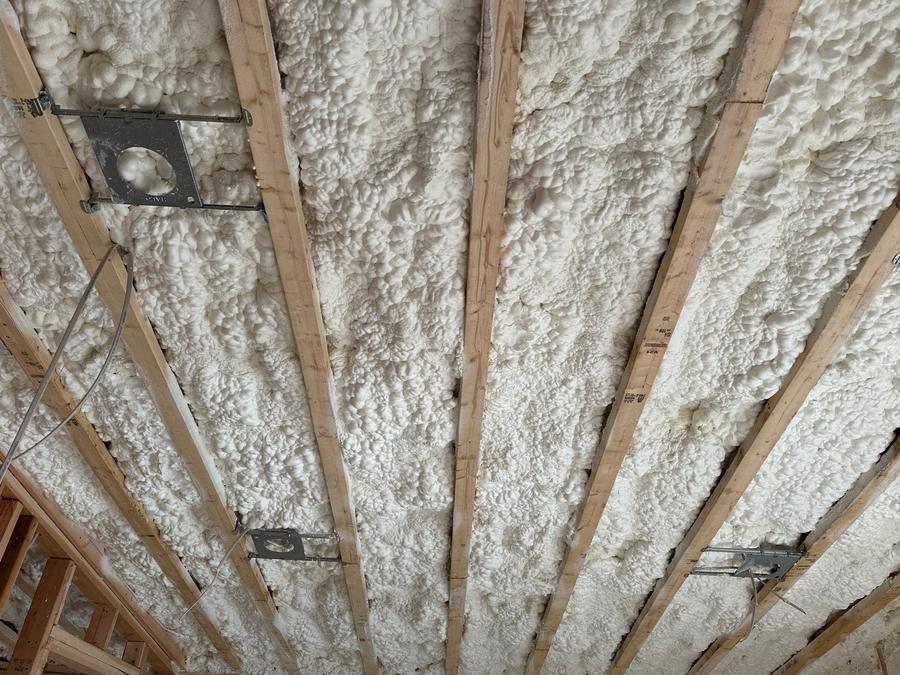
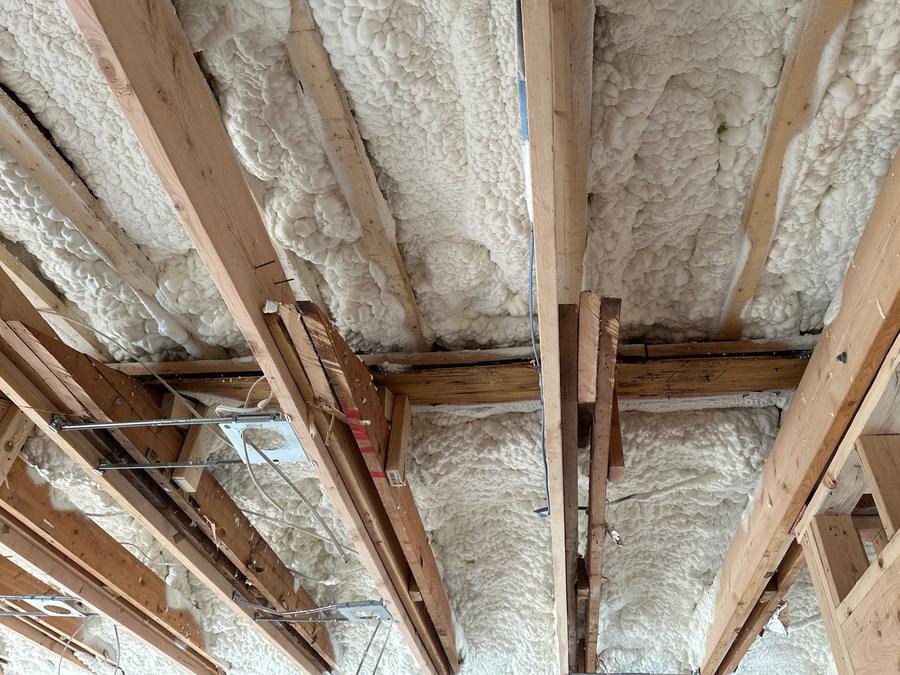
The 1960s gave Carmel 17.8% of its stock and the 1970s another 17.0%. A raised ranch from those years leaks first along its rim joist, which sits on top of the block foundation around the whole perimeter, bare or stuffed with a loose batt. Below it is a lower level half under grade: a family room against cold block, a garage beside it or under a bedroom. The split-level adds open joist bays over the garage and a short wall where the upper level meets the attic. All of them have a long, low attic of settled loose-fill with the top plates, plumbing stack, chimney chase and bath fans open into it.
The 1940s and 50s, 18.6% of the town, are capes and small ranches. A cape fails at the knee wall: no air barrier behind it, joist bays open to the eave, unbaffled slopes and a shallow flat attic above. Carmel has been the county seat since 1812, yet its 11.6% built before 1940 is the smallest pre-war share of any Putnam town we cover; in those houses we assume balloon framing and check the wiring before anything goes into a wall.
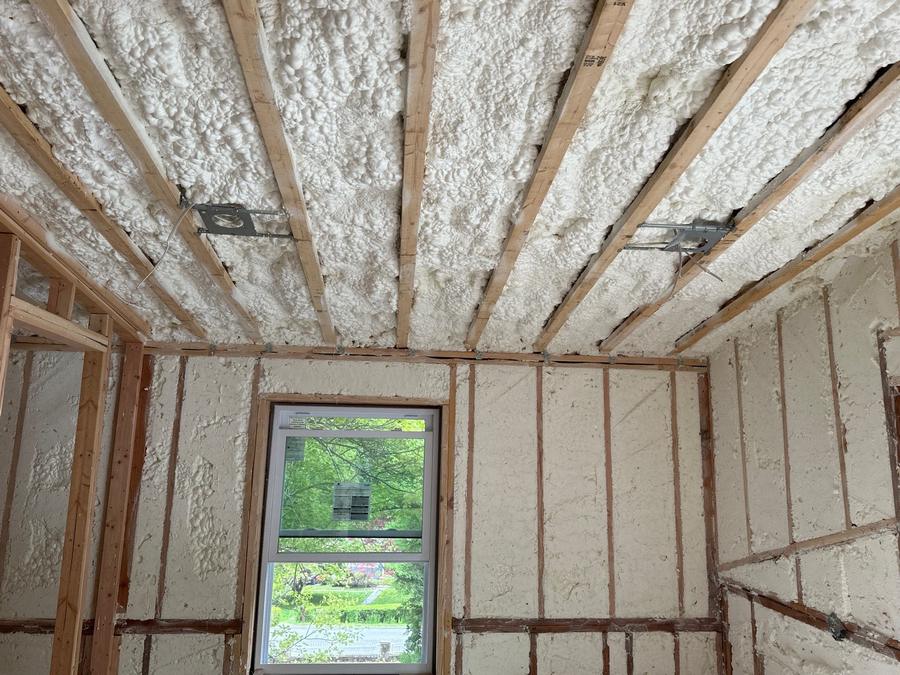
The 1980s added 13.1% and the 1990s 8.4%: colonials and contemporaries with filled walls, cathedral ceilings, recessed lights and bonus rooms over garages. There the job is the attic plane, the slopes, the garage ceiling and the rim, and in the houses built since 2000 it is usually the air handler and ducts sitting in a vented attic.
4.6 of the town’s 40.7 square miles are water, Lake Mahopac, Lake Gleneida and Long Pond among it. A house that steps down toward a lake usually has a walk-out lower level or a damp crawl space dug into the grade. We seal and insulate the crawl space walls and band instead of hanging batts between the joists, where they sag and hold moisture, and no closed-cell foam goes on a wall that takes water until the water is handled.
In the condominium communities, King’s Grant near Fair Street among them, the party wall is often open into the attic above both units and the roof belongs to the association. We scope the owner’s part, the ceiling plane, the rim and any floor over a garage, and say plainly when the rest is the board’s decision.
Oil heat in Carmel and Mahopac
61.0% of Carmel heats with oil, and gas lines reach only parts of the town, so for many houses there is no main to switch to. An oil customer does not watch a meter: the saving from sealing and insulating shows up as fewer deliveries each winter. Because oil is usually a more expensive way to make heat than gas, the payback on the same work tends to be shorter in an oil-heated house than in a gas-heated one of the same size. The 21.0% on electric heat sees the same logic, on a meter.
Tightening a house also changes how its boiler breathes. Before we seal a basement rim or a raised ranch’s lower level, we check where the oil burner and water heater draw combustion air and how the chimney drafts. The chimney chase is closed with sheet metal and fire-rated sealant at the proper clearance, never foam against the flue, and we work around the tank and its lines. New York’s heat pump program is moving to reward — and from 2028 require — a sealed and insulated house before it pays for a heat pump, so if a heat pump is in your plans, insulate first.
We seal before we insulate
Insulation slows heat moving through a surface. It does nothing about air moving through a gap. Blow a foot of cellulose into a raised ranch’s attic, leave the rim open on the block wall, and the family room downstairs stays exactly as cold.
In a Carmel raised ranch the order is: seal the rim joist around the whole perimeter, with closed-cell foam where it is bare; seal the garage ceiling and the band under any bedroom over it; seal the top plates, plumbing stack, chimney chase, bath fans and attic hatch; baffle the eaves; then insulate the attic to depth. In a split-level, add the short wall between the upper level and the attic.
If a quote specifies a depth of insulation and never mentions air sealing, it is half a job.
What insulation costs in Carmel
Most of our projects run between $3,500 and $12,500. In a raised ranch or split-level the number moves with the length of rim joist, whether the garage ceiling and the lower-level walls are in the scope, and the attic area. A cape is priced on its knee walls and slopes, a condo on what the owner controls. For the foam side, see what spray foam insulation costs.
Open cell foam runs R-3.9 to R-4.2 per inch. Closed cell runs R-6.9 to R-7.1 per inch and also acts as a vapor retarder, which is why it costs more and why it is right in some assemblies and unnecessary in others. All products are manufactured in the United States and meet applicable building code and safety standards. ENERGY STAR says sealing air leaks and adding insulation can save up to 10% on annual energy bills.
Insulation rebates in Carmel
Carmel buys its electricity from NYSEG, Mahopac included. Gas service is limited: lines reach only parts of the town, and many homes heat with oil, propane or electricity. In New York the electric company decides which programs a house can use, and for a NYSEG home that means NYSERDA’s.
NYSERDA’s Comfort Home program pays $2,500 toward sealing and insulating the attic and rim joist, $3,000 if walls and floors are added, and $2,000 more toward ENERGY STAR windows, through a NYSERDA-approved Comfort Home contractor. It is for market-rate owners of one- to four-family homes who pay the System Benefits Charge on their electric bill, as NYSEG customers do. Comfort Home is open in 2026. It closes when New York’s utilities start their new weatherization programs, planned for around January 2027, so a homeowner who wants Comfort Home money should not wait.
If your household income is under Putnam County’s limit — for a household of four, $97,200 or less for the no-cost tier and under $129,600 for the half-cost tier — NYSERDA’s EmPower+ program can pay for air sealing and insulation: at no cost up to $14,000 for lower-income households, or half the cost up to $7,000 for moderate-income households, through an EmPower+ contractor. Renters can apply.
NYSEG has offered its own insulation and air-sealing incentive for one- to four-unit homes; ask us or NYSEG what is open when you call. NYSERDA’s Green Jobs–Green New York program lends $1,500 to $25,000 over 5, 10 or 15 years, on the utility bill or as a monthly loan. Every one of these programs pays through its own participating contractors, so check eligibility and approved contractors on the MyEnergy portal before you sign.
The federal insulation tax credit (Section 25C) ended for work placed in service after 31 December 2025, so there is no federal insulation credit on a 2026 job. New York has no state tax credit for insulation. The details are in our New York and New Jersey rebate guide.
Code and climate in Carmel
65.1% of Carmel’s housing was built before 1980. New York’s first statewide energy code took effect on 1 January 1979, so nearly all of those houses went up without one. Putnam County is Climate Zone 5; Westchester, across the southern town line in Somers and Yorktown, is Climate Zone 4.
The 2025 Energy Conservation Construction Code of New York State has been in force since 31 December 2025. For a new house in Zone 5 it sets R-49 ceilings, or R-38 where the full height of uncompressed R-38 extends over the wall top plate at the eaves; R-30 floors; basement and crawl space walls at R-15 continuous, R-19, or R-13 plus R-5 continuous; U-0.27 windows; and no more than 3.0 air changes per hour at 50 pascals.
An existing house is treated differently. The parts you do not alter need not comply, the code does not require a blower door test when you insulate an existing home, and any cavity the work exposes gets filled to its full depth. ENERGY STAR recommends R-60 for an uninsulated attic in this climate and R-49 where 3 to 4 inches already sit, and that is what we build toward in a Carmel attic.
Common questions about insulation in Carmel
Do you install insulation in Carmel, NY?
Yes, across the town: Mahopac, Mahopac Falls, the hamlet of Carmel, Carmel Hills, Baldwin Place, Stillwater and Tilly Foster. Most of our work here is the 1960s and 70s raised ranch, split-level and ranch, 34.8% of the stock, usually with an oil boiler in the basement and an unsealed rim joist on the block wall. We also insulate the older capes, the 1980s and 90s colonials, and the owner’s side of townhouses and condos.
How much does insulation cost in Carmel?
Most projects run $3,500 to $12,500. In a raised ranch or split-level the drivers are the length of rim joist to seal, whether the garage ceiling and lower-level walls are included, and the size of the attic. A cape is priced on its knee walls and slopes, and a condo on the parts the owner controls rather than the association. You get a written scope and price after a free walk-through.
Are there insulation rebates in Carmel?
Yes. Carmel is NYSEG electric territory, so NYSERDA’s Comfort Home program pays market-rate homes $2,500 for sealing and insulating the attic and rim joist, or $3,000 with walls and floors, through a NYSERDA-approved Comfort Home contractor. It closes when the utilities’ new programs start, planned for around January 2027. Income-eligible owners and renters can use EmPower+. The federal 25C credit ended after 31 December 2025, and New York has no state tax credit for insulation.
Our raised ranch in Mahopac has a lower-level family room that is always cold. Why?
Usually because the rim joist and the lower-level walls are doing nothing. The rim sits on the block foundation around the whole house, half the room is below grade against cold block, and the garage shares a wall and sometimes a ceiling with it. We seal the rim with closed-cell foam, insulate the block and framed walls, and seal the wall and ceiling shared with the garage. More insulation in the attic helps the bedrooms upstairs, not that room.
Free energy audit in Carmel
We walk the attic and eaves, the rim joist around the whole basement or lower level, the garage ceiling and any bedroom over it, the knee walls in a cape, and the crawl space in a house that steps down toward the water. In an oil-heated house we look at the boiler, the chimney and the burner’s air supply before recommending anything tighter. Then a written scope and a price. No charge, no obligation.
Call 914-554-2289 or use the contact form. Open 8am–8pm, seven days. We are a family-owned company working out of New Rochelle, NY with a 100-plus in-house crew we never subcontract.
Get my free estimateor call 914-554-2289, 8am–8pm every day