18.4% of the housing in the Town of Fishkill, 1,842 units, is townhouses and duplex halves, and another 15.5% sits in buildings of five to nine units. Detached houses make up just 36.7% of the town’s 9,999 units. Fishkill also built late: the median unit dates from 1980, and 27.3% of the stock has gone up since 2000, 19.5% of it between 2000 and 2009 alone.
63.1% of occupied homes are owner-occupied. Utility gas heats 57.9% of homes, fuel oil or kerosene 20.0%, electricity 16.7% and bottled propane 3.8%. The older half of the town is here too: 50.7% of units predate 1980, including 18.8% from the 1970s and 12.4% from the 1960s.
Everything here is the Town of Fishkill, which includes the Village of Fishkill, Merritt Park and most of Brinckerhoff. The town surrounds the City of Beacon, but Beacon is a separate city with its own insulation page and none of its numbers are counted here. Fishkill runs from sea level on the Hudson at Fishkill Landing and Dutchess Junction to 1,600 feet on South Beacon Mountain, with Fishkill Creek and Interstate 84 crossing it east to west and Route 9 running north to south through the town and the village.
The houses we insulate in Fishkill
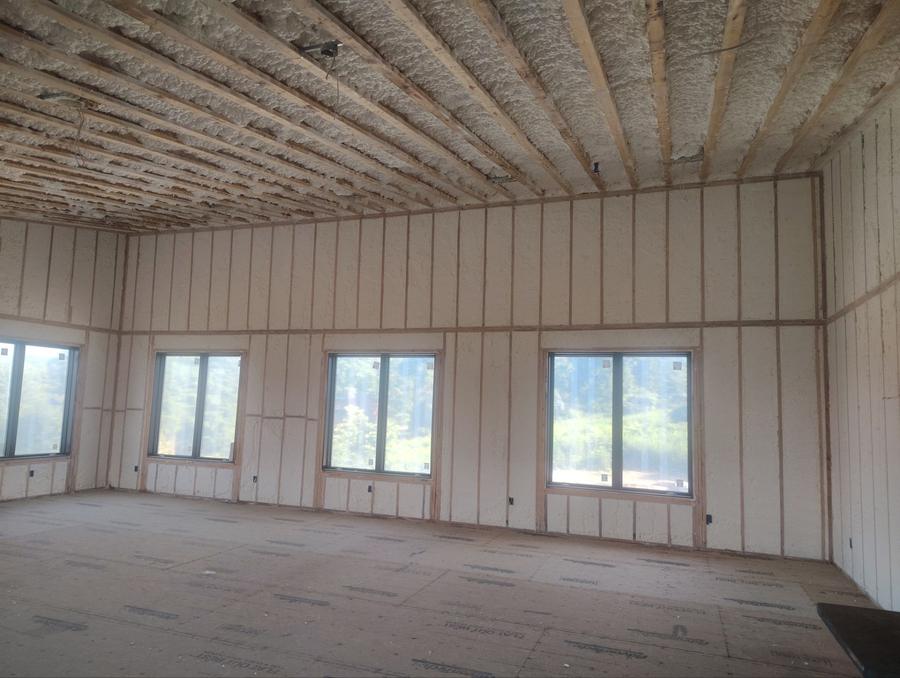
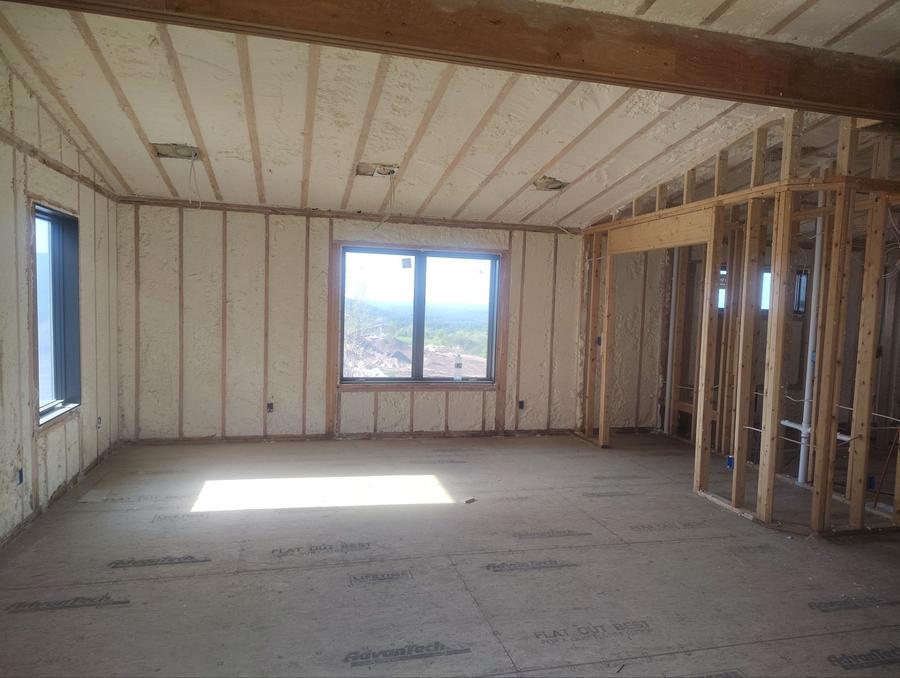
The townhouse is the defining Fishkill house: two-story units in rows, often with a garage under part of the living space, a furnace in a closet, the basement or the attic, a loft or cathedral ceiling on the top floor, and often one attic running over several units. The 1980s gave the town 10.8% of its stock, the 1990s 11.2% and the 2000s 19.5%, and a row built in those years has walls filled to the code of its day. The losses are at the top of the party walls, the flue and duct chases, the recessed lights, the attic access and the garage ceiling.
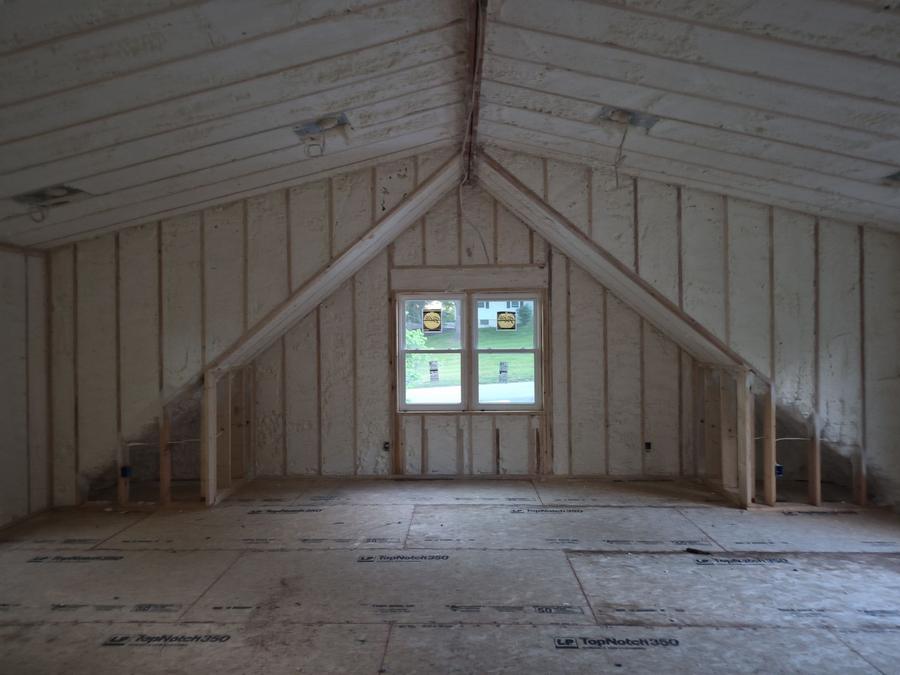
The detached houses number 3,674. The 1960s and 70s gave Fishkill 31.2% of its housing, and the detached houses of those decades are ranches, raised ranches and split-levels: a bare rim joist on the foundation, a lower level half below grade next to the garage, and a shallow attic of settled loose-fill over a ceiling nobody sealed. The 1950s, 11.3%, are capes and small ranches, and the cape still fails where it always does, behind the knee wall, where the joist bays run open to the eave.
The 1,551 units in buildings of five to nine units, and 972 in buildings of ten to nineteen, belong to landlords and associations. We scope those for the owner or the board, not for one resident.
Only 6.3% of the town, 625 units, predates 1940, though the history runs deep: the Rombout Patent, Catheryna and Roger Brett’s mill at the mouth of Fishkill Creek, the Continental Army’s supply depot a mile south of the village. Mount Gulian and the Van Wyck Homestead Museum are historic sites, not jobs. In the older private houses we assume balloon framing, look for knob-and-tube wiring before any wall is filled, and treat a wet stone cellar as a water problem before an insulation one.
Townhouses and the attic you share
In a row of townhouses the attic is rarely one owner’s. The fire separation between units is supposed to run up to the roof deck, and often it stops short, or runs up as drywall with gaps at the top, around the trusses and where the ducts cross. Warm air from one unit rises into an attic shared by the whole row, and a neighbor’s unsealed recessed lights leak into the same space as yours. Insulating over one unit helps that unit’s ceiling; it does not stop the row from leaking.
Who owns what decides the scope. In many associations the roof, the attic and the exterior walls are common property, and the board decides what happens to them. What is usually yours is the inside of the unit: the ceiling plane you can seal from below, the recessed lights and bath fans, the garage ceiling under your bedroom, the rim joist in your basement, the duct boots and registers, the attic access in your hallway. That work is worth doing, and we will scope it without touching the common elements. When a board wants a whole building sealed and insulated, we price the building, party walls included, because that is where the savings are.
One rebate detail matters here. NYSERDA’s Comfort Home program lists townhomes as eligible but excludes condominiums in buildings of more than four units, so a townhouse owned as a condominium in a long row should confirm on the MyEnergy portal before counting on the incentive.
We seal before we insulate
Insulation slows heat moving through a surface. It does nothing about air moving through a gap. Lay batts over a townhouse ceiling full of open light cans and a flue chase, and the upstairs still overheats in July and loses its warmth in January.
In a Fishkill townhouse the order is: seal the recessed lights with airtight covers or rated replacements; seal the bath fan housings and duct them outdoors; seal the duct boots to the ceiling drywall; close the flue chase with sheet metal and fire-rated sealant; weatherstrip and insulate the attic access; seal and insulate the garage ceiling under the living space; then the rim joist. Where the association allows it, the top of the party wall and the attic insulation come last.
If a quote specifies a depth of insulation and never mentions air sealing, it is half a job.
What insulation costs in Fishkill
Most of our projects run between $3,500 and $12,500. A single townhouse sits toward the low end: its ceiling plane, garage ceiling, rim joist and ducts. A detached 1960s or 70s raised ranch moves with the length of rim joist, the garage wall and ceiling, and the attic area. A whole townhouse building for an association is priced on the building. Our attic insulation page explains how attic scopes are built.
Open cell foam runs R-3.9 to R-4.2 per inch. Closed cell runs R-6.9 to R-7.1 per inch and also acts as a vapor retarder, which is why it costs more and why it is right in some assemblies and unnecessary in others. All products are manufactured in the United States and meet applicable building code and safety standards. ENERGY STAR says sealing air leaks and adding insulation can save up to 10% on annual energy bills.
Insulation rebates in Fishkill
The Town of Fishkill is Central Hudson territory for electricity. Most of the town outside the village is on Central Hudson gas lines, and in the Village of Fishkill Central Hudson gas is available on many streets, not all. 57.9% of homes heat with gas, so for most owners the saving shows on the gas bill. For the 20.0% still on oil, it shows as fewer deliveries, and the higher the price paid for each unit of heat, the quicker the same work pays back.
Central Hudson customers use NYSERDA’s programs for insulation incentives. NYSERDA’s Comfort Home pays $2,500 toward sealing and insulating the attic and rim joist, $3,000 if walls and floors are added, and $2,000 more toward ENERGY STAR windows, through a NYSERDA-approved Comfort Home contractor, for market-rate one- to four-family homes that pay the System Benefits Charge. Comfort Home is open in 2026. It closes when the new utility programs start around January 2027, so a homeowner who wants Comfort Home money should not wait.
NYSERDA’s EmPower+ serves income-eligible owners and renters of one- to four-family homes. For a Dutchess County household of four, $80,160 or less qualifies for air sealing and insulation at no cost up to $14,000, and under $106,880 for half the cost up to $7,000, through an EmPower+ contractor.
For financing, NYSERDA’s Green Jobs–Green New York loans run $1,500 to $25,000 over 5, 10 or 15 years, repaid on the Central Hudson bill or by monthly payment. Every one of these programs pays through its own participating contractors; check eligibility and approved contractors on the MyEnergy portal, and ask any installer directly, before you sign. See our New York and New Jersey rebate guide.
The federal insulation credit under Section 25C ended for work placed in service after 31 December 2025, so there is no federal credit on a 2026 job; be wary of anyone who says otherwise. New York has no state tax credit for insulation.
Code and climate in Fishkill
50.7% of Fishkill’s housing was built before 1980. The town’s capes, ranches and raised ranches of the 1950s and 60s went up before New York’s first statewide energy code took effect on 1 January 1979. From the river to the top of South Beacon Mountain, all of Fishkill falls in Dutchess County’s Climate Zone 5.
The 2025 Energy Conservation Construction Code of New York State took effect on 31 December 2025. For a new Zone 5 house or townhouse it requires R-49 ceilings, or R-38 where the full uncompressed R-38 reaches over the wall top plate at the eaves; R-30 floors; R-15 continuous, R-19, or R-13 plus R-5 continuous on basement and crawl space walls; U-0.27 windows; and air leakage of 3.0 air changes per hour or less at 50 pascals.
Existing homes are handled differently. Parts of the building you do not alter need not comply, no blower door test is required when you insulate an existing home, and any cavity the work opens is filled to its full depth. ENERGY STAR recommends R-60 for an uninsulated attic in this climate and R-49 where 3 to 4 inches are already in place.
Common questions about insulation in Fishkill
Do you install insulation in Fishkill, NY?
Yes, throughout the Town of Fishkill: the Village of Fishkill, Merritt Park, Brinckerhoff and the townhouse and condominium communities built since the 1980s, along with the detached ranches, raised ranches and capes of the 1950s, 60s and 70s. We scope townhouses around what the owner controls and whole buildings for associations. The City of Beacon is a separate city, and we work there too.
How much does insulation cost in Fishkill?
Most projects run $3,500 to $12,500. A single townhouse is usually near the low end: sealing the ceiling plane, recessed lights and duct boots, the garage ceiling under the living space, and the rim joist. A detached raised ranch or split is priced on the rim joist, the garage wall and ceiling, and the attic area. An association building is priced as a whole building. You get a written scope and a price after a free walk-through.
Are there insulation rebates in Fishkill?
Fishkill is Central Hudson electric territory, so market-rate owners of one- to four-family homes can use NYSERDA’s Comfort Home: $2,500 for sealing and insulating the attic and rim joist, $3,000 with walls and floors, through a NYSERDA-approved Comfort Home contractor, until the utilities’ new programs start around January 2027. Townhomes are eligible; condominiums in buildings over four units are not. Income-eligible owners and renters can use EmPower+. The federal 25C credit has ended, and New York has no state insulation credit.
We own a Fishkill townhouse and the association owns the roof. What can we insulate?
More than most owners think. From inside your unit we can seal and cover the recessed lights, seal the bath fans and duct boots, weatherstrip and insulate the attic access, seal and insulate the garage ceiling under your living space, and seal the rim joist in your basement. The attic above the ceiling and the party wall where it meets the roof are usually common elements, so those need the board’s approval. We write the scope so the board can see exactly what is and is not touched.
Free energy audit in Fishkill
In a townhouse we start upstairs at the ceiling plane, the light cans, the bath fans and the attic access, then the garage ceiling and the basement rim, and we ask to see the association’s rules before proposing anything above the ceiling. In a detached house we walk the attic, the rim joist, the garage and any knee walls. Then a written scope and a price. No charge, no obligation.
Call 914-554-2289 or use the contact form. Open 8am–8pm, seven days. The Home Insulators is family-owned, has worked out of New Rochelle, NY since 2015, and sends its own 100-plus in-house crew to every job rather than subcontracting.
Get my free estimateor call 914-554-2289, 8am–8pm every day