More than half of New Castle heats with oil. 54.7% of occupied homes burn fuel oil or kerosene, 31.8% use utility gas, 7.8% electricity and 5.4% bottled gas. Con Edison gas is available on many streets, but most New Castle heating bills still arrive on a delivery ticket, and every gap we close in an attic here is counted in gallons.
The rest of the numbers describe a town of owned, detached houses. Of 6,374 housing units, 83.9% are detached and 7.6% are attached townhouses; two-unit buildings are 3.4%, and buildings of 50 or more units 2.1%. 88.2% of occupied homes are owner-occupied. The median unit dates from 1964, but the median hides how evenly the town was built: 22.2% predates 1940, 22.1% went up in the 1940s and 50s, 25.6% in the 1960s and 70s and 23.0% in the 1980s and 90s, with 7.0% added since 2000. Four eras in near-equal shares means four different sets of failures.
There is also no one place called New Castle. The town is Chappaqua, its largest hamlet, whose ZIP code covers most of the town; Millwood in the northwest; the “West End,” where addresses read Ossining or Millwood; and edges that share ZIP codes with Armonk, Briarcliff Manor, Mount Kisco, Pleasantville and Yorktown. The hamlet center has its own Chappaqua insulation page; what follows covers the whole town, Millwood and the West End included.
The houses we insulate in New Castle
The oldest layer is 22.2% of the stock, 1,418 units built before 1940. The first European settlers were Quakers, who reached present-day Chappaqua in 1753 and built a meeting house that still stands on Quaker Street, and the town broke away from North Castle in 1791. The Register-listed Williams-DuBois House and Isaac Young House belong to a wider stock of farmhouses and early houses across the town. Their walls are empty cavities behind clapboard or shingle, often balloon-framed so a stud bay runs open from cellar to attic; the cellar is fieldstone with a bare rim joist; the attic floor is boards over nothing. We assume knob-and-tube wiring until we see otherwise, and NYSERDA’s Comfort Home rules say that wiring can block a house from the program’s incentive. Solid concrete, like Rehoboth on Horace Greeley’s old farm, the first concrete barn in the country, has no cavity to fill.
The 1940s and 50s added 22.1%: capes, small colonials and the first ranches. A cape’s upstairs is wrapped by three cold spaces, two knee-wall attics and a low flat attic, and the floor joists under the knee wall run open to the eave, so winter air moves under the bedroom floor. A ranch of the same years has one long attic of settled loose-fill with the top plates and chimney chase open beneath it.
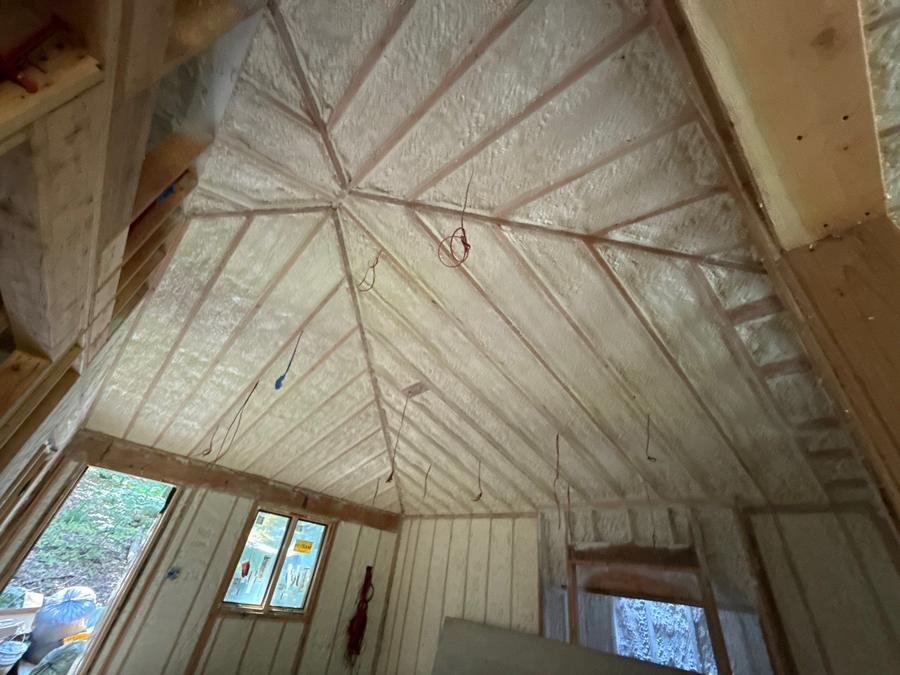
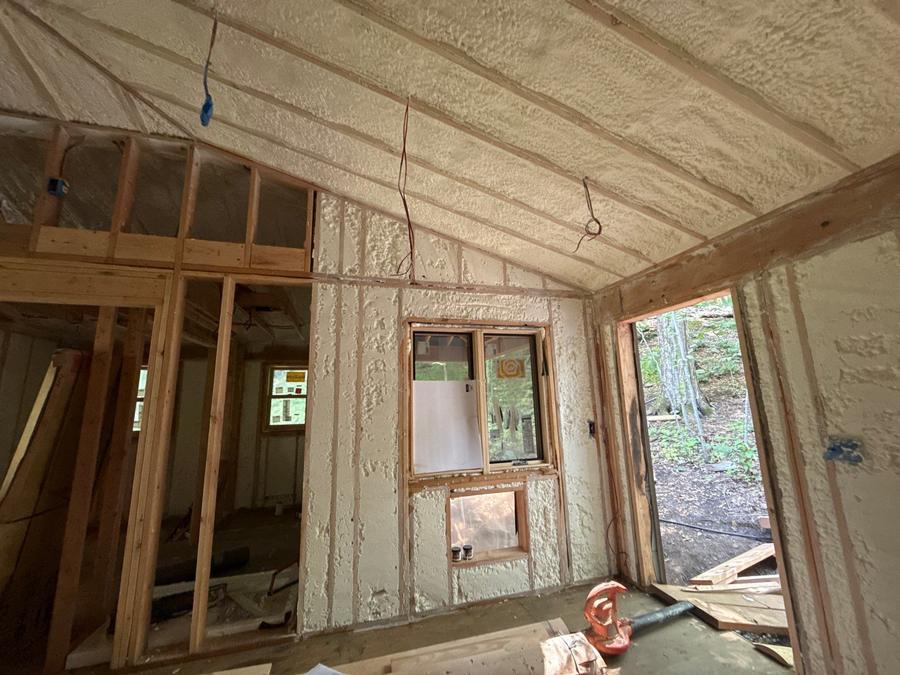
The largest cohort, 25.6%, is the 1960s and 70s: split-levels, raised ranches, center-hall colonials and contemporaries. A split puts a bedroom wing over the garage and has two attics at different heights, with the step between them often left open. The contemporaries bring cathedral ceilings: rafter bays packed with fiberglass tight to the roof deck, no vent space, recessed lights cut through, and a ridge that shows as a melted line on a snowy morning. These houses have some insulation, so owners assume the job is done.
The 1980s and 90s, 23.0%, built large colonials with two-story foyers and bonus rooms over the garage. The walls hold the batts of the day, but the ducts and often the air handler sit in a vented attic outside the insulation, and the bonus room floor is open at its edges. The 486 attached townhouse units are a different job: the party wall where it meets each attic lets air travel between units, and the association usually owns the roof and signs off first.
Oil tanks, chimneys and the heat pump question in New Castle
With 54.7% of homes on oil and 5.4% on bottled gas, most of New Castle buys its heat by the gallon. That makes air sealing easy to judge: compare the gallons delivered the winter before the work with the winter after. Oil has usually cost more per unit of heat than piped gas, so the same sealing tends to pay back faster in an oil house than on a gas meter, though the pace depends on each season’s oil. We do not promise a payback year.
An oil boiler means a chimney, and the chimney chase is one of the largest holes in a New Castle attic: a framed opening around the masonry, open from basement to roof. It gets closed with sheet metal and high-temperature sealant, never foam against the chimney or flue. The rim joist above the oil tank is usually bare, so it is sealed and insulated on the same visit.
Many oil households are weighing a heat pump. Do the house first: a heat pump is sized to the heat a house loses, so one sized to a leaky house is bigger than the sealed house needs. New York’s heat pump program, NYS Clean Heat, run here by Con Edison, is moving to reward — and from 2028 require — a sealed and insulated house before it pays for a heat pump. The same order holds for a switch from oil to Con Edison gas where a main runs past.
We seal before we insulate
Insulation slows heat moving through a surface. It does nothing about air moving through a gap. In an oil-heated house the gap is where the gallons go: warm air leaving through the top of the house pulls cold air in at the bottom, whatever depth is lying in the attic.
In a New Castle split or 1970s colonial we start at the top and the bottom. In the attic: the chimney chase, top plates, wiring and plumbing holes, bath fans, recessed lights and the hatch, with a rigid barrier across the open step between a split’s two attics. Over the garage: the ceiling under the bedroom wing. In the basement: the rim joist. Then the insulation, with baffles at the eaves so it does not choke the soffit vents.
If a quote specifies a depth of insulation and never mentions air sealing, it is half a job.
What insulation costs in New Castle
Most of our projects run between $3,500 and $12,500. A 1960s or 70s split with one reachable attic and a garage ceiling sits toward the lower end. Cathedral ceilings cost more, because a closed slope has to be dense-packed or opened and foamed. A pre-1940 farmhouse with walls to fill, a fieldstone rim to foam and attic floorboards to lift sits toward the upper end, and a large 1980s colonial is priced on its attic area and the ductwork in it. For the foam side, see what spray foam costs.
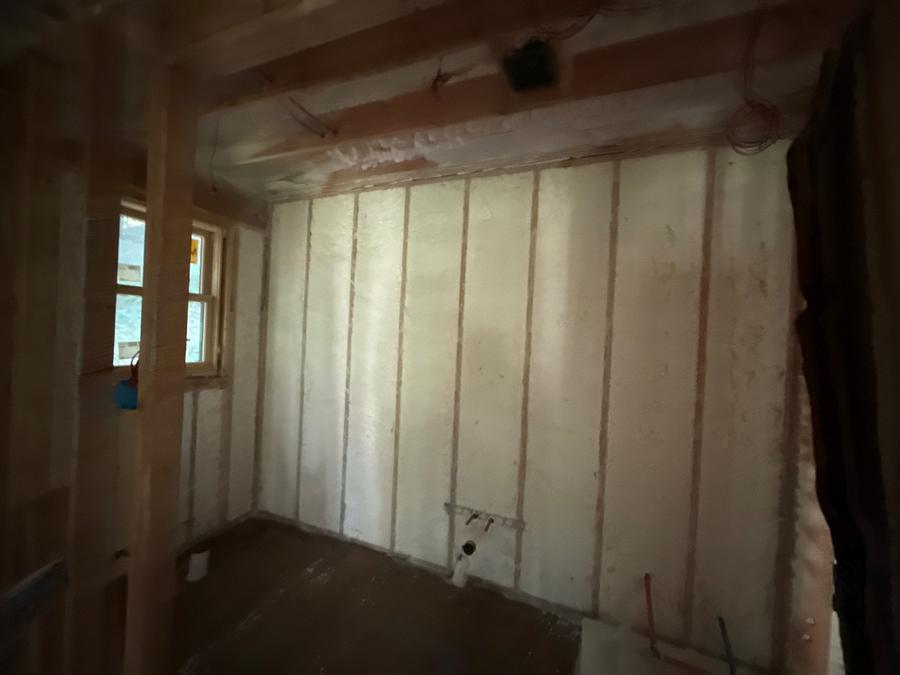
Open cell foam runs R-3.9 to R-4.2 per inch. Closed cell runs R-6.9 to R-7.1 per inch and also acts as a vapor retarder, which is why it costs more and why it is right in some assemblies and unnecessary in others. All products are manufactured in the United States and meet applicable building code and safety standards. ENERGY STAR says sealing air leaks and adding insulation can save up to 10% on annual energy bills.
Insulation rebates in New Castle
New Castle is Con Edison territory for electricity, and Con Edison gas is available on many streets; most homes off those lines burn oil. The electric company decides which programs a house can use. Con Edison’s own Weather Ready insulation rebates no longer take applications; Con Edison points Westchester homeowners to NYSERDA’s Comfort Home program and says new weatherization incentives are coming in 2027.
NYSERDA’s Comfort Home program pays $2,500 when the attic and rim joist are sealed and insulated, $3,000 when the walls and floors are done as well, and another $2,000 toward ENERGY STAR windows, through a NYSERDA-approved Comfort Home contractor. It is for owners of one- to four-family homes who pay the System Benefits Charge on their electric bill, as Con Edison customers do, and it is aimed at market-rate households. Comfort Home is open in 2026, but Comfort Home closes when the new utility programs start around January 2027, so a homeowner who wants that money should not wait.
Income-eligible owners and renters use NYSERDA’s EmPower+ instead. In Westchester a four-person household at or below $102,000 can get air sealing and insulation at no cost up to $14,000, and one below $136,000 can get half the cost covered up to $7,000. The town’s median household income is $244,375, well above those limits, so Comfort Home is the program most New Castle owners will look at.
Both programs pay only through their own participating contractors; eligibility and approved contractors are listed on the MyEnergy portal. We quote the work and explain which programs your house may fit. The federal insulation tax credit (Section 25C) ended for work placed in service after 31 December 2025, so there is no federal insulation credit on a 2026 job. New York has no state tax credit for insulation. The full picture is in our New York and New Jersey rebate guide.
Code and climate in New Castle
70.0% of New Castle’s housing went up before 1980. New York’s first statewide energy code took effect on 1 January 1979, so nearly all of that stock was built before the state set any energy standard for a house. Westchester County is Climate Zone 4.
The 2025 Energy Conservation Construction Code of New York State has been in force since 31 December 2025. For a new house it sets ceilings at R-49, or R-38 where the full height of uncompressed R-38 extends over the wall top plate at the eaves; floors at R-30; basement and crawl space walls at R-15 continuous or R-19; windows at U-0.27; and air leakage no higher than 3.0 air changes per hour at 50 pascals.
An existing house is treated differently. Unaltered parts do not have to be brought up to the new-home table, and New York’s code does not require a blower door test when you insulate an existing home. Where an alteration opens a wall or roof cavity, it has to be filled to full depth. ENERGY STAR recommends adding R-60 to an uninsulated attic in this zone, or R-49 where 3 to 4 inches are already down.
Common questions about insulation in New Castle
Do you install insulation in New Castle, NY?
Yes, across the whole town: Chappaqua, Millwood, the West End with its Ossining and Millwood addresses, and the edges that carry Armonk, Mount Kisco, Pleasantville, Briarcliff Manor and Yorktown addresses. Most of the work is detached houses, 83.9% of the stock, spread over four eras in close to equal shares: pre-1940 farmhouses, 1940s and 50s capes and ranches, 1960s and 70s splits and contemporaries, and 1980s and 90s colonials. We also insulate townhouses where the association agrees.
How much does insulation cost in New Castle?
Most projects run $3,500 to $12,500. A 1960s or 70s split with one open attic and a garage ceiling is usually toward the lower end. Cathedral ceilings cost more, because the slopes have to be dense-packed or foamed. A pre-1940 farmhouse with walls to fill and a fieldstone rim to seal, or a large 1980s colonial with ducts in the attic, usually sits toward the upper end. We put the scope and price in writing after a free walk-through.
Are there insulation rebates in New Castle?
Yes, through NYSERDA, because New Castle’s electric company is Con Edison, whose own Weather Ready rebates are closed. Comfort Home pays a NYSERDA-approved Comfort Home contractor $2,500 toward an attic and rim joist package, or $3,000 when walls and floors are included, and the amount is passed to you; Comfort Home closes when the new utility programs start around January 2027. Income-eligible households go to EmPower+. There is no federal 25C credit on a 2026 job and no New York insulation credit.
Our New Castle house heats with oil. Should we insulate before adding a heat pump?
Yes. A heat pump is sized to the heat the house loses, so sizing one to a leaky house buys more equipment than the sealed house needs. New York’s heat pump program is moving to reward, and from 2028 require, a sealed and insulated house before it pays for a heat pump. Meanwhile the boiler keeps working, and every gallon the sealing saves is one you do not buy while you decide. Seal the attic, chimney chase and rim joist first, then size the heat pump.
Free energy audit in New Castle
We start where the heat escapes: the attic and its chimney chase, the knee walls or cathedral slopes, the ceiling over the garage, the rim around the boiler, and in a pre-1940 house the wall cavities and the wiring in them. The scope and price come in writing, free and with no obligation. If the real job is the chimney chase and the rim, not another attic layer, we will say so.
Call 914-554-2289 or use the contact form. Open 8am–8pm, seven days. We are a family-owned company working out of New Rochelle, NY since 2015 with a 100-plus in-house crew we never subcontract.
Get my free estimateor call 914-554-2289, 8am–8pm every day