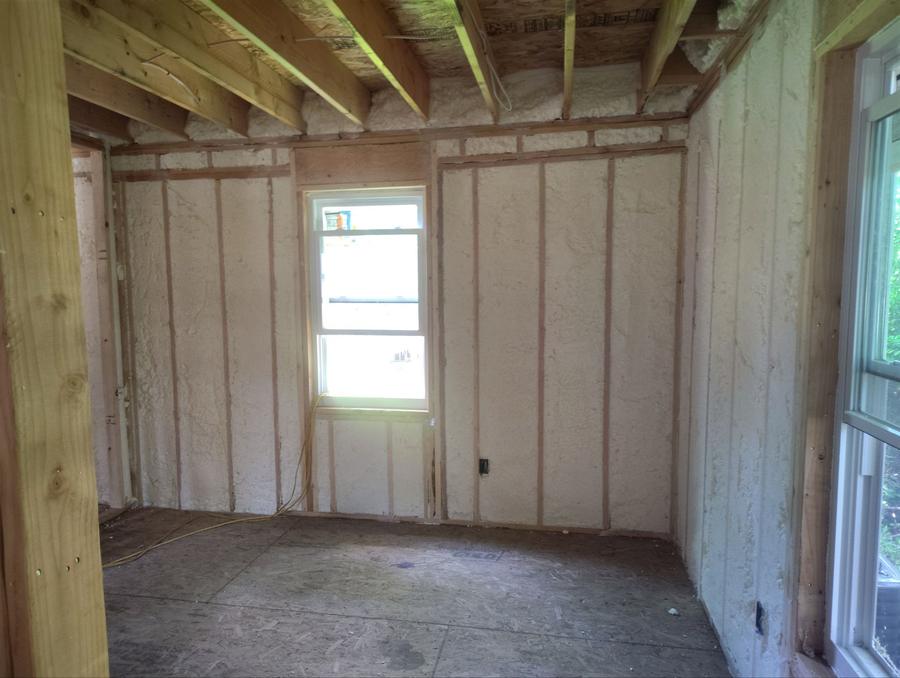
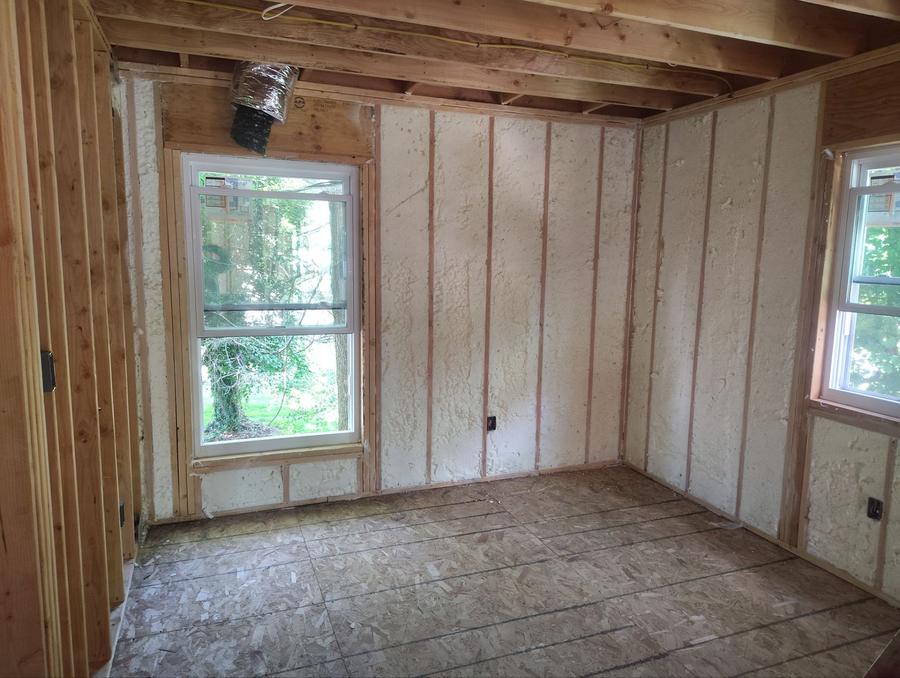
A quarter of the housing in Ossining village is a two-family or a small
apartment building, most of it standing on a hill, and most of it heated as
though it were one house. In that stock the detail that decides the winter bill
is not the attic. It is the stair tower.
The houses we insulate in Ossining
There are two Ossinings and the numbers differ enough to matter. This page is
about the village: median year built 1961,
51.4% owner-occupied, 29.8% detached (39.2% counting attached
houses), 32.2% built before 1940, and 26.0% of all
units in small multifamily — 15.7% two-family and 12.7% in
buildings of five to nine units. The surrounding Town of Ossining, which also
takes in part of
Briarcliff Manor,
reads newer and more suburban: median 1965, 62.8% owner-occupied, 40.5% detached,
25.2% pre-1940, with 13.9% built in the 1980s and 9.6% in the 1990s.
The village sits on a steep grade running down toward the river, and the
two-family form here is shaped by it: a tall narrow frame house, a walk-out
cellar at the downhill end, an apartment per floor, and a converted attic on
top. Which brings us to the stair.
The common stair in one of these houses is a chimney. It runs
enclosed from the cellar door to the top floor and usually to an attic hatch, and
it is neither heated nor insulated. Warm air from both apartments leaks into it
around the apartment doors and through the open framing of the enclosure, rises
the full height of the building, and leaves through the attic hatch and the top
plates around the stairwell. On a steep lot the cellar door at the bottom of that
stack sits at grade on the downhill side, so as fast as warm air leaves the top,
cold outdoor air is pulled in at the bottom. The top-floor tenant feels the
draft. Whoever pays the heating bill pays for it.
So the order of work in an Ossining two-family is: cap the stack first. The
attic hatch or door weatherstripped and insulated, the top plates around the
stair enclosure sealed, the cellar door and frame sealed. Then the converted
attic, which in this stock always has knee walls with no air barrier on the back
side and sloped ceiling bays with no baffles. Then the cellar ceiling and rim
joist, which on a walk-out is partly above grade and facing weather. In the
pre-1900 frame houses the stud bays run sill to attic and get dammed at the top
plate before anything is dense-packed.
We seal before we insulate
Insulation slows heat moving through a surface. It does nothing about air
moving through a gap. Pack a leaky attic with cellulose and you have a leaky
attic with cellulose in it — the air still moves, it just moves through
something softer.
In a three-story Ossining house the point is sharper than usual, because
height drives stack effect. The taller and leakier the vertical path, the harder
the building pumps air out the top and pulls it in at the bottom, and insulation
laid over an open stairwell hatch does nothing about that. Seal the top, seal
the bottom, seal the apartment doors into the stair, and only then decide how
much material goes down. Then we insulate.
If a quote gives you a depth and never mentions air sealing, it is half a
job.
What insulation costs in Ossining
Most of our projects run between $3,500 and $12,500. In
Ossining the cost driver is usually the building rather than the square footage.
A single-family house with an open attic sits near the bottom. A three-story
two-family with an occupied top-floor apartment, a converted attic to open up, a
stair enclosure to seal and a walk-out cellar sits near the top, because that is
several separate work areas and scheduling around tenants.
Open cell foam runs R-3.9 to R-4.2 per inch. Closed cell runs R-6.9 to R-7.1
per inch and also acts as a vapor retarder, which is why it costs more and why it
is right in some assemblies and unnecessary in others. All products are
manufactured in the United States and meet applicable building code and safety
standards. ENERGY STAR says sealing air leaks and adding insulation can save up to 10% on annual energy bills.
Insulation rebates in Ossining
In a village that is only 51.4% owner-occupied and a quarter small
multifamily, the first rebate question is who owns the assembly being insulated,
so settle that before anything else. The utility is not in doubt: Ossining is
Con Edison for gas and electricity. Con Edison’s residential
Weather Ready program is not accepting
applications, and Con Edison’s own page tells Westchester customers to
expect news about 2027 incentives and to use NYSERDA in the meantime. The $4,000
figure still on one of its index pages is stale.
The live program is NYSERDA Comfort Home:
$2,500 to air seal and insulate the attic and rim joist,
$3,000 if wall and floor insulation is added, and
$2,000 more toward ENERGY STAR windows afterwards. The
contractor has to be on NYSERDA’s Comfort Home list and the house has to meet the
conditions of the whole package, not half of one. Households at or below 80% of
area median income should look at EmPower+: no cost up to
$14,000 downstate, or half the cost up to $7,000
at moderate incomes. See the full New York
rebate guide for the mechanics.
The federal Section 25C tax credit ended for anything placed in service after
31 December 2025. There is no federal insulation credit on a
2026 job.
Code and climate in Ossining
About a third of the village went up before 1940 and the median is 1961, so
the overwhelming majority of Ossining was built with no energy code behind it.
The current one is the 2025 Energy Conservation Construction Code of New
York State, in force since 31 December 2025 and based
on the 2024 IECC. Westchester is climate zone 4.
For new construction and additions it sets R-49 in the
ceiling, R-30 in wood-framed walls (or R-20 cavity plus R-5
continuous), R-30 in floors, and R-15 continuous or R-19 cavity in basement and
crawl space walls. Anyone quoting R-60 is quoting Connecticut’s code.
None of it applies to a building already standing. The code does
not require an existing building to be altered, only that an alteration not leave
you with less R-value than you had. ENERGY STAR recommends R-60 for a retrofit attic here, which is guidance, not law.
Common questions about insulation in Ossining
Do you install insulation in Ossining, NY?
Yes. Much of what we do in Ossining village is two-family and small apartment
work — stair enclosures, converted attics, cellar ceilings on walk-out
lots — alongside standard single-family attics. The newer detached housing
in the surrounding town is the more conventional job.
How much does insulation cost in Ossining?
Most projects run $3,500 to $12,500. A single-family Ossining attic sits near
the bottom. A three-story two-family runs toward the top, because the work is
spread across a converted attic, a stair enclosure and a walk-out cellar, and it
has to be scheduled around whoever is living there.
Are there insulation rebates in Ossining?
Yes, through NYSERDA. Ossining is Con Edison for gas and electric, and Con
Edison’s weatherization program is not accepting applications, so Comfort Home is
the live one: $2,500 for air sealing plus attic and rim joist, $3,000 with walls
and floors. EmPower+ covers income-qualified households. No federal credit
applies to a 2026 job.
Why is the top floor of our Ossining two-family always drafty?
Because the common stair is behaving like a flue. Warm air from both
apartments leaks into an unheated stairwell, rises three stories and escapes
through the attic hatch, which pulls cold air in at the cellar door to replace
it. Adding insulation over that hatch does not stop it. Sealing the top and
bottom of the stack does, and it is usually a small job.
Free energy audit in Ossining
We walk the attic and any converted space, the stair enclosure top and bottom,
and the cellar and rim joist, then give you a written scope and a price. No
charge, no obligation. If the honest answer is that your attic is adequate and
the problem is a stairwell hatch, that is what we will quote.
Call 914-554-2289 or use the form on this page. Open
8am–8pm, seven days. We have insulated hundreds of homes across New York,
Connecticut and New Jersey with a 100-plus in-house crew.
Get my free estimateor call 914-554-2289, 8am–8pm every day
Learn more
- Insulation contractors across Westchester County
- Briarcliff Manor, part of which lies in the Town of Ossining
- New York insulation rebates in full
- Types of insulation
- Open cell and closed cell spray foam compared
- Insulating an older home
- What happens during an energy audit
- Full insulation FAQ