Pelham is two villages with two different housing profiles, and the
difference shows up in the quote. Pelham Manor is 92% owner-occupied, 71%
detached and 72% pre-1940. Pelham village runs 67%, 53% and 59%. Both sit on top
of the same underlying problem, which is how these houses were framed.
The houses we insulate in Pelham
The Census bottom-codes Pelham’s median year built at 1939 or
earlier. It will not name a year because the middle of the town’s
housing is older than the table goes. Town-wide, 64.8% of units
predate 1940, 78.8% are owner-occupied and 60.7% are detached. Split by village,
Pelham Manor is the older and more purely single-family half at
71.8% pre-1940 and 70.5% detached; Pelham village runs 59.2% and
52.8%. Same era, different mix.
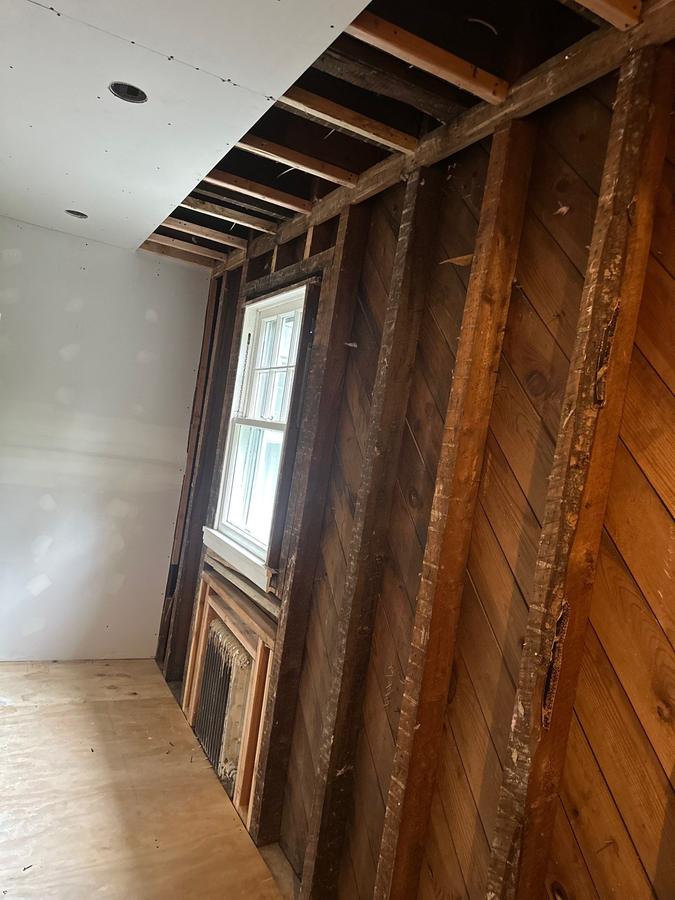
What that era means in the field is balloon framing. In a house built before
roughly 1935, the studs commonly run in one piece from the sill plate to the
attic with no blocking at the floor lines, so every stud bay is a continuous
vertical shaft from cellar to roof. Blow loose-fill onto the attic floor over
open bays and you have not insulated the house. You have built a chimney and
capped it with something fluffy. The bays get dammed at the top plate first
— all of them, not most of them — and only then does anything go
down.
The second finding is that the bare attic floor is not neglect. These houses
were designed around steam or hot-water heat and gravity ventilation, and the
open attic was part of how the building was meant to work. Owners read it as
normal because it has always looked that way. It stopped being normal when the
house got a modern boiler and a family that expects the second floor to hold
temperature.
The third is wiring. Live knob-and-tube in attic and wall cavities is common
in this stock and has to be remediated before anything blown goes near it. We
price the electrician in at the audit rather than finding it on the second
morning and stopping work, which is how these jobs fall apart halfway.
So a Pelham scope reads: confirm the wiring, block and seal every stud bay at
the top plate, seal the penetrations, then blow the attic floor deep. Wall
dense-packing comes after the bays are blocked at both ends, or not at all.
We seal before we insulate
Insulation slows heat moving through a surface. It does nothing about air
moving through a gap. Pack a leaky attic with cellulose and you have a leaky
attic with cellulose in it — the air still moves, it just moves through
something softer.
In a balloon-framed Pelham house that is not a detail, it is the whole job.
Until the stud bays are blocked at the top plate, the wall cavity feeds warm air
straight into the attic and cold air straight into the first floor, and the depth
of insulation sitting on the joists makes almost no difference to either. Top
plates, bays, penetrations, hatch. Then we insulate.
If a quote gives you a depth and never mentions air sealing, it is half a
job.
What insulation costs in Pelham
Most of our projects run between $3,500 and $12,500. In
Pelham two things drive the number. The first is how many stud bays have to be
opened, blocked and closed back up, which is a function of the house’s footprint
rather than its square footage. The second is knob-and-tube: remediation is
electrical work on an electrical permit, not insulation work, and we would rather
show it as its own line than bury it.
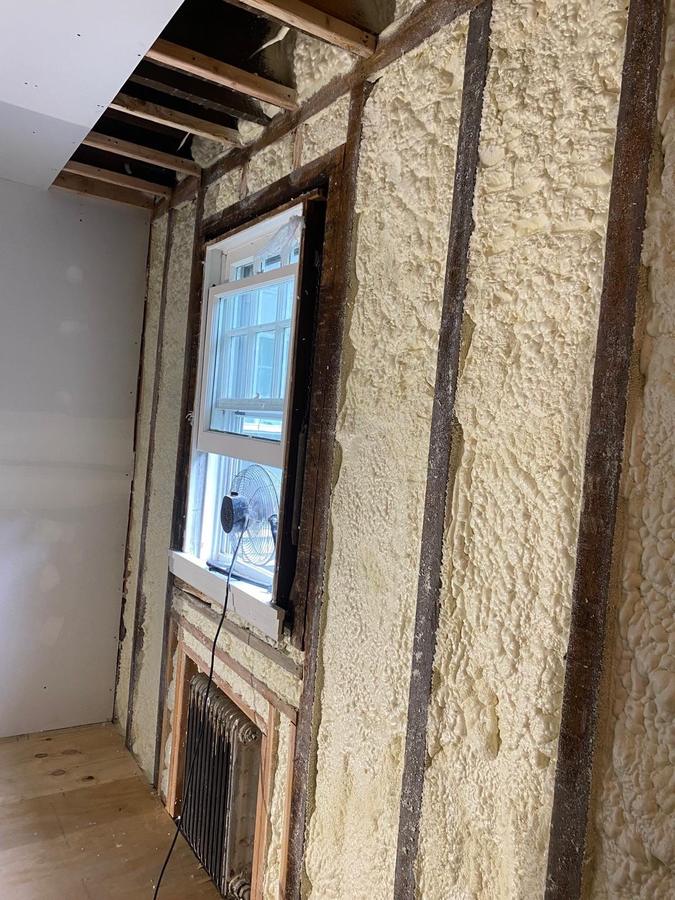
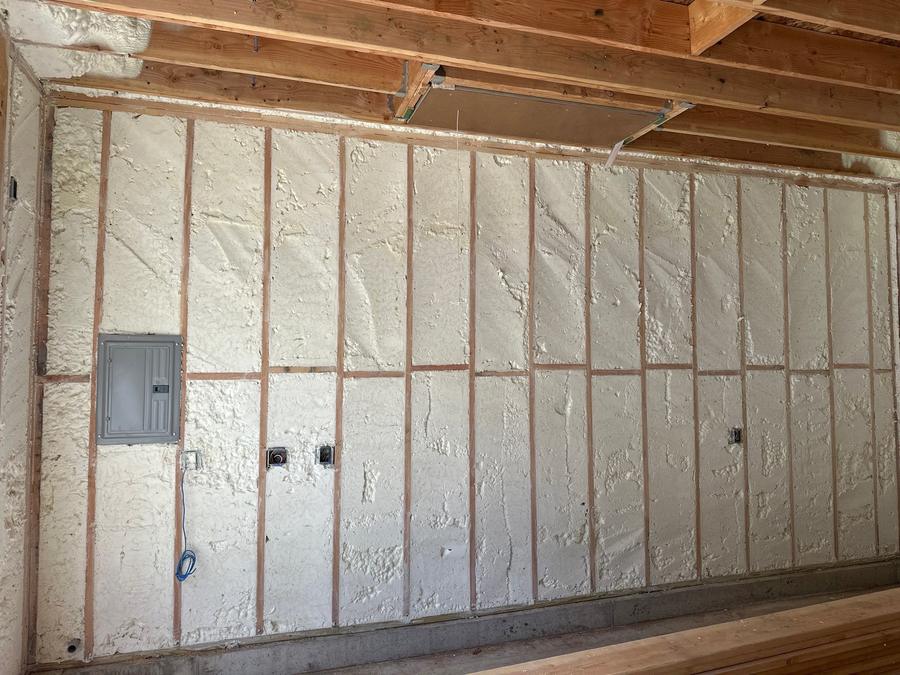
Open cell foam runs R-3.9 to R-4.2 per inch. Closed cell runs R-6.9 to R-7.1
per inch and also acts as a vapor retarder, which is why it costs more and why it
is right in some assemblies and unnecessary in others. All products are
manufactured in the United States and meet applicable building code and safety
standards. ENERGY STAR says sealing air leaks and adding insulation can save up to 10% on annual energy bills.
Insulation rebates in Pelham
Both villages are Con Edison territory for electricity and
gas, so the rebate picture is the same on either side of the town line. Con
Edison’s residential Weather Ready weatherization program is
not accepting applications; the utility’s own page says to
expect news about 2027 incentives and directs Westchester customers to NYSERDA in
the meantime.
The live program is NYSERDA Comfort Home:
$2,500 to air seal and insulate the attic and rim joist,
$3,000 if wall and floor insulation is added, and
$2,000 more toward ENERGY STAR windows once that work is done.
The installer has to be on NYSERDA’s Comfort Home list, and the house has to meet
the conditions of the whole package — half a tier does not pay half the
money. In a balloon-framed house the walls are often the second half of the
sensible scope anyway. Households at or below 80% of area median income should look at
EmPower+: no cost up to $14,000 downstate, or
half the cost up to $7,000 at moderate incomes. It is also how
New York currently delivers the federal HEAR money. See
the full New York rebate guide for the
mechanics.
The federal Section 25C tax credit ended for anything placed in service after
31 December 2025. There is no federal insulation credit on a
2026 job.
Code and climate in Pelham
Two-thirds of Pelham predates 1940, and in Pelham Manor it is closer to 72%.
Effectively the whole town was built before New York had an energy code. The
current one is the 2025 Energy Conservation Construction Code of New York
State, in force since 31 December 2025 and based on the
2024 IECC. Westchester sits in climate zone 4.
New construction and additions get R-49 in the ceiling,
R-30 in wood-framed walls (R-20 cavity plus R-5 continuous also
satisfies it), R-30 in floors, and R-15 continuous or R-19 cavity in basement
walls. Those figures changed at the end of 2025, so an older
Westchester number is a dead code and an R-60 ceiling number is Connecticut’s.
None of it applies to a house already standing. The code does not
require an existing building to be altered, only that an alteration not leave you
with less R-value than you had. ENERGY STAR recommends R-60 for a retrofit attic in this zone, which is guidance, not law.
Common questions about insulation in Pelham
Do you install insulation in Pelham, NY?
Yes, in both villages. The work is similar on either side of the line because
the housing is from the same era, though Pelham Manor skews older and more
detached, so we see more full-house scopes there and more partial attic-only
scopes in Pelham village. The audit sorts out which one you have.
How much does insulation cost in Pelham?
Most projects run $3,500 to $12,500. A Pelham house lands high in that range
when the walls are in scope, because every stud bay in a balloon-framed house has
to be blocked at the top plate before it can be dense-packed. An attic floor with
the bays dammed and nothing else touched sits near the bottom.
Are there insulation rebates in Pelham?
Yes, through NYSERDA. Pelham and Pelham Manor are both Con Edison territory,
and Con Edison’s own weatherization program is closed to applications, so the
live money is Comfort Home: $2,500 for air sealing plus attic and rim joist,
$3,000 with walls and floors added. EmPower+ covers income-qualified households.
No federal tax credit applies to a 2026 job.
Our Pelham house still has knob-and-tube wiring. Can you insulate around
it?
No, and anyone who says yes is taking a risk with your house. Live
knob-and-tube was designed to shed heat into open air, and burying it in
insulation removes that. It has to be remediated by an electrician first. We flag
it at the audit and price the sequence so the job does not stall between two
trades.
Free energy audit in Pelham
We walk the attic, the cellar and the crawl space, find where the house is
losing air and heat, and give you a written scope and a price. No charge, no
obligation. If the honest answer is that your attic is adequate and the real
problem is open stud bays and a bath fan dumping into the soffit, we will say
so.
Call 914-554-2289 or use the form on this page. Open
8am–8pm, seven days. We have insulated hundreds of homes across New York,
Connecticut and New Jersey with a 100-plus in-house crew.
Get my free estimateor call 914-554-2289, 8am–8pm every day