We sell two different things in Scarsdale and they are not the same job. On
the 1920s stock it is a deep envelope retrofit. On the houses built since 2000 it
is usually not insulation at all — it is duct sealing and an attic plane
that was never closed. A 2018 Scarsdale house can measure worse than a 1928
one.
The houses we insulate in Scarsdale
Scarsdale is almost purely single-family: 92.7% of its 5,921
units are detached, 92.3% are owner-occupied, and 0.2% sit in buildings of 50
units or more. The median build year is 1943 and
48% predates 1940. The number that changes how we quote,
though, is at the other end of the table — 8.0% of the housing went up
between 2010 and 2019 and another 6.2% in the 2000s. That is 841 units since
2000, a genuine teardown-and-rebuild wave.
The pre-1940 half is 1920s Tudor and colonial revival with slate or clay-tile
roofs, radiators and a full-height unfinished attic. Two things set the scope.
The roof: foaming the deck under slate means scaffolding and a slater, and the
economics almost never survive that, so the work goes to the attic floor plus
targeted sealing of the bypasses — the masonry chimney chase carrying two
or three flues, the plumbing stacks, the dropped soffits over the built-ins. The
wiring: live knob-and-tube turns up often enough in this stock that we check
before quoting, because it has to be remediated before anything blown goes into a
cavity.
The 2000s and 2010s houses are the opposite problem. They are not short of
R-value. They were built to a code and inspected against it. What they have is
the air handler and the duct trunk sitting in a vented attic, outside the thermal
envelope, leaking conditioned air into a space that runs far hotter than
outdoors in August and near-outdoor in January. Add recessed cans, an unsealed
attic hatch and open top plates above the second-floor partitions, and the newest
house on the street is the one with the hot bedrooms.
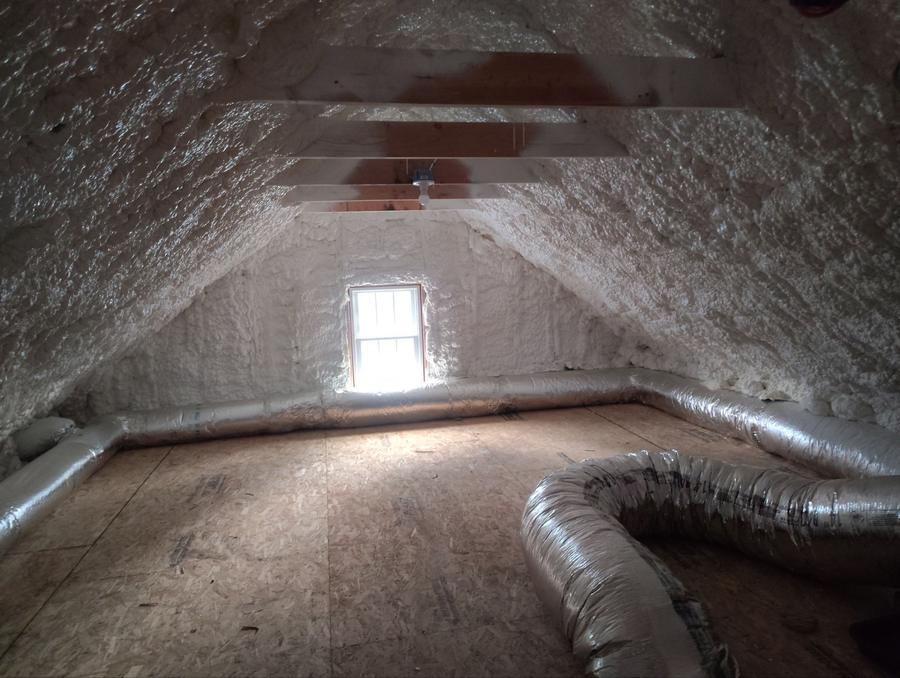
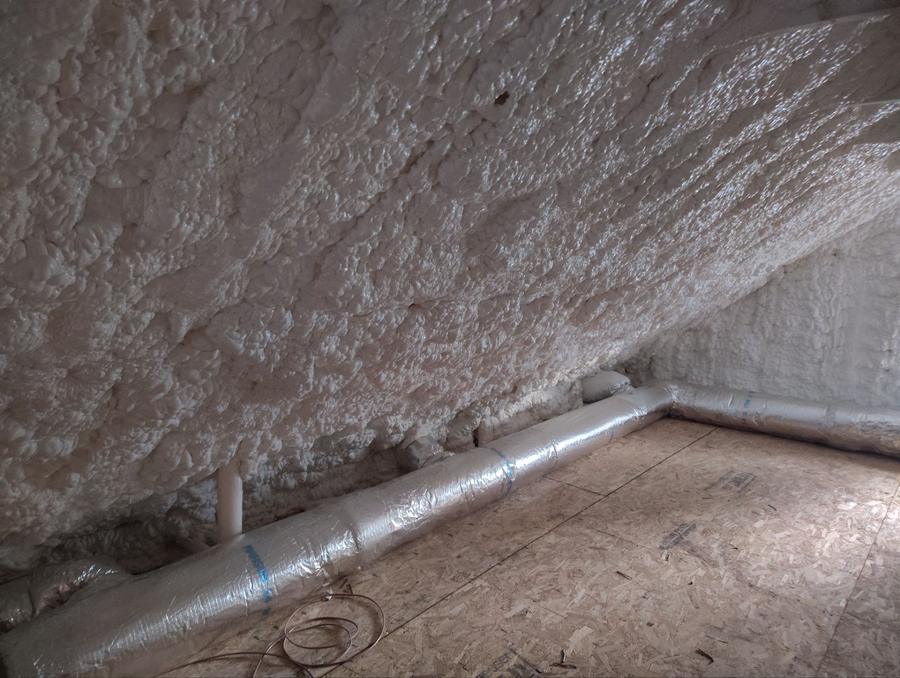
On those houses the fix is not more depth. It is sealing and testing the duct
system, closing the attic plane, and sometimes bringing the attic inside the
envelope with foam at the roof line so the equipment stops living outdoors. We
will tell you which of the three your house needs, and if your attic is already
fine, the report will say that.
We seal before we insulate
Insulation slows heat moving through a surface. It does nothing about air
moving through a gap. Pack a leaky attic with cellulose and you have a leaky
attic with cellulose in it — the air still moves, it just moves through
something softer.
In Scarsdale that principle cuts both ways. On the old houses the holes are
the chimney chase, the stacks and the soffits, and they get closed before an inch
of insulation goes down. On the new ones the biggest hole in the building is the
duct system itself, which is pressurized, so it does not leak gently — it
pumps. Sealing that is the highest-value hour anybody will spend in a 2015
Scarsdale attic. Then we insulate.
If a quote gives you a depth and never mentions air sealing, it is half a
job.
What insulation costs in Scarsdale
Most of our projects run between $3,500 and $12,500. The two
Scarsdales land in different places inside it. A 1920s house with a complicated
slate roofline, settled fill to clear, several open bypasses and a
knob-and-tube question sits toward the top, because that is days of labor before
material. A newer house where the work is duct sealing and closing the attic
plane sits near the bottom — smaller job, and often the one that fixes the
complaint.
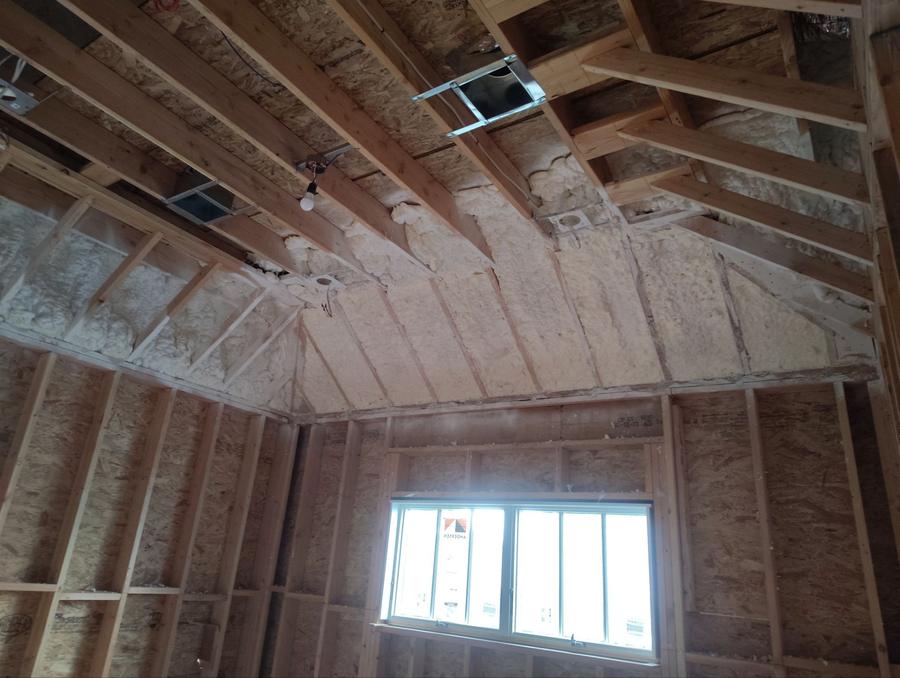
Open cell foam runs R-3.9 to R-4.2 per inch. Closed cell runs R-6.9 to R-7.1
per inch and also acts as a vapor retarder, which is why it costs more and why it
is right in some assemblies and unnecessary in others. All products are
manufactured in the United States and meet applicable building code and safety
standards. ENERGY STAR says sealing air leaks and adding insulation can save up to 10% on annual energy bills.
Insulation rebates in Scarsdale
Scarsdale has the heaviest gas penetration in Westchester —
77.6% of households heat with utility gas and only 12.7% are on
fuel oil — and Con Edison is the utility for both the gas
and the electricity. That helps less than it sounds. Con Edison’s residential
Weather Ready weatherization program is not accepting
applications, and Con Edison’s own page tells Westchester customers to
expect news about 2027 incentives and to go to NYSERDA in the meantime. Any
$4,000 Con Edison weatherization figure still floating around, including on Con
Edison’s own index pages, is stale.
The live program is NYSERDA Comfort Home:
$2,500 to air seal and insulate the attic and rim joist,
$3,000 if wall and floor insulation is added, and
$2,000 more toward ENERGY STAR windows afterwards. The installer
has to be on NYSERDA’s Comfort Home list and the house has to meet the conditions
of the whole package, not half of one. Households at or below 80% of area median
income should look at EmPower+ instead: no cost up to
$14,000 downstate, or half the cost up to
$7,000 at moderate incomes. See
the full New York rebate guide for the
mechanics.
The federal Section 25C tax credit ended for anything placed in service after
31 December 2025. There is no federal insulation credit on a
2026 job.
Code and climate in Scarsdale
Unusually for Westchester, a lot of Scarsdale was built under an energy code:
841 units have gone up since 2000. Those owners should know the code moved. The
current one is the 2025 Energy Conservation Construction Code of New York
State, in force since 31 December 2025 and based on the
2024 IECC, and Westchester is climate zone 4.
For new construction and additions it sets R-49 in the
ceiling, R-30 in wood-framed walls, R-30 in floors, and R-15 continuous or R-19 cavity in
basement walls. Anyone quoting Westchester’s older numbers is quoting a code no
longer in force, and anyone quoting R-60 is quoting Connecticut’s.
None of it applies to a house that is already standing, including
the 2005 one. The code does not require an existing building to be altered, only
that an alteration not leave you with less R-value than you had. The Department
of Energy separately recommends R-60 for a retrofit attic here, which is guidance,
not law.
Common questions about insulation in Scarsdale
Do you install insulation in Scarsdale, NY?
Yes, and in Scarsdale we quote two distinct kinds of work: envelope retrofits
on the 1920s Tudors and colonials, and duct sealing plus attic-plane air sealing
on the houses built since 2000. Nearly the whole village is detached
single-family, so almost everything we do here is a house, not a building.
How much does insulation cost in Scarsdale?
Most projects run $3,500 to $12,500. An old house with a slate roof, a
complicated roofline, material to clear out and a knob-and-tube question sits
toward the top. A newer house needing duct sealing and an attic plane closed sits
near the bottom, and that smaller job is often the one that actually fixes the
complaint.
Are there insulation rebates in Scarsdale?
Yes, through NYSERDA. Scarsdale is Con Edison for gas and electric, and Con
Edison’s own weatherization program is not accepting applications, so Comfort
Home is the live one: $2,500 for air sealing plus attic and rim joist, $3,000
with walls and floors. EmPower+ covers income-qualified households. No federal
tax credit applies to a 2026 job.
Our Scarsdale house was built in 2018 and the upstairs is still hot. Does it
need more insulation?
Probably not. In a recent Scarsdale build the air handler and ducts usually
sit in a vented attic, and pressurized ducts leaking into that space will beat
any amount of insulation you add above them. Seal and test the duct system, close
the attic plane, and only then decide whether depth is worth changing.
Free energy audit in Scarsdale
We walk the attic, look at the equipment and ductwork if they live up there,
check the basement and rim joist, and give you a written scope and a price. No
charge, no obligation. If the honest answer is a duct-sealing job rather than an
insulation job, that is what we will quote.
Call 914-554-2289 or use the form on this page. Open
8am–8pm, seven days. We have insulated hundreds of homes across New York,
Connecticut and New Jersey with a 100-plus in-house crew.
Get my free estimateor call 914-554-2289, 8am–8pm every day