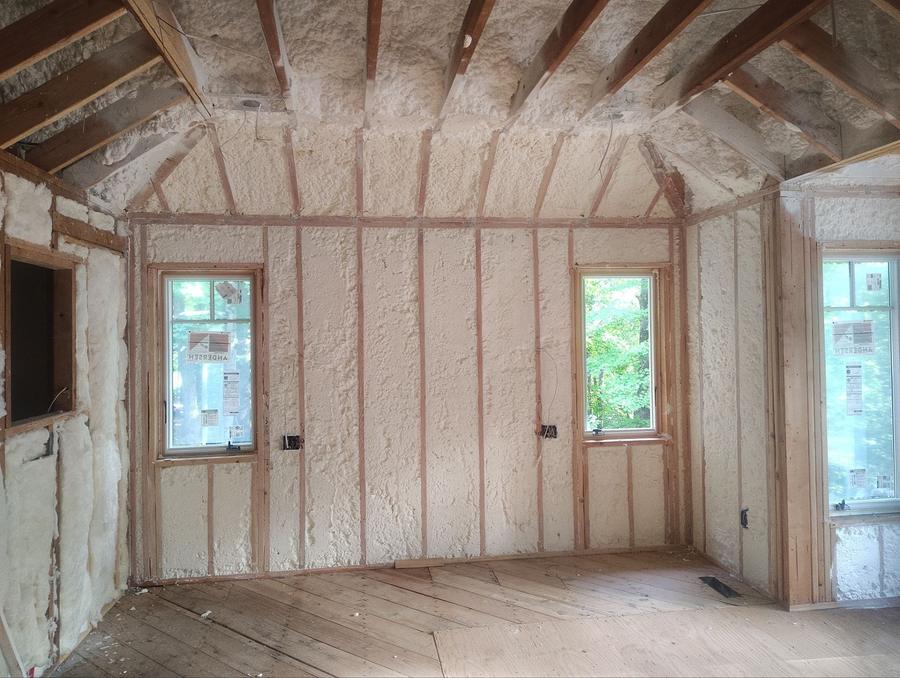
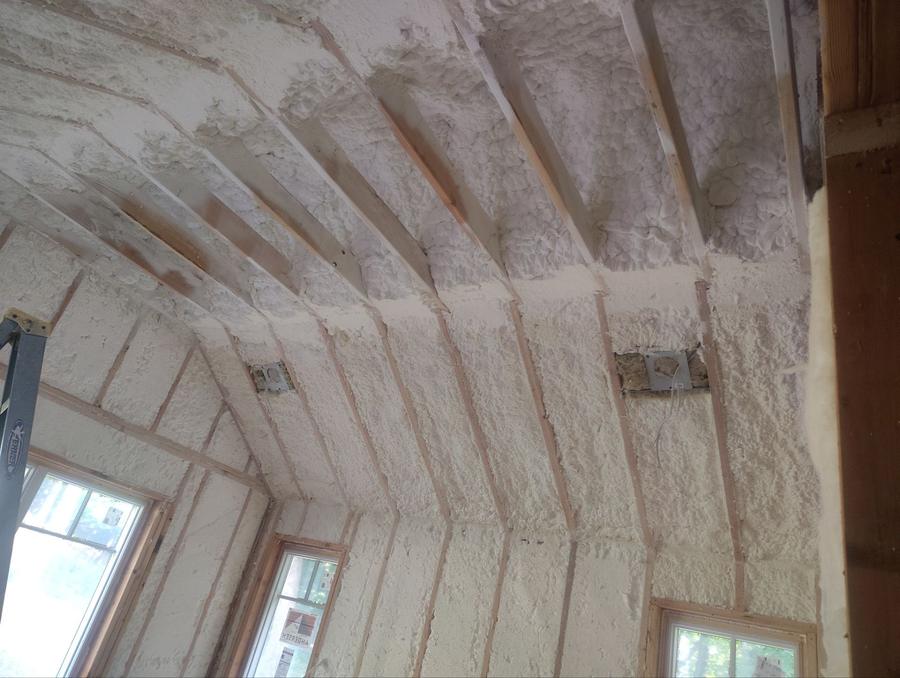
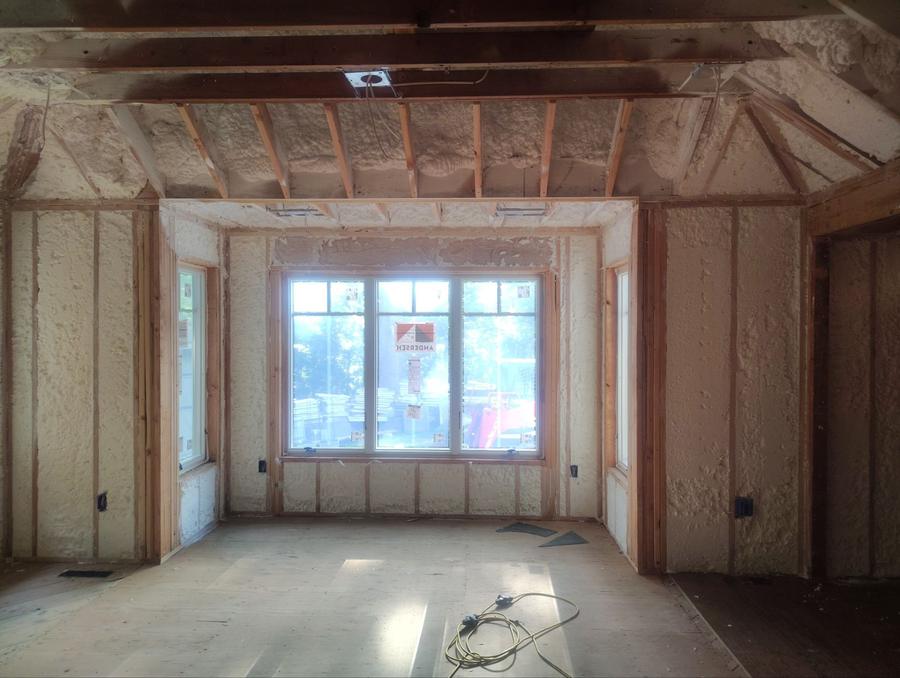
Bedford is three hamlets and three different insulation jobs. Katonah is a dense
pre-war village core, Bedford Village is detached houses on acreage and almost
nothing else, and Bedford Hills sits between them. A contractor who quotes all
three off the same square-foot number is guessing.
The houses we insulate in Bedford
The town holds 6,140 housing units, 80.3%
owner-occupied and 78.2% detached. The median build year is
1963 and 25.7% predates 1940, but what came
after is spread unusually evenly: 15.4% in the 1950s, 12.7% in the 1960s, 14.8%
in the 1970s, 12.6% in the 1980s. There is no single Bedford house.
Katonah is the oldest geography in northern Westchester: median build year
1948, 33.7% before 1940 and another
20.1% put up in the 1940s, on village lots rather than acreage.
In the pre-1940 half we find plaster on lath over irregular framing, stud bays
with no blocking, and knob-and-tube live often enough that we check before
quoting, because it has to be remediated before anything is blown in. The 1940s
half is small post-war capes, where the money is in the knee-wall triangles
behind the upstairs bedrooms, which have no air barrier on the back.
Bedford Village is the other extreme: 100.0% single-family
detached, 99.0% owner-occupied and 14.2% pre-1940. The old
houses here are really old — timber-frame and early balloon-frame
farmhouses, converted barns and carriage houses on fieldstone foundations with
open sills you can see daylight through from the basement. Sill and rim air
sealing comes first. Where a property has collected additions across three
centuries, each framed differently and none blocked at the junctions, the
deliverable is a thermal boundary map: deciding where the heated envelope stops.
That step gets skipped, which is why these houses get insulated twice and stay
cold.
The 1970s and 1980s add better than a quarter of the town in custom
contemporaries and colonials: cathedral ceilings framed with no ventilation
baffles, exposed-beam ceilings with only a roof deck between the room and the
weather, R-19 attics, and breezeway and mudroom bump-outs over vented crawls.
We seal before we insulate
Insulation slows heat moving through a surface. It does nothing about air moving
through a gap. Pack a leaky attic with cellulose and you have a leaky attic with
cellulose in it — the air still moves, it just moves through something
softer.
What that means changes by hamlet. In a Katonah village house it is the open
stud bays at the top plate, the chimney chase and the attic hatch, closed before
material goes in above them. In a Bedford Village farmhouse it is the sill and
the rim first, because a house pulling cold air in at the basement will keep
pulling it. Then we insulate.
If a quote gives you a depth and never mentions air sealing, it is half a job.
What insulation costs in Bedford
Most of our projects run between $3,500 and $12,500. In Bedford
the number is driven by how many separate assemblies a property contains, not by
floor area. A 1970s colonial with one attic plane sits near the bottom. A main
house plus an ell plus a converted barn sits at the top, because that is days of
hand sealing before material.
Open cell foam runs R-3.9 to R-4.2 per inch. Closed cell runs R-6.9 to R-7.1 per
inch and also acts as a vapor retarder, which is why it costs more and why it
suits some assemblies and not others. All products are manufactured in the
United States and meet applicable building code and safety standards. ENERGY STAR says sealing air leaks and adding insulation can save up to 10% on annual energy bills.
Insulation rebates in Bedford
58.0% of Bedford households heat with fuel oil and 10.5% with
bottled propane. Only 15.0% are on utility gas, about one house
in seven, so for most of the town heat arrives as a delivery and the payback is
counted in deliveries per winter.
Bedford also straddles a utility boundary that does not follow the town line,
and which side you are on changes what you can claim: part of the town is
NYSEG for electricity and the rest is Con Edison. Con Edison is
the gas utility either way, and much of the town is not on a gas main.
Check the name on your electric bill first.
NYSEG customers can take up to $2,000 in
insulation and air sealing incentives, deducted directly from the cost of the
work rather than claimed back later, and NYSEG takes oil, propane and other
delivered-fuel customers as readily as gas ones — being off the
gas main does not disqualify you. In a town that is 58% oil, that is
the most useful line on this page. Con Edison customers have no
weatherization program open: Weather Ready is not accepting applications and Con
Edison’s page points customers to NYSERDA until 2027.
Either way NYSERDA Comfort Home is live:
$2,500 to air seal and insulate the attic and rim joist,
$3,000 with walls and floors added, and $2,000
more toward ENERGY STAR windows afterwards, from a contractor on NYSERDA’s
Comfort Home list. Below 80% of area median income, EmPower+
covers the work at no cost up to $14,000 downstate, or half up
to $7,000. See the full
New York rebate guide.
The federal Section 25C credit ended for anything placed in service after
31 December 2025, so there is no federal insulation credit on a
2026 job.
Code and climate in Bedford
A quarter of Bedford predates 1940 and the 1950s through the 1980s hold better
than half of the rest, so almost the whole town was built before New York had a
residential energy code. Westchester is climate zone 4, and
the code now is the 2025 Energy Conservation Construction Code of New
York State, in force since 31 December 2025 and based
on the 2024 IECC.
For new construction and additions it sets R-49 in the ceiling,
R-30 in wood-framed walls (or R-20 cavity plus R-5 continuous,
R-13 plus R-10 continuous, or R-20 continuous), R-30 in floors, and R-15
continuous, R-19 cavity or R-13 plus R-5 continuous in basement and crawl space
walls. Anyone quoting R-60 is quoting Connecticut’s. None of it applies
to a house already standing: the code does not require an existing
building to be altered, only that an alteration not leave you with less R-value
than you had. ENERGY STAR recommends R-60 for a retrofit
attic here, which is guidance, not law.
Common questions about insulation in Bedford
Do you install insulation in Bedford, NY?
Yes, in all three hamlets — Katonah, Bedford Hills and Bedford Village.
Bedford is 78.2% detached and 80.3% owner-occupied, so nearly everything we do
here is a house rather than a building, and most of it is on oil or propane.
How much does insulation cost in Bedford?
Most projects run $3,500 to $12,500. What moves a Bedford house up that range is
the number of separate assemblies in it, not the floor area. One attic plane
over a 1970s colonial is a small job; a main house plus an ell plus a converted
barn is days of air sealing first.
Are there insulation rebates in Bedford?
It depends on your electric bill. Part of Bedford is NYSEG, which takes up to
$2,000 in insulation and air sealing incentives straight off the price and
accepts oil and propane customers. Con Edison’s weatherization program is not
accepting applications. Either way NYSERDA Comfort Home pays $2,500 for air
sealing plus attic and rim joist.
Is a Katonah house a different job from a Bedford Village house?
Usually, yes. More than half of Katonah went up before 1950, on village lots, so
the work is village-house work: blocked stud bays, knee walls, a knob-and-tube
check. Bedford Village is 100% detached on acreage, where the job is a
fieldstone sill, a rim joist, and deciding where the heated envelope stops
across three centuries of additions.
Free energy audit in Bedford
We walk the attic, the basement or crawl space, the sill and the additions and
give you a written scope and a price. No charge, no obligation. If the attic is
fine and the problem is an open sill and an unblocked bay behind a knee wall,
the report says so.
Call 914-554-2289 or use the form on this page. Open
8am–8pm, seven days. We have insulated hundreds of homes across New York,
Connecticut and New Jersey with a 100-plus in-house crew.
Get my free estimateor call 914-554-2289, 8am–8pm every day