54.1% of the City of Kingston’s 11,049 housing units were built in 1939 or earlier, and the median unit falls in that same pre-war group. 89.7% predates 1980, and only 4.4% has been built since 2000. No other place we cover in Ulster County has housing this old.
These are the numbers for the City of Kingston, the county seat, at the confluence of the Rondout Creek and the Hudson River. The Town of Kingston is a separate municipality with its own, much smaller housing stock, and nothing here describes it. The city itself dates from 29 May 1872, when the villages of Kingston and Rondout merged with the hamlet of Wilbur.
Kingston is also a city of two-families and renters. 44.2% of units are detached houses and 3.4% attached, while 19.1% sit in two-unit buildings, 11.6% in buildings of three or four, 8.2% in buildings of five to nine and 6.9% in buildings of ten to nineteen. 48.5% of occupied homes are owner-occupied. Utility gas heats 55.4% of occupied homes, electricity 21.1% and fuel oil 18.4%, so for most owners the bill that comes down is a gas bill.
The houses we insulate in Kingston
Most of the city was built in its canal, cement and railroad century. Rondout was a small farming village until work on the Delaware and Hudson Canal began in 1825; once the canal was completed in 1828, Rondout became a tidewater coal terminal. Natural cement quarrying began at Ponckhockie in 1844, large brick factories went up near the shipping hub, and Wilbur shipped bluestone for New York City’s sidewalks. The 5,979 units built in 1939 or earlier are the houses and flats of that city.
In a pre-war Kingston frame house we assume balloon framing: stud bays open from the cellar to the attic, so each wall acts as a flue and the attic floor above it is never really sealed. Add plaster on lath the owner wants to keep, a stone or brick foundation with an open sill, and knob-and-tube wiring until we have proved otherwise. The walls get blocked at top and bottom and dense-packed with cellulose through small holes, and live knob-and-tube is replaced before insulation goes near it.
The 2,111 units in two-unit buildings and the 1,279 in buildings of three or four are where much of the city lives. Whether a two-family is up-and-down or side-by-side, it shares a cellar, a stair or a party wall, and a roof, and the air path through the stair chase and the floor cavity runs through every unit. We scope it as one building, even when the owner lives in one apartment and rents the other.
The 1950s built 13.5% of the city and the 1940s another 6.1%: capes and small ranches for the most part. The cape fails at the knee wall and the eave, with joist bays open to the outside air under the upstairs floor; the ranch fails across a low attic of settled loose-fill and unsealed top plates. The small newer stock, 5.8% from the 1980s and 90s and 4.4% since 2000, already has full walls, and the job there is the attic, the ducts and the rim.
The 493 units in buildings of fifty or more are a different matter: their envelopes are an owner’s or a board’s capital decision, not something one tenant can order.
Stone in the Stockade, frame and brick in Midtown and the Rondout
Kingston’s three recognized neighborhoods are the Uptown Stockade area, Midtown and the Downtown Waterfront, and each carries a district on the National Register of Historic Places: the Stockade District uptown, the Midtown Neighborhood Broadway Corridor, and the Rondout-West Strand Historic District along the creek, the old village of Rondout. They call for different work.
In the Stockade, many 17th-century stone buildings remain, the Senate House of the 1670s among them, and many of the old buildings the British burned in October 1777 were restored later. A mortared stone wall has no cavity. We do not drill it, and we do not seal the inside face of centuries-old stone with foam. The work in a stone house is the roof or garret floor, the cellar and sill, the chimney, the air leaks at windows and doors, and any later frame addition.
Midtown, the largest neighborhood, grew with early 20th-century industry; the Rondout grew with the canal terminal, the cement works and the brickyards. In a city that made brick, some walls are solid masonry and some are frame, and the walk-through settles which. That answer decides whether the walls belong in the job at all.
Nearly everything useful in an old Kingston house can be done from inside: the attic, the cellar, the rim, the chimney chase, and frame walls filled through small holes that are patched and painted. Where a wall has to be filled from outside, we lift a clapboard rather than drill through its face.
We seal before we insulate
Insulation slows heat moving through a surface. It does nothing about air moving through a gap. In a balloon-framed house the gap is the wall itself: cellar air rises inside the stud bays and spills into the attic, and insulation laid on the attic floor above those open bays barely slows it.
In a Kingston two-family the sequence is: block the stud bays at the cellar and at the attic; seal the sill on the foundation; close the stair chase at each floor and the floor cavity between the apartments; seal the chimney chase with sheet metal and fire-rated sealant and the plumbing stack where it passes through both units; seal the ceiling below the attic or the roof cavity over the top unit; then dense-pack the walls, insulate the attic or roof cavity, and insulate the rim.
If a quote specifies a depth of insulation and never mentions air sealing, it is half a job.
What insulation costs in Kingston
Most of our projects run between $3,500 and $12,500. A two-family or a three- or four-unit building is priced as one building, and the number moves with the count of wall bays to block and dense-pack across every floor, how plaster or clapboard is opened and patched, the roof over the top unit, and cellar access. A Stockade stone house often comes in lower than its size suggests, because the walls drop out of the scope.
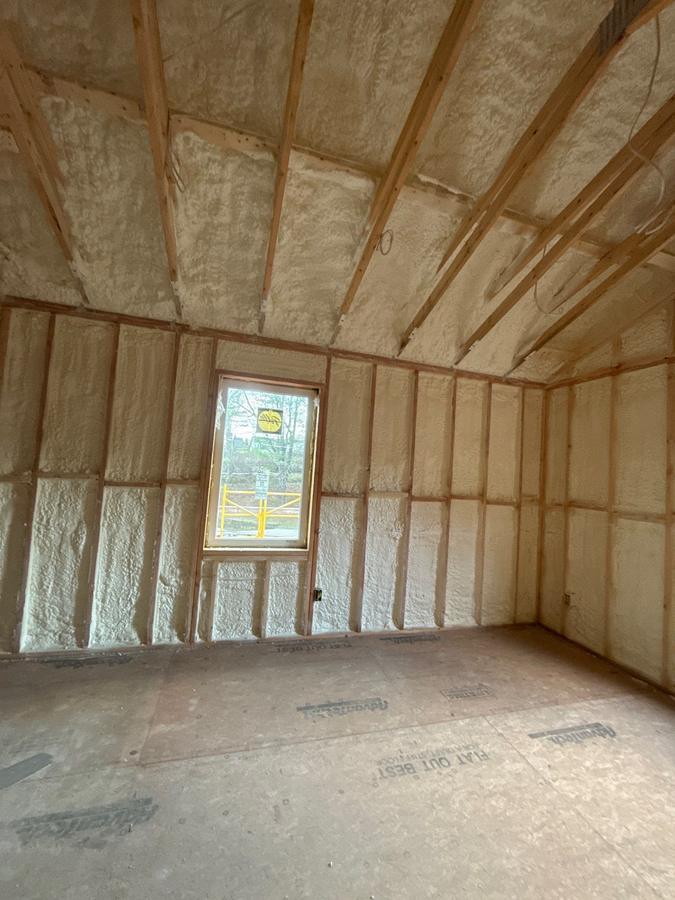
Open cell foam runs R-3.9 to R-4.2 per inch. Closed cell runs R-6.9 to R-7.1 per inch and also acts as a vapor retarder, which is why it costs more and why it is right in some assemblies and unnecessary in others. All products are manufactured in the United States and meet applicable building code and safety standards. ENERGY STAR says sealing air leaks and adding insulation can save up to 10% on annual energy bills.
Insulation rebates in Kingston
Kingston is Central Hudson territory for electricity, and most of the city is on Central Hudson gas lines. The electric company sets the program lane in New York, so a Kingston home uses NYSERDA’s Comfort Home, or EmPower+ if the household is income-eligible, for insulation incentives.
Comfort Home, run by NYSERDA, pays $2,500 toward sealing and insulating the attic and rim joist, $3,000 if walls and floors are added, and $2,000 more toward ENERGY STAR windows, through a NYSERDA-approved Comfort Home contractor. It is for Con Edison, NYSEG, Central Hudson and Orange & Rockland electric customers who own market-rate one- to four-family homes, which takes in Kingston’s two-families and three- and four-unit buildings, and knob-and-tube wiring can block eligibility. Comfort Home is open in 2026 and closes when the new utility programs start around January 2027, so an owner who wants the money should not wait.
With fewer than half of Kingston’s homes owner-occupied, NYSERDA’s EmPower+ matters here because renters can apply. If your household income is under Ulster County’s limit, it can pay for air sealing and insulation — at no cost up to $14,000 for lower-income households, or half the cost up to $7,000 for moderate-income households in our area — through an EmPower+ contractor, for your primary residence only. For two people the 2026 limits are $57,525 or less for the no-cost tier and under $76,700 for the half-cost tier.
To spread the cost, NYSERDA’s Green Jobs–Green New York program offers unsecured loans of $1,500 to $25,000 over 5, 10 or 15 years, either on the Central Hudson bill or as a regular monthly loan. Loans are not rebates and must be paid back, and the on-bill version requires that you own the home and are named on the utility account, which matters in a two-family where the tenant pays the electric bill.
Each program pays through its own participating contractors, so check eligibility and approved contractors on the MyEnergy portal first. The federal Section 25C insulation credit ended for work placed in service after 31 December 2025, so a 2026 job carries no federal insulation credit, and New York has no state tax credit for insulation. The detail is in our New York and New Jersey rebate guide.
Code and climate in Kingston
89.7% of Kingston’s housing was built before 1980. The 54.1% built in 1939 or earlier went up four decades or more before New York’s first statewide energy code took effect on 1 January 1979. Ulster County is Climate Zone 6; Dutchess, across the river in Rhinebeck and Red Hook, is Climate Zone 5.
New construction is governed by the 2025 Energy Conservation Construction Code of New York State, in force since 31 December 2025. In Zone 6 it calls for R-49 ceilings, or R-38 over the entire ceiling where that full, uncompressed depth runs out over the wall top plates at the eaves; mass walls of R-15/R-20; R-30 floors; R-15 continuous, R-19, or R-13 plus R-5 continuous on basement and crawl space walls; U-0.27 windows, with no solar heat gain requirement in Zone 6; and no more than 2.5 air changes per hour at 50 pascals for a new home, against 3.0 in Zones 4 and 5.
None of that reaches back to an old house. Unaltered parts of an existing building need not comply, New York’s code does not require a blower door test when you insulate an existing home, and any cavity opened during the work is filled to full depth. ENERGY STAR recommends R-60 in an uninsulated attic in Zones 5 and 6, and R-49 in one that already holds 3 to 4 inches.
Common questions about insulation in Kingston
Do you install insulation in Kingston, NY?
Yes, throughout the City of Kingston: Uptown and the Stockade, Midtown and the Broadway Corridor, and the Rondout and the Downtown Waterfront. 54.1% of the city predates 1940, so most of the work is balloon-framed houses and two-families, with Stockade stone houses handled from the garret and the cellar. The Town of Kingston is a separate municipality from the city; if you are not sure which one your house is in, your property tax bill names it.
How much does insulation cost in Kingston?
Most projects run $3,500 to $12,500. A two-family or a three- or four-unit building is priced as one building, and the drivers are the number of wall bays to block and dense-pack on every floor, how plaster or clapboard is opened and patched, the roof over the top unit and cellar access. A stone house in the Stockade often comes in lower than its size suggests, because its walls are not part of the job. You get a written scope and price after a free walk-through.
Are there insulation rebates in Kingston?
Yes. Kingston is Central Hudson territory, so market-rate homes of one to four units can use NYSERDA’s Comfort Home: $2,500 for sealing and insulating the attic and rim joist, or $3,000 with walls and floors, through a NYSERDA-approved Comfort Home contractor, until new utility programs replace it around January 2027. Income-eligible owners and renters can use EmPower+ for their primary residence. The federal 25C credit ended for work placed in service after 31 December 2025, and New York has no state insulation tax credit.
We own a two-family in Midtown Kingston and live in one unit. Can you insulate only our apartment?
We can, but it is the weaker job, and we will say so. In a two-family the stair chase, the floor cavity between the units, the balloon-framed walls and the roof form one air path, so heat from your apartment keeps leaving through the other one. We scope and price the building as a whole, then phase the work if the tenant’s unit has to wait. Comfort Home is also open to owners of one- to four-family homes, and a two-family is one of those.
Free energy audit in Kingston
We start in the cellar with the foundation, sill and rim, go up the stair chase, open a wall bay or two to see the framing and the wiring, and finish in the attic or the roof cavity over the top unit. In a Stockade stone house the time goes to the garret, the chimney and the cellar, and we tell you plainly that the walls stay as they are. Then a written scope and a price. No charge, no obligation.
Call 914-554-2289 or reach us through the contact form. Open 8am–8pm, seven days. We work out of New Rochelle, NY, with a 100-plus in-house crew that never subcontracts.
Get my free estimateor call 914-554-2289, 8am–8pm every day