Irvington’s housing comes in two blocks with a gap between them. 30.9% of its 2,849 units predate 1940 and 29.9% were built in the 1950s alone, while the 1960s and 70s together added only 9.0%. The median unit dates from 1955. Then the village built again: the 1980s and 90s account for 20.9%, and 117 units, 4.1% of the stock, have gone up since 2020 after none in the 2010s.
44.6% of units are detached houses and 12.9% attached homes; 6.9% are in two-unit buildings, 12.2% in buildings of three or four, and 10.5% in buildings of fifty or more. 82.4% of occupied units are owner-occupied, and owner-occupied homes carry a median value of $889,800. Gas heats 62.1% of homes, fuel oil 22.0%, electricity 12.3% and bottled gas 3.6%. Irvington is a village in the Town of Greenburgh, between Tarrytown to the north and Dobbs Ferry to the south, and it includes Ardsley-on-Hudson, which has its own ZIP code and Metro-North station and is not the Village of Ardsley.
The village was laid out on paper. In 1848 John Jay, grandson of the Founding Father, bought the farm that became it, named the place Dearman and began auctioning lots in New York City in April 1850, the railroad having arrived in 1849. The landscape designer Andrew Jackson Downing condemned Jay’s right-angled street grid on such a hilly, heavily wooded site. In 1854 the village took the name Irvington for Washington Irving, then living at Sunnyside, and it incorporated in 1872. Its half-mile Main Street was added to the National Register of Historic Places as a historic district in 2014.
The houses we insulate in Irvington
Many of the oldest houses stand on Jay’s grid, along side streets off Main Street that were once lettered A, B and C and now carry the names of settler families such as the Dutchers, the Buckhouts and the Eckers. A house that has stood since the 19th century has usually grown in stages: an original block, a rear kitchen wing, a later addition, each with its own roof and its own small attic. The seams are where the heat goes. Where an addition meets the old house there is often an open gap in the wall or floor framing straight to the outside, and the small attics over the wings are cut off from the main attic with no access at all. We open access, then seal each junction before insulating each roof space.
The 1950s, 29.9% of the village and 851 units, include the cooperative apartment complexes built after World War II, whose shells belong to the cooperatives, not to anyone we can quote. On the hills Downing described, a house of that decade or any other often has a lower level that is a basement on the uphill side and a full-height wall on the downhill side, often with a garage door in it. The buried side needs closed cell foam or rigid board directly on the concrete; the exposed side is a framed wall that leaks at the rim like any other.
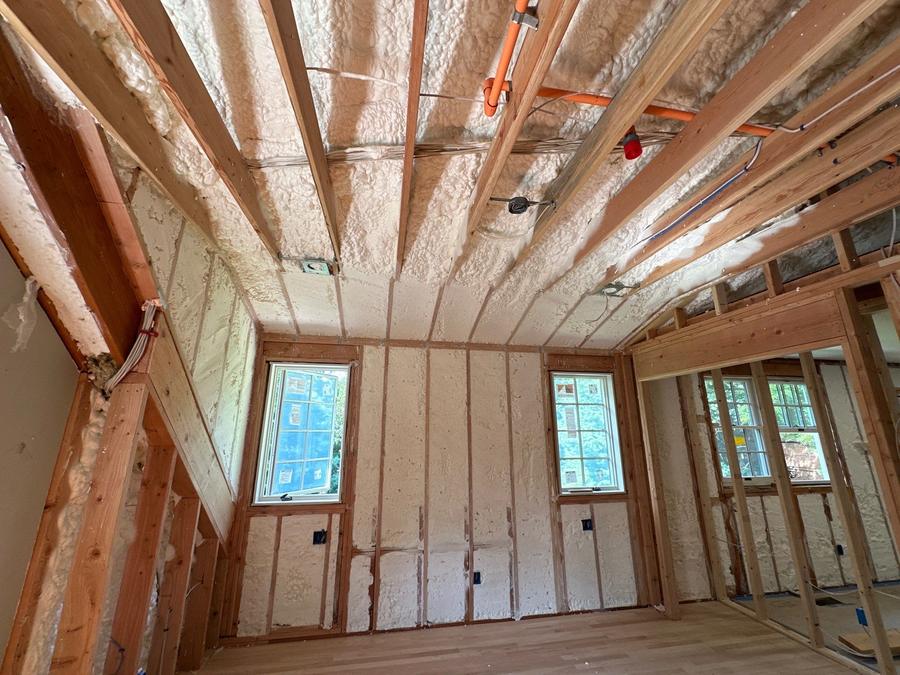
If your home is one of the 20.9% built in the 1980s and 90s and has a vaulted ceiling or skylights, look there first. A vault loses heat at its peak, where the rafter bays are narrow, the insulation is thin and air from the soffit vents washes over it, and around the skylight wells, whose framed sides are rarely insulated as well as the roof. The 117 units built since 2020 went up under recent energy codes and are the one part of the village we seldom need to touch.
22.0% of Irvington heats with oil, and the size of the houses shapes the payback. A large, tall house burns a great deal of fuel, and the more of it that leaks out through seams and roof spaces, the more each hour of sealing is worth. Sealing a big oil-heated house tends to pay back sooner than the same work in a small one, even though the job is bigger.
From summer estates to year-round houses
Once the railroad made the trip easy, wealthy New Yorkers bought up farms around the village and built large summer residences on their new estates, drawn by the cool breezes off the Hudson. Through the Gilded Age the estates on both sides of Broadway between Irvington and Briarcliff Manor were known as Millionaires’ Row. Most of those estates are gone. A big house that began as a summer place still shows it: tall ceilings, large windows, porches and roof spaces nobody expected to heat.
After World War I some of the bigger estates were broken into smaller lots and developed as communities inside the village, among them Jaffray Park, Matthiessen Park and Spiro Park. Houses from that era are complicated overhead: steep roofs broken by dormers and porches enclosed as rooms on the upper floor. A dormer is three small walls and a small roof set into the main roof, and the framing where its side walls meet the rafters is rarely sealed, so the dormer is often the coldest corner of the top floor. An upstairs porch turned into a room has a floor over the porch below, outside air on three sides and a low-slope roof with almost no depth, so its floor and ceiling have to be treated as outside surfaces.
We seal before we insulate
A house with several roof spaces has several sets of seams, and insulation closes none of them. Batts laid in the main attic do nothing for the gap where a wing meets the old wall, the unsealed framing around a dormer or the open edge of a porch-room floor, and air keeps moving through each of them.
In a 1920s house in one of the park subdivisions the sequence starts at the top. Seal the attic floor above the top story: top plates, chimney chase, plumbing stacks, the attic stair or hatch. Seal the dormer walls where they meet the rafters, and the floor and roof edges of any enclosed upstairs porch. Then the bottom: the basement rim and sill, and on a hillside lot the exposed downhill wall. Only then do the attic, the dormers, the porch floor and the rim get insulated.
If a quote specifies a depth of insulation and never mentions air sealing, it is half a job.
What insulation costs in Irvington
Most of our projects run between $3,500 and $12,500. In a larger Irvington house the number follows how many separate attics and roof spaces there are, since each wing, dormer and porch roof is its own small job, and whether a lower level has a full-height wall exposed on a downhill side. A village-center house that grew by additions is priced by its seams. A townhouse or a 1980s or 90s house is mostly its vault, skylight wells and rim.
Open cell foam runs R-3.9 to R-4.2 per inch. Closed cell runs R-6.9 to R-7.1 per inch and also acts as a vapor retarder, which is why it costs more and why it is right in some assemblies and unnecessary in others. All products are manufactured in the United States and meet applicable building code and safety standards. ENERGY STAR says sealing air leaks and adding insulation can save up to 10% on annual energy bills.
Insulation rebates in Irvington
Irvington is Con Edison for electricity, and most of the village is on Con Edison gas lines. Con Edison’s Weather Ready insulation rebates are closed; the company now directs Westchester homeowners to NYSERDA’s Comfort Home program and says new weatherization incentives are coming for 2027.
Comfort Home pays $2,500 for sealing and insulating the attic and rim joist, $3,000 if walls and floors are included, and $2,000 more toward ENERGY STAR windows once the air sealing and insulation are done, for one- to four-family homes whose owners pay the System Benefits Charge. The home must meet the conditions of the entire package, and the attic target applies across the entire attic, which in a house with several roof spaces usually means all of them. A household that has already done a package can put $1,000 toward another within a year, or $2,000 after more than a year. The incentive is paid through a NYSERDA-approved Comfort Home contractor. It is taking applications in 2026 and closes when the new utility programs start around January 2027.
EmPower+ covers income-eligible owners and renters: air sealing and insulation at no cost up to $14,000 for lower-income households, or half the cost up to $7,000 for moderate-income households, through an EmPower+ contractor. Any owner of a one- to four-family home can also start with NYSERDA’s free Home Energy Plan, a virtual assessment done online rather than a visit.
We price the job and tell you plainly which programs require their own contractors. The federal insulation tax credit (Section 25C) ended for work placed in service after 31 December 2025, so be wary of anyone still advertising it on a 2026 job, and New York has no state tax credit for insulation. Our New York and New Jersey rebate guide has the full detail.
Code and climate in Irvington
74.2% of Irvington was built before 1980. Nearly all of it dates from before New York’s first statewide energy code took effect on 1 January 1979, including every one of the 880 units built before 1940. Westchester is Climate Zone 4 under New York’s county table.
A house built in Irvington today follows the 2025 Energy Conservation Construction Code of New York State, in force since 31 December 2025: R-49 ceilings, or R-38 across the whole ceiling where its full height carries over the wall top plate at the eaves; R-30 floors; basement and crawl space walls at R-15 continuous, R-19, or R-13 plus R-5 continuous, the line that governs a walk-out lower level; U-0.27 windows; and 3.0 air changes per hour at 50 pascals.
Older houses answer to narrower rules. The unaltered parts of an existing house do not have to meet the new-home table. Where a renovation opens a wall or a roof slope, the exposed cavities have to be filled to full depth. New York’s code does not require a blower door test when you insulate an existing home, though on a big, complicated house we often recommend one. ENERGY STAR recommends R-60 for an attic in this zone that has nothing in it and R-49 for one with 3 to 4 inches already down.
Common questions about insulation in Irvington
Do you install insulation in Irvington, NY?
Yes, across the village: the older houses on the side streets off Main Street, the 1920s houses of Jaffray Park, Matthiessen Park and Spiro Park, the post-war houses on the hillsides, the attached homes and two-families, and Ardsley-on-Hudson, which is part of Irvington. 30.9% of the village predates 1940 and 29.9% was built in the 1950s. The post-war cooperative apartment complexes are left to the cooperatives that own them.
How much does insulation cost in Irvington?
Most projects run $3,500 to $12,500. In a larger Irvington house the cost is set by how many separate attic and roof spaces there are, dormers and enclosed upstairs porches included, and by the lower level, especially a full-height wall exposed on the downhill side. A house that grew by additions is priced by the junctions between them. The walk-through and the written price cost nothing.
Are there insulation rebates in Irvington?
Irvington is Con Edison for electricity and gas, and Con Edison’s own weatherization rebates are closed. NYSERDA’s Comfort Home pays $2,500 for sealing and insulating the attic and rim joist, $3,000 with walls and floors, and $2,000 toward ENERGY STAR windows afterward, through its approved contractors, and it closes when the new utility programs start around January 2027. EmPower+ helps income-eligible owners and renters. The federal 25C credit ended for work placed in service after 31 December 2025, and New York has no state credit.
Our Irvington house is built into a hill, with a walk-out basement on the downhill side. How should the lower level be insulated?
As two different walls. The uphill side is concrete or stone against damp soil, and it takes closed cell spray foam or rigid foam board applied directly to the masonry, never fiberglass batts against a foundation that can sweat. The downhill side is usually a framed wall above grade, often with a garage or patio door in it, and it gets its rim joist sealed and its cavities insulated like any exterior wall. Where the foundation steps down between the two, the sill is sealed so outside air cannot run along it.
Free energy audit in Irvington
In an Irvington house we count the attics first, because a house that grew in stages or carries dormers and porch rooms may have several separate roof spaces, and each one gets looked at. Then the top floor, the junctions where additions meet the original house, and the basement, including the downhill wall on a hillside lot and the heating plant. A written scope and a price follow, at no charge and with no obligation.
Call 914-554-2289 or use the form. Open 8am–8pm, seven days. We are family-owned, working out of New Rochelle, NY with a 100-plus in-house crew rather than subcontractors.
Get my free estimateor call 914-554-2289, 8am–8pm every day